1 Samuel 2 – The Lord Rejects Eli’s Household

The second chapter begins with Hannah’s song of praise to the Lord – a hymn; and many passages in the Old Testament are similar, particularly Psalm 113 – especially verse 9 of that Psalm’s reference to a barren woman.  Verse 12 then moves to the despicable behavior of Hophni and Phinehas, Eli’s sons.  Eli was a priest in the line of Ithamar, a son of Aaron; and the sacrifices brought to the temple were to be handled according to the commands of God.  Their lack of regard for God as demonstrated in verses 12-17 was certainly known to be wrong not only to themselves, but to those bringing their offerings, as the law stated in Exodus 29:13 and Leviticus 3:3-5.

In verses 22-25, Eli does rebuke his sons, but clearly he not forceful, and they have no more regard for what he says than they have for the Lord.  Samuel, on the other hand, is growing “in stature and in favor with the Lord” (verse 26), and his mother made him a robe and brought it to him each year when they came to sacrifice (verse 19).

Beginning in verse 27, the “man of God” who came and told Eli of God’s rejection of him and his house may be a prophet.  We just do not know, but this seems likely because if he was a manifestation of the Lord, usually the scripture would refer to an angel of the Lord instead.  The prophecy of the end of Eli’s priestly line is told and verse 34 serves as the sign that he will know it is true – the day is coming when both Hophni and Phinehas will die on the same day.

Read or listen to audio of ESV version of this selection from this link.

/Robert
___________________
some images © V. Gilbert & Arlisle F. Beers

Please note: I did not design the reading plan that I am following in my blog.  All of my comments in this blog, however, are solely my responsibility.  When reading ANY commentary, you should ALWAYS refer first to the scripture, which is God’s unchanging and unfailing word. Reading schedules, as well as a link to the site where you can get the reading plan that I’m currently following for yourself can be found on the “Bible Reading Schedules” page of my website at http://graceofourlord.com.  For questions and help, please see the “FAQ” and “Summaries” pages there.
1 Samuel 1 – The Birth of Samuel

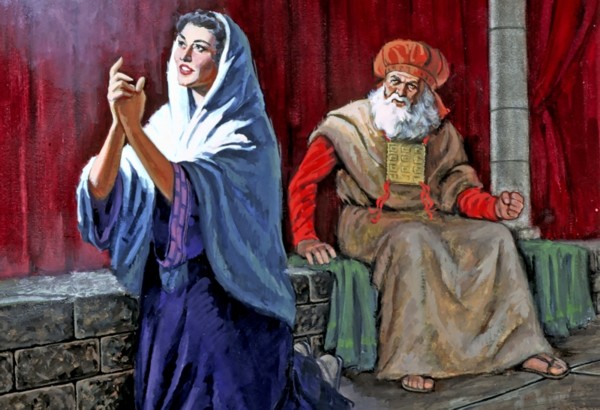
Peninnah, Elkanah’s other wife tormented Hannah because she was barren.  Another great example the Old Testament shows us of how deviating from God’s intention of one woman and one man in marriage (Genesis 2:24, Matthew 19:3-9) so often causes problems and heartache.  Two other of many cases in point are Abraham (Sarah and Hagar, Gen 16:1-6), and Jacob (Leah and Rachel, Gen 30).

Shiloh, the modern Khirbet-Seilum is 20 miles north of Jerusalem toward eastern border of Ephraim is where Hannah went with her husband Elkanah, as he sacrificed there. Hannah went to the temple (verse 11) and prayed to God for a son, and promised to give him to serve the Lord dedicated as a Nazirite (Num 6).  She was weeping, and Eli the priest thought she was drunk, and rebuked her. When she explains her grief, he blesses her. After she returns to Ramathain-Zophin with Elkanah, she does conceive a son and names him Samuel (verse 20).  After he was weaned, Elkanah supported her in her vow to the Lord and took sacrifices with them to Shiloh (verses 23-24). Hannah reminded Eli of their meeting, and presented Samuel to him for service to the Lord (verses 26-27).

Read or listen to audio of ESV version of this selection from this link.

/Robert
___________________
some images © V. Gilbert & Arlisle F. Beers

Please note: I did not design the reading plan that I am following in my blog.  All of my comments in this blog, however, are solely my responsibility.  When reading ANY commentary, you should ALWAYS refer first to the scripture, which is God’s unchanging and unfailing word. Reading schedules, as well as a link to the site where you can get the reading plan that I’m currently following for yourself can be found on the “Bible Reading Schedules” page of my website at http://graceofourlord.com.  For questions and help, please see the “FAQ” and “Summaries” pages there.

Starting Samuel \ April Week 3 Summary Posted

Painting of Samuel learning from Eli

Painting of Samuel learning from Eli (Photo credit: Wikipedia)

Having finished our scheduled reading of Judges and of Ruth, tomorrow we begin the book of Samuel.  Painting of Samuel learning from Eli from Wikipedia.

Summing Up

Each weekend, I am now posting a small PDF of one week of chapter summaries (on the website’s “Summaries” page), current to the beginning of the previous week.  I have posted the summary for Week 16 (April Week 3) of the schedule I am following.  This short PDF document contains condensed comments about Judges 3, 4, 6, 7, and 13, with hyperlinks to the ESV version of each chapter for listening or reading, and joins the summaries for other weeks already posted there.

/Robert
___________________
image © V. Gilbert & Arlisle F. Beers

Please note: I did not design the reading plan that I am following in my blog.  All of my comments in this blog, however, are solely my responsibility.  When reading ANY commentary, you should ALWAYS refer first to the scripture, which is God’s unchanging and unfailing word. Reading schedules, as well as a link to the site where you can get the reading plan that I’m currently following for yourself can be found on the “Bible Reading Schedules” page of my website at http://graceofourlord.com.  For questions and help, please see the “FAQ” and “Summaries” pages there.

Ruth 3-4 – Ruth and Boaz

Ruth in Boaz's Field

Ruth in Boaz's Field (Photo credit: Wikipedia)

Some have suggested that the uncovering of Boaz’s feet in 3:7 suggests some sort of sexual contact, but that is not the case and it does not fit the story or the characters.  Ruth’s calling Boaz her redeemer is what amounts to a marriage proposal.  He knows that there is a closer relative who has the first right of redemption, so he tells her that he will work the matter out with that relative.  If that closer relative to does not step up, Boaz promises to do so.  The land of Naomi’s husband Elimelech must be bought by a kinsman and Ruth will be part of the bargain (an overview of the process can be found in Deuteronomy 25:7-8).

Boaz meets with the relative at the city gate (equivalent to our town hall) with the elders and proposes the situation to the other relative.  At first, he likes the idea of buying the land, but taking Ruth could muddy the waters of inheritance for the children he already has.  So under witness of the elders, Boaz claims the right that this relative passes to him (chapter 4:7-11).

So Boaz marries Ruth and they have a son named Obed who will be the grandfather of David (4:22).  Ruth is the third foreign woman in this line of Jesus Christ’s ancestry (Matthew 1:1-6).  The other two are Rahab and Tamar.

Read or listen to audio of ESV version of this selection from this link.

/Robert
___________________
some images © V. Gilbert & Arlisle F. Beers

Please note: I did not design the reading plan that I am following in my blog.  All of my comments in this blog, however, are solely my responsibility.  When reading ANY commentary, you should ALWAYS refer first to the scripture, which is God’s unchanging and unfailing word. Reading schedules, as well as a link to the site where you can get the reading plan that I’m currently following for yourself can be found on the “Bible Reading Schedules” page of my website at http://graceofourlord.com.  For questions and help, please see the “FAQ” and “Summaries” pages there.

Ruth 1-2 – Naomi and Ruth

Naomi entreating Ruth and Orpah to return to t...

Naomi entreating Ruth and Orpah to return to the land of Moab by William Blake, 1795 (Photo credit: Wikipedia)

Because of a famine, Naomi and her husband, Elimelech, and their two sons went to the country of Moab.  The sons took wives from the Moabite women.  But all of the men died, and Naomi prepared to return to Judah, as she would have to depend on family now.  She told her young daughters-in-law to stay there with their people and return to their parents, but Ruth vowed to remain with Naomi and to serve “her God” (verse 16).  In verse 22 , they came to Bethlehem at the beginning of barley harvest, which would be about April – May.

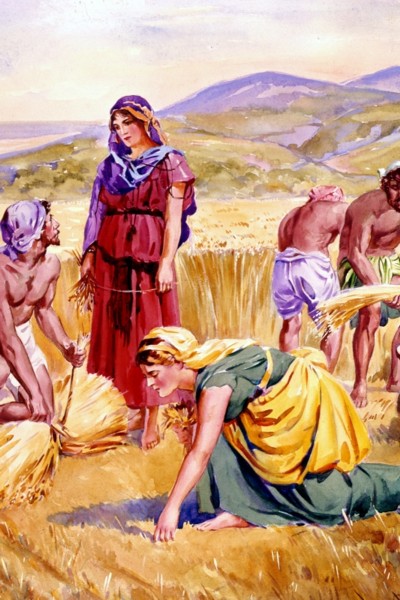
Ruth went to glean in the fields.  Gleaning was a practice allowed to the poor and the sojourner as God had commanded.  The corners of the field and any sheaves left throughout the middle on the first harvest were to be left for such people to feed themselves (Leviticus 19:9-10, Deuteronomy 24:19).  The fact that Ruth is a Moabite is mentioned several times, and that should emphasize that the Lord is working through His people.  She finds favor with Boaz because he has been told of her great kindness and loyalty to his relative, Naomi.

Read or listen to audio of ESV version of this selection from this link.

/Robert
___________________
some images © V. Gilbert & Arlisle F. Beers

Please note: I did not design the reading plan that I am following in my blog.  All of my comments in this blog, however, are solely my responsibility.  When reading ANY commentary, you should ALWAYS refer first to the scripture, which is God’s unchanging and unfailing word. Reading schedules, as well as a link to the site where you can get the reading plan that I’m currently following for yourself can be found on the “Bible Reading Schedules” page of my website at http://graceofourlord.com.  For questions and help, please see the “FAQ” and “Summaries” pages there.

Judges 16 – Samson and Delilah

Samson destroys the temple

Samson destroys the temple (Photo credit: Wikipedia)

When the Lord was with him, His gift to Samson was great strength.  Obviously, it wasn’t accompanied by much wisdom.  His blindness to coming betrayal, first by his wife and now by Delilah (verses 6, 10, 13, 15) seems to be a foretaste of the Philistines’ treatment of his eyes (verse 21).  Pair this naivety with his continued lack of regard for the Lord’s commandments, and his confidence in his own might, and you see the path his downfall.

Samson is, as usual, out of control from the start of the chapter. He visits a common prostitute in Gaza in verse one.  The Gazites, discover he is there and lay an ambush for him, but he just pulls the city gates out of the ground and carries them away.  The gates would be about two stories high with posts set deep in the ground that he pulled up with his brute strength.

When he allowed his hair to be cut, it broke the last of his Nazirite vows, and the Lord was no longer with him.  But in verse 20, he did not expect that to ever happen.  He had always done as he pleased before., so his capture surprised him.  His prayer in verse 28 and God’s will to stir the Israelites are what returned his strength long enough to bring the house down on himself and 3,000 of the Philistines.

Read or listen to audio of ESV version of this selection from this link.

/Robert
___________________
some images © V. Gilbert & Arlisle F. Beers

Please note: I did not design the reading plan that I am following in my blog.  All of my comments in this blog, however, are solely my responsibility.  When reading ANY commentary, you should ALWAYS refer first to the scripture, which is God’s unchanging and unfailing word. Reading schedules, as well as a link to the site where you can get the reading plan that I’m currently following for yourself can be found on the “Bible Reading Schedules” page of my website at http://graceofourlord.com.  For questions and help, please see the “FAQ” and “Summaries” pages there.

Judges 15 – Samson Defeats the Philistines

Samson and the Foxes, miniature (Judges 15:1-8...

Samson and the Foxes, miniature (Judges 15:1-8: “Samson went and caught three hundred foxes, and took torches, and turned the foxes tail to tail, and put one torch in the middle between two tails. When he had set fire to the torches, he released the foxes into the standing grain of the Philistines.”), Oktateuch, Vatopedi monastery, 602, fol. 440r, detail References: Weitzmann: Aus den Bibliotheken des Athos, No. 2 (Photo credit: Wikipedia)

In verse 4, the Hebrew could denote foxes or jackals.  Either way, sending them into the Philistine’s standing and stacked grain with torches tied to their tails was to get double revenge (verses 1-3).  When the Philistines came after the “son-in-law of the Timnite,” he allowed himself to be bound to be given over to the Philistines (verses 9-13) knowing he could get free.  Not only are the people not ready to battle the Philistines for their freedom, but they are happy to give Samson to their foes in order to appease them.

Samson once again has the spirit of the Lord rush over him, and gets free to reduce the number of Philistines by 1,000, using the jawbone of a donkey (verses 14-15).  Correctly giving God the credit for victory (verse 18), Samson then is disrespectful in nearly the same breath.  But God grants him his water.  He judges Israel during the Philistine rule for 20 years (verse 20).

(Side note: an excellent article on this chapter is at Ferrell’s Travel Blog.)

Read or listen to audio of ESV version of this selection from this link.

/Robert
___________________
some images © V. Gilbert & Arlisle F. Beers

Please note: I did not design the reading plan that I am following in my blog.  All of my comments in this blog, however, are solely my responsibility.  When reading ANY commentary, you should ALWAYS refer first to the scripture, which is God’s unchanging and unfailing word. Reading schedules, as well as a link to the site where you can get the reading plan that I’m currently following for yourself can be found on the “Bible Reading Schedules” page of my website at http://graceofourlord.com.  For questions and help, please see the “FAQ” and “Summaries” pages there.

Judges 14 – Samson’s Marriage

Samson kills a lion with his bare hands

In verses 1-3, Samson decides he must have a Philistine woman he saw for his wife.  This was expressly forbidden in Deuteronomy 7:1-3.  In verses 8-9. he violates his Nazirite vow (Numbers 26) by touching the lion’s carcass.  As for his wedding feast, the Hebrew word in verse 10 is “mishteh” which denotes a feast with much drinking.  If Samson participated, such would be another violation of his vow.

Samson right away begins to show disregard not just for his Nazirite vow, but for the will of God in general. Unfortunately, it will not get any better, as we will see in the next two chapters.  So why was he chosen even before birth in chapter 13?  Why was the spirit of the Lord with him so much of the time, such as when he tore the lion to pieces with his strength (verses 5-6)?  Verse 14 gives us the answer – God was going to use him against the Philistines in his own way. This time, the people were not crying out at their plight – at  least not yet.  They needed someone to stir things up – and to wake them up!

Read or listen to audio of ESV version of this selection from this link.

/Robert
___________________
image © V. Gilbert & Arlisle F. Beers

Please note: I did not design the reading plan that I am following in my blog.  All of my comments in this blog, however, are solely my responsibility.  When reading ANY commentary, you should ALWAYS refer first to the scripture, which is God’s unchanging and unfailing word. Reading schedules, as well as a link to the site where you can get the reading plan that I’m currently following for yourself can be found on the “Bible Reading Schedules” page of my website at http://graceofourlord.com.  For questions and help, please see the “FAQ” and “Summaries” pages there.
Closing out Judges \ April Week 2 Summary Posted

Ruth gleans in the fields of Boaz

This week, we will finish our scheduled reading of the book of Judges with the rest of Samson’s tragic story, and complete the book of Ruth as well.  Ruth is a very short book but, as is the case with all of God’s word, an important one, and very different from the book of Judges.  The child that Ruth and Boaz will have (Obed) will be  the father of Jesse – who in turn will have a son named David that will become king in the book of Samuel.  This lineage of Jesus Christ is related in Matthew 1:1-5.

Summing Up

Each weekend, I am now posting a small PDF of one week of chapter summaries (on the website’s “Summaries” page), current to the beginning of the previous week.  I have posted the summary for Week 15 (April Week 2) of the schedule I am following.  This short PDF document contains condensed comments about Joshua 9, 10, 24, and Judges 1 and 2, with hyperlinks to the ESV version of each chapter for listening or reading, and joins the summaries for other weeks already posted there.

/Robert
___________________
image © V. Gilbert & Arlisle F. Beers

Please note: I did not design the reading plan that I am following in my blog.  All of my comments in this blog, however, are solely my responsibility.  When reading ANY commentary, you should ALWAYS refer first to the scripture, which is God’s unchanging and unfailing word. Reading schedules, as well as a link to the site where you can get the reading plan that I’m currently following for yourself can be found on the “Bible Reading Schedules” page of my website at http://graceofourlord.com.  For questions and help, please see the “FAQ” and “Summaries” pages there.

Judges 13 – The Birth of Samson

The wife of Manoah (woman in a veil and wimple)

The wife of Manoah (woman in a veil and wimple) (Photo credit: Wikipedia)

Chapter 13 brings us to the most famous of the judges, Samson.  Unfortunately, his story is one of the most misunderstood by most people.  His power came from God, and it left him because of his lack of self-control and unfaithfulness to the Lord, as we will see in the next three chapters.  The angel of the Lord appeared first to Samson’s childless mother, and told her that she would have a son. and would be a Nazirite.  Her husband Manoah showed his faithfulness first when instead of questioning what she said, prayed to God, wanting to have the opportunity to be instructed how to raise the child.  When asked his name, the angel of the Lord replied that it was too wonderful for man to comprehend (verse 18).

Any man or woman could take a vow to become a Nazirite as told in Numbers 6.  It was a vow to set ones self apart for God, and it came with certain restrictions, including no razor to the hair, no fruit from a vine, and no contact with the dead (corpses).  After Samson was born, verses 24-25 relate that as the young man grew, the spirit of the Lord began to “stir him.”  The Philistines were in control of the Israelites, and God would use Samson to stir the people as well.  Clearly, they needed it.

Read or listen to audio of ESV version of this selection from this link.

/Robert
___________________
some images © V. Gilbert & Arlisle F. Beers

Please note: I did not design the reading plan that I am following in my blog.  All of my comments in this blog, however, are solely my responsibility.  When reading ANY commentary, you should ALWAYS refer first to the scripture, which is God’s unchanging and unfailing word. Reading schedules, as well as a link to the site where you can get the reading plan that I’m currently following for yourself can be found on the “Bible Reading Schedules” page of my website at http://graceofourlord.com.  For questions and help, please see the “FAQ” and “Summaries” pages there.