1 Peter 2 – A Living Stone and a Holy People

Mediterranean Sea near Joppa. Joppa, today called Jaffa, was once the seaport for Jerusalem. Hiram sent cedar logs from Lebanon to King Solomon for the Temple, floating them to Joppa (2 Chronicles 2:15). From Joppa the prophet Jonah ran away from God ( Book of Jonah), sailing from there toward Tarshish. Here Peter raised Tabitha, or Dorcas, from the dead (Acts 9:36-42). Later he was staying here at the house of Simon the Tanner when he saw a vision of unclean animals, which led him to visit Cornelius' house in Caesarea and win him to Christ.

Mediterranean Sea near Joppa. Joppa, today called Jaffa, was once the seaport for Jerusalem. Hiram sent cedar logs from Lebanon to King Solomon for the Temple, floating them to Joppa (2 Chronicles 2:15). From Joppa the prophet Jonah ran away from God ( Book of Jonah), sailing from there toward Tarshish. Here Peter raised Tabitha, or Dorcas, from the dead (Acts 9:36-42). Later he was staying here at the house of Simon the Tanner when he saw a vision of unclean animals, which led him to visit Cornelius’ house in Caesarea and win him to Christ.

Peter continues his admonishment to be holy in this letter, beginning  by urging them to leave behind wickedness, thoughts and deeds of ill will toward others, and to study God’s word.  The reference to the Scriptures as spiritual milk is used in other passages such as Hebrews 5:12 and 1 Corinthians 3:2.  Verse 3’s reference to having “tasted” that the Lord is good, is quoted from Psalm 34:8 appropriately here, as the entire Psalm is about the Lord delivering the righteous who are suffering.  He then describes them as a living stone “rejected by men but in the sight of God chosen and precious,”  being built up as a spiritual house, with Jesus as the cornerstone (Isaiah 28:16, Psalm 118:22).

He addresses Christians in verse 9, referring to them with terms that were reserved for Jews in the past – “a chosen race, a royal priesthood, a holy nation” (Exodus 19:5-6, Deuteronomy 7:6, Isaiah 61:6).  Many of them were Gentiles.  Peter then tells them they must abstain from passions of the flesh, and keep their actions among the Gentiles honorable, referring to unbelievers as “Gentiles.”  Living as a holy people, they must submit to the authority of those who rule, and by doing good amid their suffering and persecution they honor Jesus who suffered, “but continued entrusting himself to him who judges justly.”

The last few verses of the chapter remind them of just how much Jesus suffered for us, and correspond to the Suffering Servant of Isaiah 53 as follows:

Verse 22 – Isaiah 53:9

Verse 23 – Isaiah 53:7

Verse 24 – Isaiah 53:12, 5

Verse 25 – Isaiah 53:6

Read or listen to audio of ESV version of this selection from this link.

/Bob’s boy
___________________
some images © V. Gilbert & Arlisle F. Beers

Please note: I did not design the reading plan that I am following in my blog.  All of my comments in this blog, however, are solely my responsibility.  When reading ANY commentary, you should ALWAYS refer first to the scripture, which is God’s unchanging and unfailing word. Reading schedules, as well as a link to the site where you can get the reading plan that I’m currently following for yourself can be found on the “Bible Reading Schedules” page of my website at http://graceofourlord.com.  For questions and help, please see the “FAQ” and “Summaries” pages there.

1 Peter 1 – Called to Be Holy

Map of the route of Paul's second missionary journey.  Here in the epistle, Peter writes to Christians to the north and east.

Map of the route of Paul’s second missionary journey. Here in the epistle, Peter writes to Christians to the north and east.

Peter opens this letter addressing Christians in the northern and eastern provinces of Turkey (such as Pontus,  Cappadocia, and Bithynia) who had scattered because of persecution – and indeed still suffered such.  It is notable that Peter now refers to Christians – Jew and Gentile – in terms formerly reserved only for the Jews (chosen, elect exiles of the dispersion, etc.).  Because of the blood of Jesus Christ, according to the foreknowledge of God the Father, Christians were now the chosen ones, as Jesus made plain in John 15:16-19.  Peter is offering them comfort, as he reminds them that God in His mercy has caused us to be born again through the resurrection of His son, Jesus, for an imperishable inheritance of salvation.

Ruins in Cappadocia, the largest province of Asia Minor, located in what is today eastern Turkey. It became more easily accessible to points south, including Jerusalem, after the Romans constructed roads through the Cilician Gates in the Taurus range. Despite the Roman empire's disdain for Christians, these roads actually helped the Gospel to spread.

Ruins in Cappadocia, the largest province of Asia Minor, located in what is today eastern Turkey. It became more easily accessible to points south, including Jerusalem, after the Romans constructed roads through the Cilician Gates in the Taurus range. Despite the Roman empire’s disdain for Christians, these roads actually helped the Gospel to spread.

His words of comfort urge them to realize that the persecution they are enduring  will test the genuineness of their faith, but their love for Him and steadfastness will be rewarded by His grace.  He reminds them of the promise of the prophets concerning Christ, who was “foreknown before the foundation of the world” – that they were ransomed by His blood and by His victory over death.  Peter calls on them to not fall back on their old ways – the ways of their fathers – but to purify themselves in love for one another and to be holy.

This latter point is most important.  People often try to excuse their sinful behavior by saying “God wants me to be happy.”   Sure, God wants us to rejoice in  the hope that we have because of Jesus, but He is not nearly so focused on our personal happiness.  He wants us to be holy!  Peter reminds us in verses 15-16 (quoting Leviticus 11:44) “…as he who called you is holy, you also be holy in all your conduct, since it is written, ‘You shall be holy, for I am holy.'”  Verses 24-25 are cited from Isaiah 40:6-8, reminding us to trust in God , whose word endures forever.

Read or listen to audio of ESV version of this selection from this link.

/Bob’s boy
___________________
some images © V. Gilbert & Arlisle F. Beers

Please note: I did not design the reading plan that I am following in my blog.  All of my comments in this blog, however, are solely my responsibility.  When reading ANY commentary, you should ALWAYS refer first to the scripture, which is God’s unchanging and unfailing word. Reading schedules, as well as a link to the site where you can get the reading plan that I’m currently following for yourself can be found on the “Bible Reading Schedules” page of my website at http://graceofourlord.com.  For questions and help, please see the “FAQ” and “Summaries” pages there.

Let’s Hear From Peter \ Week 48 summary posted

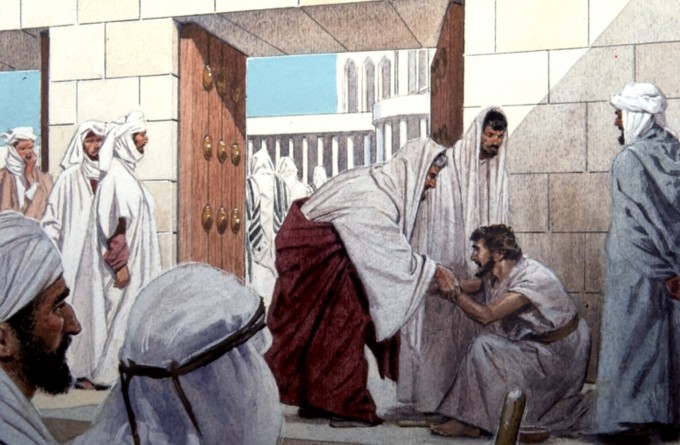
Peter healed a crippled beggar at the Beautiful Gate of the Temple (Acts 3:1-11)

Peter healed a crippled beggar at the Beautiful Gate of the Temple (Acts 3:1-11)

Having finished the Book of Acts and Paul’s Epistle to the Ephesians, this week we will turn from Paul’s writing, first to a letter from Peter (1 Peter), then to the Book of Hebrews.  The former was probably written around 62-63 AD, before Nero’s persecution, but almost certainly during his reign.  As to the Hebrew letter, there has been much conjecture about the authorship, but as one writer put it, “Who actually wrote the epistle, only God knows.”

Summing Up

Each weekend, I am now posting a small PDF of one week of chapter summaries (on the website’s “Summaries” page), current to the beginning of the previous week.  I have posted the summary for Week 48 (November Week 4) of the schedule I am following.  This short PDF document contains condensed comments about Acts 25, 26, 27, 28, and Ephesians 1, with hyperlinks to the ESV version of each chapter for listening or reading, and joins the summaries for other weeks already posted there.

/Bob’s boy
___________________
image © V. Gilbert & Arlisle F. Beers

Please note: I did not design the reading plan that I am following in my blog.  All of my comments in this blog, however, are solely my responsibility.  When reading ANY commentary, you should ALWAYS refer first to the scripture, which is God’s unchanging and unfailing word. Reading schedules, as well as a link to the site where you can get the reading plan that I’m currently following for yourself can be found on the “Bible Reading Schedules” page of my website at http://graceofourlord.com.  For questions and help, please see the “FAQ” and “Summaries” pages there.
Ephesians 6 – The Whole Armor of God

Paul closes his letter to the Ephesians in this chapter beginning with the admonition for children to “honor your father and mother,” referring to the fifth of the Ten Commandments (Exodus 20:12) as being “the first commandment with a promise, ‘that it may go well with you and that you may live long in the land.'”  It was the only one of those ten commandments to contain a promise; and the emphasis throughout the Bible on children being expected to obey their parents is nothing to be taken lightly.  Consider the opposite of the aforementioned promise, for example.  Verse 4, as with all of these “submission passages” reminds fathers of their duty to them – to love their children enough to “bring them up in the discipline and instruction of the Lord.”  As Proverbs 22:6 teaches, such instruction will stay with them.

Paul was a prisoner in Rome, under house arrest, but he was free to preach the Gospel to many who came to listen (Acts 28:16-31).

Paul was a prisoner in Rome, under house arrest, but he was free to preach the Gospel to many who came to listen (Acts 28:16-31).

He continues the theme of Christians submitting one to another that he began in Chapter 5:21 with similar instructions for bondservants and their masters.  Verses 5-9 do not constitute an endorsement of slavery or servitude on the part of the Apostle.  Its applications then and today are relevant to the relationship of people to any lawfully established authority (and vice-versa, which is sometimes forgotten).

The “meat and potatoes” of this chapter come in verse 10 and following.  The “whole armor of God” described in these verses correlate to a fully armed soldier, and the descriptions would be familiar to people throughout the Roman Empire.  Verse 12 reminds us that the spiritual forces of evil – the devil himself – is a very real adversary, not some imagined foe, but the very real “roaring lion” (1 Peter 5:8).  Christians arm themselves for this battle with a list of items he relates to this armor and weapons – truth, righteousness, and the readiness given by the gospel of peace.  Faith, he says, is our shield against “flaming darts of the evil one.”

As he encourages them to be strong in prayer, he asks also for their prayers for him to be strong, as he declares himself their “ambassador in  chains.”

Read or listen to audio of ESV version of this selection from this link.

/Bob’s boy
___________________
some images © V. Gilbert & Arlisle F. Beers

Please note: I did not design the reading plan that I am following in my blog.  All of my comments in this blog, however, are solely my responsibility.  When reading ANY commentary, you should ALWAYS refer first to the scripture, which is God’s unchanging and unfailing word. Reading schedules, as well as a link to the site where you can get the reading plan that I’m currently following for yourself can be found on the “Bible Reading Schedules” page of my website at http://graceofourlord.com.  For questions and help, please see the “FAQ” and “Summaries” pages there.

Ephesians 5 – Walk In Love

As Paul opens in this chapter telling the Ephesians to be imitators of God, he tells them in verse 2 to “walk in love.”  The verb “walk” is used to mean “to live ones life, and exhibit the characteristics of.” This fits perfectly with 1 John 4:8, which says “Anyone who does not love does not know God, because God is love.”  Paul refers to the expectation that Christians walk in love in other passages such as Romans 14:15, and says it is what “binds everything together in perfect harmony (Colossians 3:14).

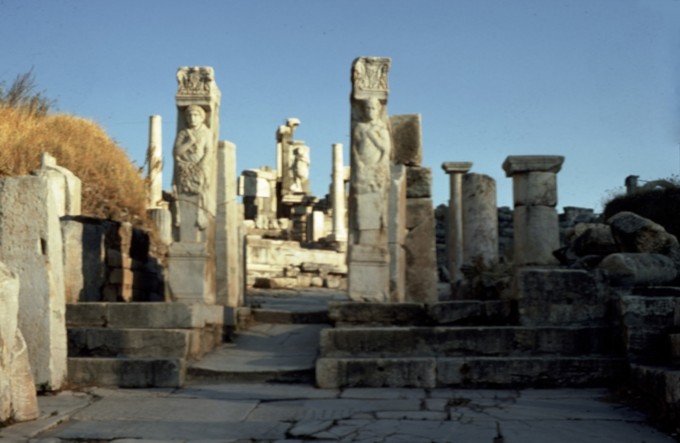
Ruins at Ephesus

Ruins at Ephesus

Paul contrasts that by urging them to stay away from sexual immorality (which covers everything outside of relations between a husband and a wife), as well as all impurity and covetousness – which is idolatry – and even filthy talk, or crude joking.  Indeed, he says that such should not even be named of the people of God.  A Christian’s integrity and reputation matter, and public sins dishonor the Lord.  He makes it clear in verse 5 that those who are guilty of these things have “no inheritance in the kingdom of Christ and God.”  Verse 8’s “children of light” remind us of Jesus’ words in John 12:35-36.

Verses 21-33 deal with the relationship of a husband and wife – not women and men in general.  Paul restates Genesis 3:16 in terms of the husband being the head of the wife, just as Jesus is the head of the church (Ephesians 1:22-23).  But that does not give the husband license to be a tyrant.  Rather, the husband is to love his wife as Jesus loved the church, and “gave himself up for her.”  A wife should be able to count on just such love from her husband.  Verse 31 quotes Genesis 2:24, as they become one flesh; and the husband should also love his wife as he loves himself.

Read or listen to audio of ESV version of this selection from this link.

/Bob’s boy
___________________
some images © V. Gilbert & Arlisle F. Beers

Please note: I did not design the reading plan that I am following in my blog.  All of my comments in this blog, however, are solely my responsibility.  When reading ANY commentary, you should ALWAYS refer first to the scripture, which is God’s unchanging and unfailing word. Reading schedules, as well as a link to the site where you can get the reading plan that I’m currently following for yourself can be found on the “Bible Reading Schedules” page of my website at http://graceofourlord.com.  For questions and help, please see the “FAQ” and “Summaries” pages there.
Ephesians 4 – Unity in the Body of Christ

Paul is preaching unity here, as he emphasizes the church as the body of Christ, with Christ as the head (Colossians 1:18, Ephesians 2:16, 1 Corinthians 12:27) – that there is one body and one Spirit, just as we have been “called to the one hope” (verses 4-5) of eternal life in Christ and “one Lord, one faith, one baptism, one God and Father of all.”  But in this unity, grace was given to each individual member, according to the measure of Christ’s gift (verses 7-11).  This is not speaking just of supernatural gifts, as the age of those will soon pass (though they, too, had their place in “building up the body of Christ”); and Paul is speaking not just to Christians of that age, but to all future Christians.  Verse 8 is from Psalm 68:18.

Along a main inland road from Ephesus to the Euphrates River, Colossae shared the beauty of the Lycus Valley with its sister cities Hierapolis. The original roads from Ephesus and Sardis joined there, and this defensible and well-watered hill became a strategic point in antiquity. Declining in importance by the time of Paul's Epistle to them, they had already been surpassed in size by the other Lycus Valley cities.

Along a main inland road from Ephesus to the Euphrates River, Colossae shared the beauty of the Lycus Valley with its sister cities Hierapolis. The original roads from Ephesus and Sardis joined there, and this defensible and well-watered hill became a strategic point in antiquity. Declining in importance by the time of Paul’s Epistle to them, they had already been surpassed in size by the other Lycus Valley cities.

Paul began in verse 1 stating that we must walk in a manner worthy of that calling; and he picks up that thought again beginning in verse 17, as he says they (we) must no longer walk as the Gentiles do.  This is relevant to us as well as a reference to all unbelievers, who are “darkened in their understanding, alienated from the life of God because of the ignorance that is in them, due to their hardness of heart…given themselves up to sensuality, greedy to practice every kind of impurity.”

But instead, a Christian, taught the truth in Christ, is “to put off your old self, which belongs to your former manner of life and is corrupt through deceitful desires, and to be renewed in the spirit of your minds” (verses 21-23).  Then, he turns in verses 25-32 to the importance of honesty and being Godly in speech, thought, and heart, which is to rule how we treat each other; and sharing with those in need is to play an important role in our lives (verse 27).  Verse 26 says “be angry and do not sin.”  One can have anger, particularly “righteous anger,” but it should not rule our hearts or our mouths.    Verse 32 sums up that section well – “Be kind to one another, tenderhearted, forgiving one another, as God in Christ forgave you.”

Read or listen to audio of ESV version of this selection from this link.

/Bob’s boy
___________________
some images © V. Gilbert & Arlisle F. Beers

Please note: I did not design the reading plan that I am following in my blog.  All of my comments in this blog, however, are solely my responsibility.  When reading ANY commentary, you should ALWAYS refer first to the scripture, which is God’s unchanging and unfailing word. Reading schedules, as well as a link to the site where you can get the reading plan that I’m currently following for yourself can be found on the “Bible Reading Schedules” page of my website at http://graceofourlord.com.  For questions and help, please see the “FAQ” and “Summaries” pages there.

Ephesians 3 – The Mystery of the Gospel Revealed

Ephesus, in modern Turkey, is the best-preserved classical city on the Mediterranean, and one of the best places in the world to get the feeling for what life was like for early Christians in Roman times. Roman theater.

Ephesus, in modern Turkey, is the best-preserved classical city on the Mediterranean, and one of the best places in the world to get the feeling for what life was like for early Christians in Roman times. Roman theater.

Verse 1 of this chapter is key to the message Paul is conveying here.  He is a prisoner for Jesus Christ, on behalf of the Gentiles.  The “mystery” that he received revelation about was (as  verse 6 says) “that the Gentiles are fellow heirs, members of the same body, and partakers of the promise in Christ Jesus through the gospel.” This plan was not known to previous generations (verse 5), but now has been revealed to His apostles and prophets.  He declares this as his ministry in verse 7 – “of this gospel I was made a minister according to the gift of God’s grace, which was given me…”  And he makes it known in verses 10-11 that this was always God’s plan, according to His wisdom – “this was according to the eternal purpose that he has realized in Christ Jesus our Lord…”

The chapter ends with Paul’s prayer for spiritual strength in verses 14-21, that he began in the previous chapter.  This is one of the most beautiful and poignant prayers in the Bible.  Read it again and again, and take comfort in wisdom and truth of it, as well as the promise it brings to the hearts of Christians:

“For this reason I bow my knees before the Father,
from whom every family in heaven and on earth is named,
that according to the riches of his glory he may grant you to be strengthened with power through his Spirit in your inner being
so that Christ may dwell in your hearts through faith—that you, being rooted and grounded in love
may have strength to comprehend with all the saints what is the breadth and length and height and depth,
and to know the love of Christ that surpasses knowledge, that you may be filled with all the fullness of God.
Now to him who is able to do far more abundantly than all that we ask or think, according to the power at work within us,
to him be glory in the church and in Christ Jesus throughout all generations, forever and ever. Amen.”

Read or listen to audio of ESV version of this selection from this link.

/Bob’s boy
___________________
some images © V. Gilbert & Arlisle F. Beers

Please note: I did not design the reading plan that I am following in my blog.  All of my comments in this blog, however, are solely my responsibility.  When reading ANY commentary, you should ALWAYS refer first to the scripture, which is God’s unchanging and unfailing word. Reading schedules, as well as a link to the site where you can get the reading plan that I’m currently following for yourself can be found on the “Bible Reading Schedules” page of my website at http://graceofourlord.com.  For questions and help, please see the “FAQ” and “Summaries” pages there.

Ephesians 2 – By Grace Through Faith

The ruins of the Roman Theater in Ephesus, Turkey. Paul visited here on his Second Missionary Journey and later wrote the epistle Ephesians to the Christians of Ephesus

The ruins of the Roman Theater in Ephesus, Turkey. Paul visited here on his Second Missionary Journey and later wrote the epistle Ephesians to the Christians of Ephesus

Paul, addressing the Ephesians, interchanges the pronouns “you”, “we”, and “us” (verses 1, 3, and 4, for example), pointing out that we were all lost in our sin.  But God, being rich in mercy, made us alive through Jesus Christ, in whom we were raised up, along with Him.  He says that we are saved by grace through faith.  The significance of that statement is emphasized by making clear that it is not by anything that we did (verse 8), but it is the gift of God.  But one must take account of the whole of Scripture in order to understand this part, as is always the case.  It is by grace that we are saved, certainly.  But it is not by grace alone, otherwise the entire world would be saved without even having belief.  Therefore, faith is a necessary part of that salvation, but faith alone, without grace, cannot save us.  But one must also remember that, as James said (James 2:24),  “a person is justified by works and not by faith alone.”

He then goes on to remind that the Gentiles were once separated by the Law of Moses, a wall that in Christ Jesus was broken down (verses 13-16); and through Him, Jews and Gentiles alike have access “in one spirit to the father” (verse 18).  Such salvation for all people of the world was always the plan of God through Jesus (Titus 2:11), on which foundation He is the cornerstone (verses 20-21, Isaiah 28:16).

Read or listen to audio of ESV version of this selection from this link.

/Bob’s boy
___________________
some images © V. Gilbert & Arlisle F. Beers

Please note: I did not design the reading plan that I am following in my blog.  All of my comments in this blog, however, are solely my responsibility.  When reading ANY commentary, you should ALWAYS refer first to the scripture, which is God’s unchanging and unfailing word. Reading schedules, as well as a link to the site where you can get the reading plan that I’m currently following for yourself can be found on the “Bible Reading Schedules” page of my website at http://graceofourlord.com.  For questions and help, please see the “FAQ” and “Summaries” pages there.

Nearing Year End \ Week 47 summary posted

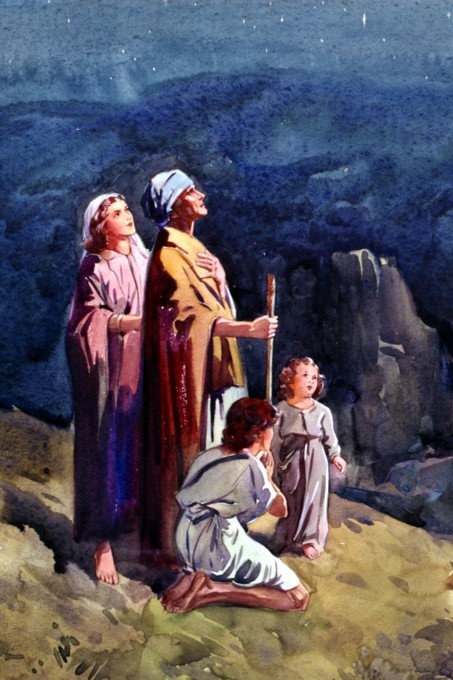
Israelites of the Old Testament look toward the coming of the Messiah — Malachi 3:1-5, Isaiah 53

As December has now arrived, it seems hard to believe that 11 months have passed since this blog started on this Bible reading plan.  We began literally “In the beginning” in Genesis, reading the first promise of the Messiah (Genesis 3:15) and, therefore, the first hints of God’s plan for man’s salvation.  Truly, one could not follow even this easy plan without seeing that the Bible is one story, with a beginning, a middle, and soon we will find, and end as well.  We read of the ancestry, birth, life, and sacrificial death of our Lord and Savior, Jesus Christ.  The focus o the Scripture now is clearly on looking ahead to Jesus’ return, as we all are; and we still have a month of the New Testament left of getting the “big picture” of the Bible.

Summing Up

Each weekend, I am now posting a small PDF of one week of chapter summaries (on the website’s “Summaries” page), current to the beginning of the previous week.  I have posted the summary for Week 47 (November Week 3) of the schedule I am following.  This short PDF document contains condensed comments about Romans 15, Acts 21, 22, 23, and 24, with hyperlinks to the ESV version of each chapter for listening or reading, and joins the summaries for other weeks already posted there.

/Bob’s boy
___________________
image © V. Gilbert & Arlisle F. Beers

Please note: I did not design the reading plan that I am following in my blog.  All of my comments in this blog, however, are solely my responsibility.  When reading ANY commentary, you should ALWAYS refer first to the scripture, which is God’s unchanging and unfailing word. Reading schedules, as well as a link to the site where you can get the reading plan that I’m currently following for yourself can be found on the “Bible Reading Schedules” page of my website at http://graceofourlord.com.  For questions and help, please see the “FAQ” and “Summaries” pages there.
Ephesians 1 – Spiritual Blessings in Christ

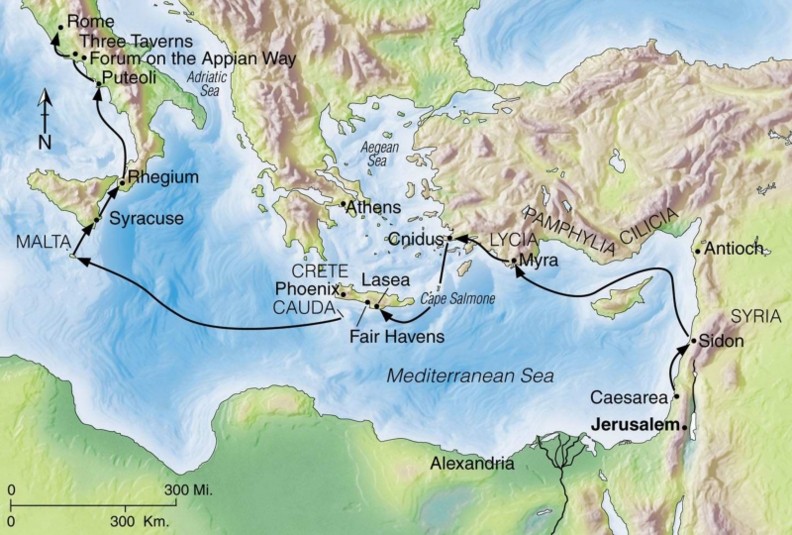
Paul finally visited Rome while a captive awaiting his trial before Caesar. The letter to the Ephesians is one of the Prison Letters. It was probably written during his first imprisonment in Rome, which lasted from A.D. 60 to 62.

Paul’s epistle to the Ephesians is one of the four “prison epistles” that he wrote while imprisoned by the Romans (the other three being Philippians, Colossians and Philemon).  Paul established the church there on his second missionary journey (Acts 18:18-21) and returned on his third missionary journey, staying for two years (Acts 19). and said a tearful farewell to the Ephesian elders in Acts 20:17-38.

In chapter one, he begins with his signature greeting; and speaks in verses 4-12 of their (and his) “adoption as sons through Jesus Christ, according to the purpose of his will.”  This does not mean that certain people are selected by God to be saved, and certain others to be condemned, no matter what they do.  The Lord predestined His chosen people – the ones who serve Him – to be saved.  Whether we wish to be part of that blessing is our choice to make.  Coffman’s commentary says it well:

“Inherent in this is the fact of God’s calling and electing people before the foundation of the world; and very few theological questions have demanded more attention and interest than this. Clearly revealed in this is the fact that the coming of Jesus Christ into the world for the purpose of taking out of it a people for himself and redeeming them unto eternal life was no afterthought on God’s part. Before the world was ever created, the divine plan of the Son of God’s visitation of the human family existed in the eternal purpose of God. That body that Christ would gather from the populations of earth is destined to receive eternal life; because what God purposes is certain of fulfillment. Such a calling and election of those “in Christ” to receive eternal glory, however, is not capricious. Every man may decide if he will or will not become a part of it and receive the intended blessing.”

Regarding verse 9’s use of the word mystery, there is more in Ephesians 3:3 and 1 Timothy 3:16.   But Coffman’s comments on this as well are salient: The New Testament use of the term ‘mystery’ is not very closely related to the modern use of the word, conveying instead the meaning of a secret once unknown, now revealed. Mackay called it ‘God’s unveiled secret.”  

Paul commends them for their faith in Jesus, and declares the ultimate authority of Jesus Christ as the “head” of the church, speaking of it as a spiritual body (verses 15-32).

Read or listen to audio of ESV version of this selection from this link.

/Bob’s boy
___________________
some images © V. Gilbert & Arlisle F. Beers

Please note: I did not design the reading plan that I am following in my blog.  All of my comments in this blog, however, are solely my responsibility.  When reading ANY commentary, you should ALWAYS refer first to the scripture, which is God’s unchanging and unfailing word. Reading schedules, as well as a link to the site where you can get the reading plan that I’m currently following for yourself can be found on the “Bible Reading Schedules” page of my website at http://graceofourlord.com.  For questions and help, please see the “FAQ” and “Summaries” pages there.