Psalm 119:137-144; Psalm 84 – The Sparrow Hath Found a House

tsadeThis stanza of Psalm 119 begins each verse with the Hebrew letter “Tsade.”  These verses are heavily salted with references to the psalmist’s state of persecution from enemies (verse 141, 143).  The point he makes, and the lesson from the stanza,  is that he takes comfort from God’s word.

Some ascribe Psalm 84 to David (Spurgeon says it “exhales to us a Davidic perfume, it smells of the mountain heather and the lone places of the wilderness, where King David must have often lodged during his many wars”).  Others hold that it was written during times of actual Temple worship during the monarchy (verse 9), suggesting that it was written during Solomon’s reign; and verses 4 and 10 certainly have that air.

In any case, the twelve verses of this hymn of praise are beautiful; and the KJV (which we include below) do better justice to the poetry than other versions IMHO.  The theme of the song is the joy of being in the house of worship to the Lord – a day of which, verse 10 says is better than a thousand elsewhere.  This blogger whole-hardheartedly agrees.  There is no time that I am happier or more at peace than when I am worshiping the Lord with my brothers and sisters.

How amiable are thy tabernacles, O Lord of hosts!
My soul longeth, yea, even fainteth for the courts of the Lord: my heart and my flesh crieth out for the living God.
Yea, the sparrow hath found an house, and the swallow a nest for herself, where she may lay her young, even thine altars, O Lord of hosts, my King, and my God.
Blessed are they that dwell in thy house: they will be still praising thee. Selah.
Blessed is the man whose strength is in thee; in whose heart are the ways of them.
Who passing through the valley of Baca make it a well; the rain also filleth the pools.
They go from strength to strength, every one of them in Zion appeareth before God.
O Lord God of hosts, hear my prayer: give ear, O God of Jacob. Selah.
Behold, O God our shield, and look upon the face of thine anointed.
For a day in thy courts is better than a thousand. I had rather be a doorkeeper in the house of my God, than to dwell in the tents of wickedness.
For the Lord God is a sun and shield: the Lord will give grace and glory: no good thing will he withhold from them that walk uprightly.
O Lord of hosts, blessed is the man that trusteth in thee.

Read or listen to audio of ESV version of this selection from this link.

/Bob’s boy
___________________
some images © V. Gilbert & Arlisle F. Beers

Please note: I did not design the reading plan that I am following in my blog.  All of my comments in this blog, however, are solely my responsibility.  When reading ANY commentary, you should ALWAYS refer first to the scripture, which is God’s unchanging and unfailing word. Reading schedules, as well as a link to the site where you can get the reading plan that I’m currently following for yourself can be found on the “Bible Reading Schedules” page of my website at http://graceofourlord.com.  For questions and help, please see the “FAQ” and “Summaries” pages there.
Psalms 68 – The Procession of My God

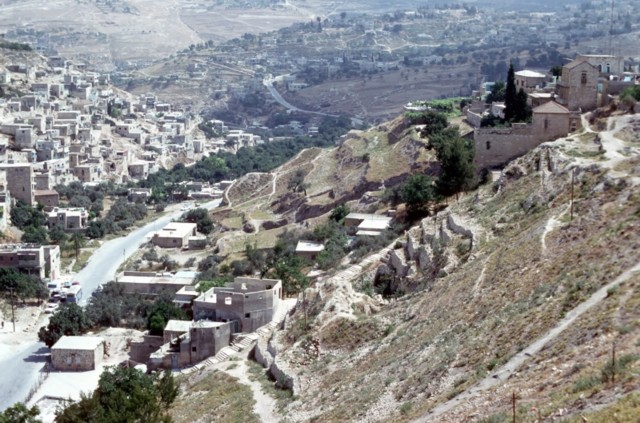
This psalm is extolled by commentators as one of the most magnificent hymnal psalms of praise that David wrote – and in some ways, one of the most difficult to outline and interpret.  It is widely accepted as having been written at the time of the removal of “the ark of God from the house of Obed-edom to the city of David with rejoicing” ( 2 Samuel 6:12).  And that certainly seems to be the case, as it starts out in verse one (“God shall arise, his enemies shall be scattered; and those who hate him shall flee before him!”) – the same way the ark was always put on its journey (see Numbers 10:35).

Hill of Ophel, south of Jerusalem, where the city of David was located.

Hill of Ophel, south of Jerusalem, where the city of David was located.

Throughout the chapter, it echoes the praise for God when on a similar journey among His people, He led them from bondage in Egypt (i.e. verses 4, 6, 7-8).  Verse 20 (“Our God is a God of salvation, and to God, the Lord, belong deliverances from death”) is one of few verses in the Old Testament that clearly demonstrates an understanding of God’s saving grace for the righteous in eternity, as we understand now comes to us from the sacrifice of His Son.

But praise for God and His power is the sole intent of this song.  Part of Spurgeon’s description of the singing which follows here conjures quite an image:

“With the words of the first two verses the ark is uplifted, and the procession begins to move. In Psalm 68:3-6, the godly in the assembly are exhorted to commence their joyous songs, and arguments are adduced to help their joy. Then the glorious march of Jehovah in the wilderness is sung: Psalm 68:7-10, and his victories in war are celebrated in verses Psalm 68:11-14. The joyous shouts are louder as Zion comes in sight, and the ark is borne up the hill…”

The psalm concludes majestically:

Awesome is God from his sanctuary;
the God of Israel—he is the one who gives power and strength to his people.
Blessed be God!

Read or listen to audio of ESV version of this selection from this link.

/Bob’s boy
___________________
some images © V. Gilbert & Arlisle F. Beers

Please note: I did not design the reading plan that I am following in my blog.  All of my comments in this blog, however, are solely my responsibility.  When reading ANY commentary, you should ALWAYS refer first to the scripture, which is God’s unchanging and unfailing word. Reading schedules, as well as a link to the site where you can get the reading plan that I’m currently following for yourself can be found on the “Bible Reading Schedules” page of my website at http://graceofourlord.com.  For questions and help, please see the “FAQ” and “Summaries” pages there.

Job 17 – Where Then Is My Hope?

storm-01In chapter 17, Job is, of course, still at his lowest, and in so many words – a shadow of his former self.  His pain and immense grief having long given way to despair, he tells his friends to speak to him again (verse 10).  But he is certain that they will not offer anything better than they have already (“come on again, all of you, and I shall not find a wise man among you”).

But contrary to how it may seem, Job is not saying that he has given up hope.  Surely, he says, his days are past and his plans are broken off (verse 11).  But he pleads with God to “put up security” for him (verse 3).  Certain that he has closed the hearts of his friends to true understanding, he asks God not to allow their assessment of him to be vindicated in his death.

For then, he says in verse 15, “Who will see my hope?”  Job still has held on to one thing even at this point – his trust in the Lord, that He is just.

Read or listen to audio of ESV version of this selection from this link.

/Bob’s boy
___________________
some images © V. Gilbert & Arlisle F. Beers

Please note: I did not design the reading plan that I am following in my blog.  All of my comments in this blog, however, are solely my responsibility.  When reading ANY commentary, you should ALWAYS refer first to the scripture, which is God’s unchanging and unfailing word. Reading schedules, as well as a link to the site where you can get the reading plan that I’m currently following for yourself can be found on the “Bible Reading Schedules” page of my website at http://graceofourlord.com.  For questions and help, please see the “FAQ” and “Summaries” pages there.

Psalm 58 – God Who Judges the Earth

There is considerable dispute over both the translation and meaning of verse one: “Do you indeed decree what is right, you gods?”  Some translations have the last word replaced with “mighty lords.”  Others insist that it is “silent ones,” implying those accustomed to running things from afar.  In any case, David (for we have no reason to doubt the superscription’s claim that it is another of David’s “Psalms of the Golden Secret” – a Miktam) would certainly not speak of false gods as entities that actually did anything.

snake charmerAs one of the so-called imprecatory psalms, it speaks with sarcastic irony of the rulers and judges that are corrupt and wicked as being like deaf adders who cannot be charmed.  The psalm declares that the righteous will rejoice when God has his vengeance upon such evil men (verse 10).  It is a mistake to believe that righteous people will not do so when evil is defeated.  even the souls of those in heaven who have been slain by such men will rejoice when evil is crushed by the Lord (Revelation 6:9-10).  It is God who judges the earth!

Read or listen to audio of ESV version of this selection from this link.

/Bob’s boy
___________________
some images © V. Gilbert & Arlisle F. Beers

Please note: I did not design the reading plan that I am following in my blog.  All of my comments in this blog, however, are solely my responsibility.  When reading ANY commentary, you should ALWAYS refer first to the scripture, which is God’s unchanging and unfailing word. Reading schedules, as well as a link to the site where you can get the reading plan that I’m currently following for yourself can be found on the “Bible Reading Schedules” page of my website at http://graceofourlord.com.  For questions and help, please see the “FAQ” and “Summaries” pages there.

Proverbs 26 – More Hope For a Fool

donkey-01In many cases, when verses of the Book of Proverbs talk about a fool, this describes someone who simply refuses to believe the truth (as in the more famous verses 4-5).   Sometimes it refers to someone who consistently makes really bad choices.  This chapter of Proverbs begins with 11 verses concerning the fool. It varies from the poor advisability of depending on a fool for anything important, to the harm a fool can do to good people by his actions.  Then comes verse 12:

Do you see a man who is wise in his own eyes?
There is more hope for a fool than for him.

The reference to being “wise” in one’s own eyes is used in many passages throughout the Bible.  Paul referred to it in Romans 11:25 and Romans 12:16.  This refers to a person who will not consider anything that contradicts their own views because they trust their own intelligence and wisdom too much.  It is this obstinate arrogance that takes them to a degree beyond a fool.   There is little hope for such people because their intellectual conceit will likely prevent them from ever changing.  There is hope for the fool, however, if you can ever get one to stop long enough to actually listen.

Read or listen to audio of ESV version of this selection from this link.

/Bob’s boy
___________________
some images © V. Gilbert & Arlisle F. Beers

Please note: I did not design the reading plan that I am following in my blog.  All of my comments in this blog, however, are solely my responsibility.  When reading ANY commentary, you should ALWAYS refer first to the scripture, which is God’s unchanging and unfailing word. Reading schedules, as well as a link to the site where you can get the reading plan that I’m currently following for yourself can be found on the “Bible Reading Schedules” page of my website at http://graceofourlord.com.  For questions and help, please see the “FAQ” and “Summaries” pages there.

Psalm 119:129-136; Psalm 15 – He Who Walks Blamelessly

peThis stanza of Psalm 119 begins each verse with the 17th letter of the Aleph-Bet, “pe” or “peh.”  The pictograph for this letter resembles a mouth, which (as often occurs with these stanzas) goes with part of the text (note verse 131).   Verse 135 (“Make your face shine upon your servant”) reminds us of the Lord’s blessing on Aaron in Numbers 6:23-25.

Some commentators have speculated that Psalm 15 was written by David after his first failed attempt to move the Ark of the Covenant (1 Chronicles 13) and before the second (1 Chronicles 15).  That seems as likely a guess as any.  But as for relevance to us today, it seems clear that the psalm reminds us that in our walk with the Lord, He cares very much about whether we are truthful, honorable, generous, and compassionate to each other (verses 2-3, 5).

Read or listen to audio of ESV version of this selection from this link.

/Bob’s boy
___________________
some images © V. Gilbert & Arlisle F. Beers

Please note: I did not design the reading plan that I am following in my blog.  All of my comments in this blog, however, are solely my responsibility.  When reading ANY commentary, you should ALWAYS refer first to the scripture, which is God’s unchanging and unfailing word. Reading schedules, as well as a link to the site where you can get the reading plan that I’m currently following for yourself can be found on the “Bible Reading Schedules” page of my website at http://graceofourlord.com.  For questions and help, please see the “FAQ” and “Summaries” pages there.

O T Facts (Second Book of Law) – Exodus

Exodus

The book’s name comes from the Greek noun exodos, meaning “a going out” or “departure.”  God leads His people out of Egypt by way of Moses, has the Tabernacle constructed, and dwells among His people.

On the first Passover, the Israelites who painted their doorways with blood were passed over when the angel of death came through the land of Egypt (Exodus 11).

On the first Passover, the Israelites who painted their doorways with blood were passed over when the angel of death came through the land of Egypt (Exodus 11).

Exodus 3 – the burning bush – God calls Moses to do His will

Exodus 4 – Moses returns to Egypt

Exodus 7:14 – 10:29 – Plagues 1 through 9

Exodus 11-12 – 10th plague and the Passover

Exodus 14 – Crossing of the Red Sea

Exodus 19 – Arrival at Mount Sinai

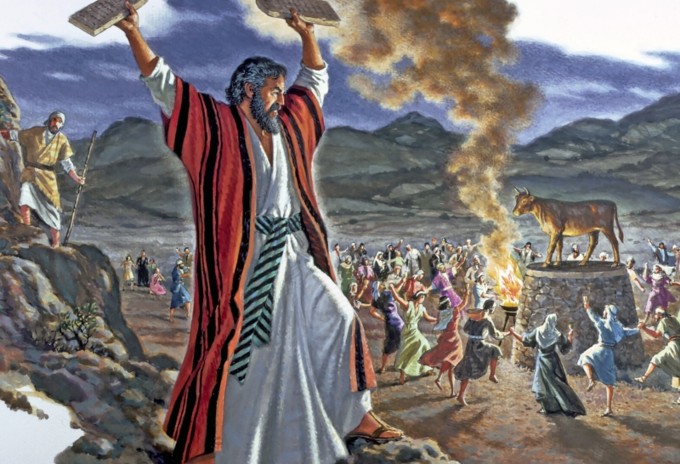
golden_calfExodus 20 – The Ten Commandments given

Exodus 24 – The Covenant Confirmed

Exodus 25 – 31 – Instructions for the Tabernacle, Ark of the Covenant

Exodus 32 – Covenant breach \ the golden calf

Exodus 36 -39 – Tabernacle Constructed

Moses makes the tabernacle in the wilderness

Moses makes the tabernacle in the wilderness

Exodus 40 – Assembly of the Tabernacle \ the Glory of the Lord

/Bob’s boy
___________________
image © V. Gilbert & Arlisle F. Beers

Please note: I did not design the reading plan that I am following in my blog.  All of my comments in this blog, however, are solely my responsibility.  When reading ANY commentary, you should ALWAYS refer first to the scripture, which is God’s unchanging and unfailing word. Reading schedules, as well as a link to the site where you can get the reading plan that I’m currently following for yourself can be found on the “Bible Reading Schedules” page of my website at http://graceofourlord.com.  For questions and help, please see the “FAQ” and “Summaries” pages there.
Psalms 50 – God Himself is Judge

This is the first of 12 “songs of Asaph.”  Asaph was one of David’s chief musicians (1 Chronicles 16:7), and undoubtedly did write some of the psalms (2 Chronicles 29:30), although it is not certain that he wrote all 12 of these, or simply was known to sing some of them.  Most commentators agree however that this one was likely written by him.  Adam Clarke said “The style of David is more polished, flowing, correct, and majestic, than that of Asaph, which is more stiff and obscure.”

Mount Zion, Aceldama, Akeldama, or Hakeldamia, the Field of Blood.

Mount Zion, Aceldama, Akeldama, or Hakeldamia, the Field of Blood.

Some say that this is a prophetic psalm concerning the Messiah, and that does have some merit.  Verse 2 (“Out of Zion, the perfection of beauty,God shines forth”) seems akin to Isaiah 2:3 (“For out of Zion shall go the law, and the word of the Lord from Jerusalem”).  In the latter, “the word” obviously is Jesus (John 1:14).  And in verses 8-14, God tells His chosen ones that He neither needs nor wants their sacrifices (which we are reminded in Hebrews 10:5-7).

He rebukes the wicked among them in verses 16-22 for believing they can live their lives doing any sort of sinful act, as long as they make their sacrifices to atone for it.  God hates fake worship; and the verses are just as relevant for us today.  Too many of us live as pagans Monday through Saturday night, yet still consider themselves Christians on Sunday, as long as they go to worship services.  God will judge us for how we live our daily lives, and His salvation is for he who “orders his way rightly” (verse 23).

Read or listen to audio of ESV version of this selection from this link.

/Bob’s boy
___________________
some images © V. Gilbert & Arlisle F. Beers

Please note: I did not design the reading plan that I am following in my blog.  All of my comments in this blog, however, are solely my responsibility.  When reading ANY commentary, you should ALWAYS refer first to the scripture, which is God’s unchanging and unfailing word. Reading schedules, as well as a link to the site where you can get the reading plan that I’m currently following for yourself can be found on the “Bible Reading Schedules” page of my website at http://graceofourlord.com.  For questions and help, please see the “FAQ” and “Summaries” pages there.

Job 16 – God Has Worn Me Out?

In the speech that Eliphaz had finished, the only new invective was that of adding to the list of Job’s supposed sins that he  is also an extreme hypocrite due to his refusal to admit his wickedness.  Job addresses them as the “miserable comforters” they are and declares that if their roles were reversed, he would try to ease their pain instead of making them more miserable.  He would rather they would have just kept silent as when they first arrived.

Depressed_002In the following verses, while he says that God has worn him out, and that his state bears witness of his sins in the eyes of those around him, he seems to have at last concluded that it is not God Himself that has done all of these things to him.  Instead, he says that God has allowed it to happen, and that he has given him up to the hands of the wicked and evil that are tormenting him (verse 11).   And the fact that he still believes that he is not wicked both confuses and saddens him.

How utterly hopeless a feeling it must be to believe that in the face of all that tragedy, not only has mankind turned their backs on him, but the Lord has abandoned him as well.  Now, it sounds like all that he has to look forward to is a few more years just waiting to die.  Job is deep in the clutches of depression, the depth of which we could never really know.

But that is not the whole story here.  In the midst of all this depression and despair, Job not only has hope, he is certain about his assurance.  Job feels that God has abandoned him to evil, yet he speaks with certainty in verses 19-21 of one who will intercede for him: “Even now, behold, my witness is in heaven, and he who testifies for me is on high.” And then: “my eye pours out tears to God, that he would argue the case of a man with God.”

Through it all, Job know through divine inspiration, that it is God Himself that will intercede for him.

Read or listen to audio of ESV version of this selection from this link.

/Bob’s boy
___________________
some images © V. Gilbert & Arlisle F. Beers

Please note: I did not design the reading plan that I am following in my blog.  All of my comments in this blog, however, are solely my responsibility.  When reading ANY commentary, you should ALWAYS refer first to the scripture, which is God’s unchanging and unfailing word. Reading schedules, as well as a link to the site where you can get the reading plan that I’m currently following for yourself can be found on the “Bible Reading Schedules” page of my website at http://graceofourlord.com.  For questions and help, please see the “FAQ” and “Summaries” pages there.
Psalms 57 – Cry Out to God Most High

According to the superscription of this psalm, it was one  written by David when he fled from Saul “in the cave” – possibly on the occasion of either 1 Samuel 22:1 or 1 Samuel 24:1-3, more likely the former.  It is hard to imagine the despair that David felt as he had to hide himself in fear for his very life, appealing to God “My soul is in the midst of lions; I lie down amid fiery beasts…”

Public domain image from www.public-domain-image.comVerse one is another of the several verses found in the psalms (17:8, 36:7, and 63:7, for example) and elsewhere that refer to a place of safety as being “in the shadow of your wings.”  In verses 1-6, David makes his “cry out to God most high” in prayer for His help.  But even in so doing, he expresses his faith in the Lord saying “I will take refuge, till the storms of destruction pass by.”  When we have done all that we can do, we must learn to trust in Him.

Then in verses 7-11, he finishes his prayer renewed with strength, and praises God for his comfort and steadfast love.  The refrain of the song, found in verse 5 is returned to in verse 11:

Be exalted, O God, above the heavens!
Let your glory be over all the earth!

It is a song that is a model for prayer most appropriate at times of despair, fear, or oppression – any time that we need to “cry out to God most high” as we often do, remembering as we make our plea, that He hears us and that He deserves our praise for all that He is and does.

Read or listen to audio of ESV version of this selection from this link.

/Bob’s boy
___________________
some images © V. Gilbert & Arlisle F. Beers

Please note: I did not design the reading plan that I am following in my blog.  All of my comments in this blog, however, are solely my responsibility.  When reading ANY commentary, you should ALWAYS refer first to the scripture, which is God’s unchanging and unfailing word. Reading schedules, as well as a link to the site where you can get the reading plan that I’m currently following for yourself can be found on the “Bible Reading Schedules” page of my website at http://graceofourlord.com.  For questions and help, please see the “FAQ” and “Summaries” pages there.