Psalm 35 – Let Them Be Turned Back

Saul and David.

Saul and David. (Photo credit: Wikipedia)

This Psalm is one of several that are classified as imprecatory psalms – a categorization to which this blogger objects because some define the word “imprecate” as “to invoke evil upon.” What David is praying for in these psalms is nothing other than the righteous judgment of the Lord on the wicked people who wish to harm and even to kill him.  Some who object to, or make excuses for, these psalms remind us that Jesus told us to love our enemies and pray for those who persecute us.  He did indeed, but he did not also tell us to pray that they will be successful in their endeavors to do us harm.

C. S. Lewis noted that “the ferocious parts of the Psalms serve as a reminder that there is in the world such a thing as wickedness and that it (if not its perpetrators) is hateful to God” (Lewis, C. S. 1958. Reflections on the Psalms. New York, NY: Harcourt, Brace, and Co.).  Dr. George DeHoff wrote “…David is not here pleading for innocent people to be destroyed, but for wicked people to be punished for their evil deeds in order to bring them to repentance and ultimate salvation.”

It is supposed that this psalm was written at the time when King Saul and his men were pursuing David.   In verses 11-14, he speaks plainly of the evil treatment he has received at the hands of people to whom he had been good and kind.  DeHoff also declared that “these prayers may be prayed by any child of God today.”

“Let not those rejoice over me
who are wrongfully my foes,
and let not those wink the eye
who hate me without cause.”

Read or listen to audio of ESV version of this selection from this link.

/Bob’s boy
___________________
some images © V. Gilbert & Arlisle F. Beers

Please note: I did not design the reading plan that I am following in my blog.  All of my comments in this blog, however, are solely my responsibility.  When reading ANY commentary, you should ALWAYS refer first to the scripture, which is God’s unchanging and unfailing word. Reading schedules, as well as a link to the site where you can get the reading plan that I’m currently following for yourself can be found on the “Bible Reading Schedules” page of my website at http://graceofourlord.com.  For questions and help, please see the “FAQ” and “Summaries” pages there.

Proverbs 19 – A Man’s Folly

The first of the verses of this chapter of Proverbs that caught our eye as real wisdom is verse 3:

When a man’s folly brings his way to ruin,
his heart rages against the Lord

Don’t misunderstand this post.  As the Book of Job eloquently points out, man’s troubles are not always brought about by his own actions.  But most of us have known someone – maybe you even know someone now – who fits the description of this verse.  The person I am speaking of has either done something foolish, or lived a life of sin – or often, both of these.  Now their deeds have caught up with them in their life, and the consequences they are having to live with are great.  Perhaps it has resulted in trouble with the law, their marriage, financial devastation.  Maybe their health is bad due to a life of fast living and sinful self-indulgence.

jailBut instead of recognizing that most of what has come to pass in their life is self-inflicted, they instead rail against the Lord.  I have known people in this position who loudly proclaim that no just God would allow such things to happen to them, and they shake their fists at the heavens.  How tragic and ironic that we are inclined to blame our Creator for such trials in our lives, when He is precisely the one we need at those times – not to mention the fact that such trials will not have the opportunity to have their effect of building our strength and character as James advised (James 1:2-4) in that frame of mind.  It is a lose/lose situation.

We begin to overcome our own folly only after we come to recognize it for what it is, resolve to change, give ourselves over to serve the Lord, and allow Him to strengthen us day by day.

Read or listen to audio of ESV version of this selection from this link.

/Bob’s boy
___________________
some images © V. Gilbert & Arlisle F. Beers

Please note: I did not design the reading plan that I am following in my blog.  All of my comments in this blog, however, are solely my responsibility.  When reading ANY commentary, you should ALWAYS refer first to the scripture, which is God’s unchanging and unfailing word. Reading schedules, as well as a link to the site where you can get the reading plan that I’m currently following for yourself can be found on the “Bible Reading Schedules” page of my website at http://graceofourlord.com.  For questions and help, please see the “FAQ” and “Summaries” pages there.

Psalm 119:73-80; Psalm 39 – The measure of my days

yodhToday’s stanza of Psalm 119 is brought to you by the letter Yod (or Yodh).  The 10th letter of the Hebrew Aleph-bet is the equivalent of the Greek Iota, and is what is referred to in Matthew 5:18, where Jesus says “For truly, I say to you, until heaven and earth pass away, not an iota, not a dot, will pass from the Law until all is accomplished.”  In the King James version, it is a “jot” or a “tittle” – jot being the Anglicized word used for iota.  In either case, it is the smallest letter, and the tittle refers to a small stroke that is merely a part of a letter.  In verse 75 of this stanza, the psalmist recognizes that there is value to the soul to be had in the trials of life.

The superscript in Psalm 39 has the familiar “to the choirmaster” notation, but with “To Jeduthun” as the instruction.  While the exact meaning of this is not clear, we do know who Jeduthun was.  He is mentioned also in Psalm 62 and Psalm 72, and was one of David’s three Music leaders, the other two being Asaph and Heman (1 Chronicles 16:37-42). He was also the King’s Seer (2 Chronicles 35:15).

The exact occasion of this psalm is not known, but David does indicate his distress at the Lord’s rebuke of him for his sins (verses 10-11).  Verses 4-6 have him asking God for the measure of his days.  But notice as he makes general observances about man’s brevity of life, that the second part of verse 6 sounds an awful lot like Solomon’s words in Ecclesiastes.  Compare “man heaps up wealth and does not know who will gather” to Ecclesiastes 2:18,21, and 26 part of which says: (“I hated all my toil in which I toil under the sun, seeing that I must leave it to the man who will come after me”).

Read or listen to audio of ESV version of this selection from this link.

/Bob’s boy
___________________
some images © V. Gilbert & Arlisle F. Beers

Please note: I did not design the reading plan that I am following in my blog.  All of my comments in this blog, however, are solely my responsibility.  When reading ANY commentary, you should ALWAYS refer first to the scripture, which is God’s unchanging and unfailing word. Reading schedules, as well as a link to the site where you can get the reading plan that I’m currently following for yourself can be found on the “Bible Reading Schedules” page of my website at http://graceofourlord.com.  For questions and help, please see the “FAQ” and “Summaries” pages there.

Understanding the Cross of Christ – Part 2 (What is Sin?)

This series began in Part One as a search for a more meaningful answer to an aspiring young Christian’s question: “Why did God send His only son to die?”  The short answer “to save us from our sins,” while correct, really only serves to raise more questions.  Whether the question comes from a young person or someone older, I should be able to do better.  Hopefully I will be more prepared to answer that question by the end of this series.

A real understanding of the answer to this question naturally begins with understanding some things about sin.  So as we turn to that subject, the first set of questions we brought up in part one center around just what the problem is with sin.

What is sin anyway?

English: Man's Sin, and God's Promise; as in G...

English: Man’s Sin, and God’s Promise; as in Genesis 3:1-6, 13-15; illustration from a Bible card published by the Providence Lithograph Company (Photo credit: Wikipedia)

Simply put, sin is that which is contrary to God’s will, His commandments, even that which is against His very nature.  Sin came into the world in what we know as “the fall” way back in Genesis 3.  At that time, man had a practical paradise on earth, as well the blessing of being really close to God.  But despite clear warning, he threw it all away in rebellion against the Lord, and nothing has been the same since that time.  God’s first reference to sin as a word in the scripture appears in Genesis 4, when Cain had become angry.  God had warned him that sin was “crouching at his door,” after which he in fact murdered his own brother.  Since that time, many specific acts that are sinful have been named in the Bible.  Some of those are named by Paul as “works of the flesh” in Galatians 5:19-20.  The fact that this is not a complete list of all sins is obvious, and made clear by the words “and things like these” at the end of the passage.

We know that those things in Paul’s letter to the Galatians are wrong.  We even know that such things as lying and murder are wrong.  But if there is no clearly exhaustive list of sins in the Bible to which we can refer, how should one know what else may be sinful?   The answer is by studying God’s word – the Scriptures.  The more we learn by reading and hearing God’s word, the more we know about what is right, what is wrong, and what is abhorrent to God (Proverbs 6:16-19, for example).   But we usually have to look no further than our own hearts.  God gave us a conscience; and if we truly examine ourselves with honesty, our internal conflict will betray our true knowledge of what God really expects from us (Romans 2:14-16).

English: The Story of Cain and Abel; as in Gen...

English: The Story of Cain and Abel; as in Genesis 4:3-15; illustration from a Bible card published by the Providence Lithograph Company (Photo credit: Wikipedia)

So why does sin matter so much to God?

God has revealed Himself in many ways to us.  One of those of those ways is by His word. One could write a dissertation on that very subject, but we should know that the Bible declares (among other things) that God is the very definition of goodness and faithfulness, and that He has enduring and steadfast love (Psalm 100:5) – indeed that He is love (1 John 4:8)!  And from His word, we know that He is truth and holiness (Leviticus 19:2) – that He is light, and in Him is no darkness (1 John 1:5).  There is no evil in His character, and He is too pure to tolerate sin or evil (Habakkuk 1:13).

Why should sin matter to us?

We will have more to say about this in Part Three of this series.  But sin is important to us first and foremost because it separates us from God.  That separation is absolutely the worst thing that has ever happened to mankind.  It separated man from God after “the fall” of Genesis 3, and God has been at work to restore that relationship with Him ever since then.  The good news is that He has a plan to do just that very thing; and that hope for us has always pointed to the Cross.

On a Sunday within the next few short weeks, we will present part three of this series with a look at God’s response to sin. as we begin to examine His plan for our salvation and hope for being with Him forever.

/Bob’s boy
___________________
image © V. Gilbert & Arlisle F. Beers

Please note: I did not design the reading plan that I am following in my blog.  All of my comments in this blog, however, are solely my responsibility.  When reading ANY commentary, you should ALWAYS refer first to the scripture, which is God’s unchanging and unfailing word. Reading schedules, as well as a link to the site where you can get the reading plan that I’m currently following for yourself can be found on the “Bible Reading Schedules” page of my website at http://graceofourlord.com.  For questions and help, please see the “FAQ” and “Summaries” pages there.

Psalm 33 -The Steadfast Love of the Lord

Psalm 33 is a hymn – a song of praise and prayer to the Lord, by whose word the heavens were made.  And it begins with the reasons for that praise – His word for man, His faithfulness to that word (verse 4), and the fact that He loves righteousness and justice.  The Lord has shown in His word over and over again how faithful He is to the promises He has made to us, and He does love righteousness.  But how fortunate for us that He also loves justice – for the fact that He is just.

201_01_0066_NatureCreationBkgAfter more praise for His creation of the world by His very word (verses 7-9), the psalmist returns to elaborate on that faithfulness and justice (verses 10-12).  Verses 16-17 simply mean that man’s faith in his own power and strength – even in large armies gives him an illusion of safety and a false promise of salvation.  He then points out God’s care for all those who wait upon Him, as He watches over those who fear Him, and see to it they are provided for (verses 18-19).  He finishes with prayer for the love of the Lord, as His people look toward Him with hope.

Read or listen to audio of ESV version of this selection from this link.

/Bob’s boy
___________________
some images © V. Gilbert & Arlisle F. Beers

Please note: I did not design the reading plan that I am following in my blog.  All of my comments in this blog, however, are solely my responsibility.  When reading ANY commentary, you should ALWAYS refer first to the scripture, which is God’s unchanging and unfailing word. Reading schedules, as well as a link to the site where you can get the reading plan that I’m currently following for yourself can be found on the “Bible Reading Schedules” page of my website at http://graceofourlord.com.  For questions and help, please see the “FAQ” and “Summaries” pages there.

Job 9 – Jesus is our Arbiter

Job concedes the point that God does not punish the righteous and even that he has had sin in his life.  But he is compelled to point out that all men have sinned, and he still contends that he can think of none that warrant such harshness toward him, nor can he think of any for which he has not repented.  Anyway, he says, nobody could argue with Him about it.

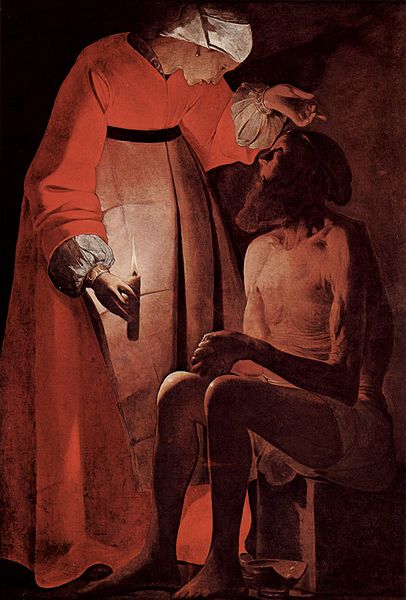
Georges de La Tour,Job Mocked by his Wife

Georges de La Tour,
Job Mocked by his Wife

He acknowledges God’s awesome power at great length, ascribing His ability to command nature even in the form of great earthquakes, His creation of the heavens and the earth – even mentioning constellations in verse 9.  But he wonders in verse 22 if God is fair.  He believes it would be pointless for him to even try to bear his burden without complaint, for more misery is surely to come.  He sees no reason for it to ever stop because he sees no reason for it to have even begun in the first place (verses 27-31). His wife had not even stood with him.  But Job is hanging on to his integrity, as he feels it is all he has left.

As he points out in verse 33 that there is nobody to serve as an arbiter, one cannot help but see that the scripture is pointing us to Jesus.  Paul wrote to Timothy in 1 Timothy 2:5: “For there is one God, and there is one mediator between God and men, the man Christ Jesus.”   This is the crux of Jesus as the Messiah and our High Priest as prophesied in Psalm 110, and as the Hebrew writer said in Hebrews 4:14-16:

“Since then we have a great high priest who has passed through the heavens, Jesus, the Son of God, let us hold fast our confession. For we do not have a high priest who is unable to sympathize with our weaknesses, but one who in every respect has been tempted as we are, yet without sin. Let us then with confidence draw near to the throne of grace, that we may receive mercy and find grace to help in time of need.”

Read or listen to audio of ESV version of this selection from this link.

/Bob’s boy
___________________
some images © V. Gilbert & Arlisle F. Beers

Please note: I did not design the reading plan that I am following in my blog.  All of my comments in this blog, however, are solely my responsibility.  When reading ANY commentary, you should ALWAYS refer first to the scripture, which is God’s unchanging and unfailing word. Reading schedules, as well as a link to the site where you can get the reading plan that I’m currently following for yourself can be found on the “Bible Reading Schedules” page of my website at http://graceofourlord.com.  For questions and help, please see the “FAQ” and “Summaries” pages there.
Psalms 31 – Hunted

David hid in one of the many caves near Adullam, a city 13 miles southwest of Bethlehem (1 Samuel 22: 1-12). David was in this area when three of his mighty men risked their lives to get him a drink of water from Bethlehem (2 Samuel 23: 13-17).

David hid in one of the many caves near Adullam, a city 13 miles southwest of Bethlehem (1 Samuel 22: 1-12). David was in this area when three of his mighty men risked their lives to get him a drink of water from Bethlehem (2 Samuel 23: 13-17).

How long did Saul hunt David?  One estimate is about four years – from 1012 – 1008 BC.  Long enough that several of the psalms he wrote were obviously from that time period.  And it shows in the construction of those psalms.  Imagine being continually on the run, living often in caves, and knowing that any day, your pursuers could catch up to you, and end it all.

Verse 5 contains a line that was quoted by Jesus on the cross (Luke 23:46) as He died:  “Then Jesus, calling out with a loud voice, said, ‘Father, into your hands I commit my spirit!’ And having said this he breathed his last.”  The psalm goes from despair into the assurance of God’s grace twice – first in verses 1-8, and again in 9-24.  Many of the verses adapt easily to the plight of any righteous person who has ever suffered:

Be gracious to me, O Lord, for I am in distress;
my eye is wasted from grief;
my soul and my body also
For my life is spent with sorrow,
and my years with sighing;
my strength fails because of my iniquity,
and my bones waste away.

The last two verses contain the advice from a man who spent all those years running, hundreds of days of fear, dread, despair and anguish.  He encourages us to take heart and have patience – wait on the Lord!

Love the Lord, all you his saints!
The Lord preserves the faithful
but abundantly repays the one who acts in pride.
Be strong, and let your heart take courage,
all you who wait for the Lord

Read or listen to audio of ESV version of this selection from this link.

/Bob’s boy
___________________
some images © V. Gilbert & Arlisle F. Beers

Please note: I did not design the reading plan that I am following in my blog.  All of my comments in this blog, however, are solely my responsibility.  When reading ANY commentary, you should ALWAYS refer first to the scripture, which is God’s unchanging and unfailing word. Reading schedules, as well as a link to the site where you can get the reading plan that I’m currently following for yourself can be found on the “Bible Reading Schedules” page of my website at http://graceofourlord.com.  For questions and help, please see the “FAQ” and “Summaries” pages there.

Proverbs 18 – Restore My Soul

Proverbs 18:14 speaks truly:

A man’s spirit will endure sickness,
but a crushed spirit who can bear?

Have you ever felt totally defeated?  Have you ever thought that if only there were someone to whom you could wave a white flag, you would be perfectly willing to surrender?  When the spirit is crushed, the whole of life can feel like it is too much to bear.  So what do you do?

depressionLearning to “surrender all” to Jesus is not easy.  It goes against everything we have been trained to do all of our lives.  We are taught to pull ourselves up “by our bootstraps.”  We’re trained to find solutions to problems, and then to implement them.  Do not misunderstand me, God does not want us to sit around and just expect that He is going to fix all of our problems for us.  Quite the contrary.  But we must learn that there is a limit to our abilities.  There are always going to be things that are beyond our control.  How about a plan?

1.  Talk to God each and every day.  Find your quiet place and your quiet time.  Perhaps you can take a walk by yourself – just you and the Lord.  Ask Him for His wisdom in knowing what you can and must do, and for His help in getting those things done.

2.  Spend time each day in God’s word.  God speaks to us through His word.  You will not find each and every time you read that there is that one magical verse that will give you insight and clarity of thought.  But by training yourself to let Him speak to you, you will receive the grace of His knowledge over time.  He has promised that He will not withhold from us the wisdom that we need.

3. This is the hardest one (for me), but the most important.  Realize that there is a point at which you have done all that you can do.  You have sought His wisdom.  You have talked with Him and bared your soul concerning your burdens.  And just as importantly, you trust Him to take care of the rest.  You trust that whatever happens next, God will not forsake you.  He will carry His sheep like the good shepherd He is, and with His help, – come what may, you can bear it.

Three scriptures, a song and a prayer for the weary soul

Psalm 55:22“Cast your burden upon the LORD and He will sustain you”

1 Peter 5:6-7 – Humble yourselves, therefore, under the mighty hand of God so that at the proper time he may exalt you, casting all your anxieties on him, because he cares for you

Philippians 4:4-7 – Rejoice in the Lord always; again I will say, rejoice. Let your reasonableness be known to everyone. The Lord is at hand; do not be anxious about anything, but in everything by prayer and supplication with thanksgiving let your requests be made known to God. And the peace of God, which surpasses all understanding, will guard your hearts and your minds in Christ Jesus.

The song – a special prayer to the Lord

Restore My Soul

Restore my spirit, Lord, I need restored.
My heart is weary, please help me, dear Lord.
I stand in need of more strength from Your Word,
Renew my love, rebuild my faith,
O restore my soul.

Revive the fire, Lord, deep in my soul.
Stir my desire to work in Your fold.
Light in my heart, dear God, my zeal grown cold.
Renew my love, rebuild my faith,
O restore my soul.

Renew my courage, Lord, it needs restored.
My cup is empty, refill it, dear Lord.
Replace all doubt and fear with faith so bold.
Renew my love, rebuild my faith,
O restore my soul.

Read or listen to audio of ESV version of this selection from this link.

/Bob’s boy
___________________
some images © V. Gilbert & Arlisle F. Beers

Please note: I did not design the reading plan that I am following in my blog.  All of my comments in this blog, however, are solely my responsibility.  When reading ANY commentary, you should ALWAYS refer first to the scripture, which is God’s unchanging and unfailing word. Reading schedules, as well as a link to the site where you can get the reading plan that I’m currently following for yourself can be found on the “Bible Reading Schedules” page of my website at http://graceofourlord.com.  For questions and help, please see the “FAQ” and “Summaries” pages there.

Psalm 119:65-72; Psalm 36 – With You is the Fountain of Life

tethToday’s reading of the ninth strophe of Psalm 119 is brought to you by the letter “teth” or “tet.”   The psalmist continues to praise God’s word, but here he acknowledges his sins and  his tendency to be ensnared by wicked ways.

Of verse 66 (“Teach me good judgment and knowledge”), Spurgeon, who advocated David as the author, said: “Since God had dealt well with him, he is encouraged to pray for judgment to appreciate the Lord’s goodness. Good judgment is the form of goodness which the godly man most needs and most desires, and it is one which the Lord is most ready to bestow. David felt that he had frequently failed in judgment in the matter of the Lord’s dealings with him: from want of knowledge he had misjudged the chastening hand of the heavenly Father, and therefore he now asks to be better instructed, since he perceives the injustice which he had done to the Lord by his hasty conclusions.”

Psalm 36 – This psalm is most often labelled a lament, but it is more importantly a prayer and song of praise.  It starts in verses 1-4 with the description of deeply sinful people who know better.  They flatter themselves that they will not be found out, have stopped trying to act wisely or to do good, for sin has penetrated their hearts.  In verses 5-10, David thanks God for His steadfast love, the refuge of His loving wings, and the abundance of His love and mercy.

“For with you is the fountain of life;
in your light do we see light”

This fountain of life makes us think of Jesus at the well with the Samaritan woman in John 4:10, and his light of John 8:12: “I am the light of the world. Whoever follows me will not walk in darkness, but will have the light of life.”

Read or listen to audio of ESV version of this selection from this link.

/Bob’s boy
___________________
some images © V. Gilbert & Arlisle F. Beers

Please note: I did not design the reading plan that I am following in my blog.  All of my comments in this blog, however, are solely my responsibility.  When reading ANY commentary, you should ALWAYS refer first to the scripture, which is God’s unchanging and unfailing word. Reading schedules, as well as a link to the site where you can get the reading plan that I’m currently following for yourself can be found on the “Bible Reading Schedules” page of my website at http://graceofourlord.com.  For questions and help, please see the “FAQ” and “Summaries” pages there.

Psalm 34 – Taste and See That the Lord Is Good

The superscript here refers to David feigning madness in the  presence of Achish, otherwise known by the Philistine title of Abimelech in 1 Samuel 21:10-14 (not to be confused with Ahimelech, the priest of the previous few verses).   Barnes identified the following four paragraphs in the psalm: (1) thanksgiving for deliverance (Psalm 34:1-6); (2) from his experience, he invites others to join in praise (Psalm 34:7-10); (3) special instructions and exhortations for the young to trust in God (Psalms 34:11-14); (4) a general summary of the security, joys, and protection for those who truly rely upon God (Psalms 34:15-22).

Don’t misunderstand verses 17-19:

“When the righteous cry for help, the Lord hears
and delivers them out of all their troubles.
The Lord is near to the brokenhearted
and saves the crushed in spirit.
Many are the afflictions of the righteous,
but the Lord delivers him out of them all.”

Those who have a contrite heart (crushed in spirit) – those who truly repent instead of continuing to do wrong – will be delivered in the end.  God has no regard for the prayers of those who have no intention of changing their ways.   The righteous will indeed suffer, but their salvation and their comfort is promised.

Of this, Coffman wrote:

“Our Lord himself was a man of sorrows and acquainted with grief; and he is the ever ready comforter and Saviour of those whose hearts have been broken by the soul’s tragic encounter with the wicked world in which we live.

NSRW Rudyard Kipling

NSRW Rudyard Kipling (Photo credit: Wikipedia)

The words of Kipling come to mind:

‘The tumult and the shouting dies;
The Captains and the Kings depart.
Still stands Thine ancient sacrifice,
An humble and a contrite heart.
Lord God of Hosts, be with us yet,
Lest we forget; lest we forget!’

— Rudyard Kipling (The Recessional)”

Regarding verse 8’s first half “Oh, taste and see that the Lord is good!, Coffman rightly stated: “God has made it possible for men to know whether or not his word is true. The person who receives it, obeys it, and trusts its promises will shortly come to know, Whom he has believed, having tasted the good Word of God and the powers of the age to come…”   Peter repeated it in 1 Peter 2:1-3.  When we dedicate our lives to serving the Lord and continue  to grow in prayer and learning from His word, our lives are better because of the goodness of the Lord and the assurance of His promises.

Of verses 9-10 (“those who seek the Lord lack no good thing”), one must not think that the scripture promises that those who fear the Lord will never have any of their earthly needs or desires lacking in satisfaction, for not all things are good for everyone – nor is what may be good for one person necessarily good for another.  Instead, we trust that the Lord will provide what we truly need.  Just come and taste for yourself!

Read or listen to audio of ESV version of this selection from this link.

/Bob’s boy
___________________
some images © V. Gilbert & Arlisle F. Beers

Please note: I did not design the reading plan that I am following in my blog.  All of my comments in this blog, however, are solely my responsibility.  When reading ANY commentary, you should ALWAYS refer first to the scripture, which is God’s unchanging and unfailing word. Reading schedules, as well as a link to the site where you can get the reading plan that I’m currently following for yourself can be found on the “Bible Reading Schedules” page of my website at http://graceofourlord.com.  For questions and help, please see the “FAQ” and “Summaries” pages there.