Psalm 55 – Cast Your Burden on the Lord

prayingmanA good portion of this psalm relates to betrayal by a once close and trusted friend; and Spurgeon seems right to assess it as reading “like a song of the times of Absalom and Ahithophel.”  Some have also seen it as a prophetic foretelling of the prayers of Jesus in the face of His betrayal and imminent death; and that certainly does fit as well.  There is no reason why it cannot be both, as most of the Royal psalms do refer to present as well as prophetic circumstances.  Consider verses 3-6:

…in anger they bear a grudge against me.
My heart is in anguish within me;
the terrors of death have fallen upon me.
Fear and trembling come upon me,
and horror overwhelms me.
And I say, “Oh, that I had wings like a dove!
I would fly away and be at rest;

But as a lament, much of it also seems to have application to the despair that overwhelms one because of the oppression of the world and the ultimate enemy – the devil himself, who lays in wait, constantly seeking to beat us down, and causes us grievous harm in ways we may not understand as being from his work at the time they occur.  As such, it is like a great many other psalms, which have tremendous power and application in our own prayers when we often wonder how we can carry on through our suffering:

Give ear to my prayer, O God,
and hide not yourself from my plea for mercy!
Attend to me, and answer me;
I am restless in my complaint and I moan
because of the noise of the enemy

Read or listen to audio of ESV version of this selection from this link.

/Bob’s boy
___________________
some images © V. Gilbert & Arlisle F. Beers

Please note: I did not design the reading plan that I am following in my blog.  All of my comments in this blog, however, are solely my responsibility.  When reading ANY commentary, you should ALWAYS refer first to the scripture, which is God’s unchanging and unfailing word. Reading schedules, as well as a link to the site where you can get the reading plan that I’m currently following for yourself can be found on the “Bible Reading Schedules” page of my website at http://graceofourlord.com.  For questions and help, please see the “FAQ” and “Summaries” pages there.

Proverbs 24 – Precious and Pleasant Riches

family-002By wisdom a house is built,
and by understanding it is established;
by knowledge the rooms are filled
with all precious and pleasant riches.

Clearly the wisdom referred to here is that which is gained from knowledge of the Lord through His word.  Through studying God’s word, one gains the understanding to avoid building “on the sand” (Matthew 7:24-27).    God has given us the plans for the architecture, the answers to the important questions of life – how to live one’s life, how to treat our husbands and wives, how to raise our children, and how to love one another.  Knowledge and application of all these things will surely fill our homes with precious and pleasant riches; and such knowledge is therefore, by example and instruction, passed down to our children and their children, even though they dwell in a wicked world.  These rooms are a more precious gift for our heirs than any worldly wealth.

Read or listen to audio of ESV version of this selection from this link.

/Bob’s boy
___________________
some images © V. Gilbert & Arlisle F. Beers

Please note: I did not design the reading plan that I am following in my blog.  All of my comments in this blog, however, are solely my responsibility.  When reading ANY commentary, you should ALWAYS refer first to the scripture, which is God’s unchanging and unfailing word. Reading schedules, as well as a link to the site where you can get the reading plan that I’m currently following for yourself can be found on the “Bible Reading Schedules” page of my website at http://graceofourlord.com.  For questions and help, please see the “FAQ” and “Summaries” pages there.

Psalm 119:113-120; Psalm 75 – The Righteous Shall Be Lifted Up

samekhThis stanza of Psalm 119 begins each line with the Hebrew letter “samekh.”  The psalmist decries the “double-minded” in the first verse.  This refers to those who claim to believe in God, but will not stay committed to Him and\or those whose faith is in low quantity and easily shaken.  Elijah spoke of these in 1 Kings 18:21 at his showdown with the prophets of Baal, asking the people “how long will you go limping between two different opinions?”  They wanted to believe in God but enjoy the sinfulness that life among Baal-worshipers afforded them.  James spoke of the double-minded as those who doubt or whose faith is not strong (James 1:5-8), saying they are unstable in all ways.

The directions to the choirmaster in the superscription of Psalm 75 say that it is to the tune of “Do not Destroy,” just as in Psalm 57.  It also says that it is a psalm og Asaph – a song.  Asaph was one of those in charge of David’s “service of song” in the Tabernacle (1 Chronicles 6:31-40).

Earth_003The psalm appears to speak in the voice of the psalmist in parts and in that of God in others.  The picture painted is of an unstable world that totters, but it is God who keeps it steady – not the boastful and the wicked who believe in their hearts that they are in control of things.  All through the ages, there have been proud societies that are often evil and oppressive to the righteous and to the weak – those who are insolent, with “haughty neck.”  But the truth is in verses 7-8:

“but it is God who executes judgment,
putting down one and lifting up another.
For in the hand of the Lord there is a cup
with foaming wine, well mixed,
and he pours out from it,
and all the wicked of the earth
shall drain it down to the dregs”

Read or listen to audio of ESV version of this selection from this link.

/Bob’s boy
___________________
some images © V. Gilbert & Arlisle F. Beers

Please note: I did not design the reading plan that I am following in my blog.  All of my comments in this blog, however, are solely my responsibility.  When reading ANY commentary, you should ALWAYS refer first to the scripture, which is God’s unchanging and unfailing word. Reading schedules, as well as a link to the site where you can get the reading plan that I’m currently following for yourself can be found on the “Bible Reading Schedules” page of my website at http://graceofourlord.com.  For questions and help, please see the “FAQ” and “Summaries” pages there.

Understanding the Cross of Christ – Part 6 (Christ Arose!)

This is the conclusion of a series begun in Part One as a search for a more meaningful answer to an aspiring young Christian’s question: “Why did God send His only son to die?”  In part 2, we looked at what sin is, why it matters so much to God, and why it should matter to us.  In part 3, we delved into God’s response to sin.  In all of that discussion, we have made great mention of the fact that God has a plan for our salvation.  In part 4, we looked at how Jesus really fits into that plan.  In part 5, we examined what was expected of the Messiah, and why His death on the cross was necessary.

What Did the Cross Accomplish?

The Very Real Suffering of “The Suffering Servant”

The Mount of Olives, looking from Jerusalem, with Gethsemane on the left and the Basilica of the Agony (also called the Church of All Nations) at the right. It is the third in a succession of churches that have been built on the site where it is believed that Jesus prayed to the Father in the hours before his crucifixion.

The Mount of Olives, looking from Jerusalem, with Gethsemane on the left and the Basilica of the Agony (also called the Church of All Nations) at the right. It is the third in a succession of churches that have been built on the site where it is believed that Jesus prayed to the Father in the hours before his crucifixion.

It is all too easy for us to get into a mindset, knowing that Jesus was the Son of God, of (at least somewhere in the back of our minds) thinking that all of this was easy for Him.  Or if not exactly easy, at least not as bad as it would be for a “regular”person.  We must never forget that although Jesus was (is) the Lord, he had made himself a man.  He had human emotions.  He felt compassion for the hungry (Matthew 15:32), love for the sick and the suffering (Matthew 14:14).  He cried real human tears for Lazarus’ death before he raised him from the dead (John 11:32-35).  Even more telling as He knew what was coming, His agony, dread, and pleas as He prayed to the Father in the Garden of Gethsemane before His arrest clearly show his humanity (Matthew 26:36-46, Luke 22:39-46).  There was nothing “easy” about preparing Himself to be crucified, any more than it was “easy” to be beaten and slowly killed on that cross.  So what exactly did His loving sacrifice and

resurrection accomplish?

Release From the “Curse of the Law”

The culmination of God’s plan to redeem mankind came at such a high price to Him, but it accomplished so much for us.  This supreme sacrifice by Jesus redeemed us from what Paul calls “the curse of the law” in Galatians 3:10-13.  Quoting Deuteronomy 27:26 (“Cursed be everyone who does not abide by all things written in the Book of the Law, and do them”), Paul points out that none of us could ever be justified under that criteria because we all have sin in our lives.  And so the sacrifices and offerings made under the old law simply put off God’s judgment.
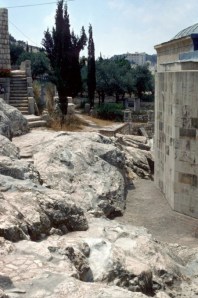
Gethsemane, Rock of Agony, where tradition says Jesus prayed

Gethsemane, Rock of Agony, where tradition says Jesus prayed

By the blood of His sacrifice, God put Jesus forward as a propitiation (an appeasement or satisfaction) for our sins (Romans 3:25, 1 John 2:2, 1 John 4:10).   Hebrews 9, speaking of the way things were before Christ, goes into some detail about the earthly “Most Holy Place” of the Tabernacle (into which only the High Priest could enter with blood to offer).  The word used for the “mercy seat” In Hebrews 9:5 (which was the lid on top of the ark) is the same as is used for “propitiation,” which is to say that it was a covering – a concealment – for the judgment of the law contained therein.

This earthly Holy Place and the Holy things it contained, the Hebrew writer refers to as mere “copies of the heavenly things” which are in Heaven.  By His death and resurrection, Jesus became a new High Priest of a better covenant (Hebrews 4:14-16, Hebrews 7:22).  And Hebrews 9:11-12 explained that by His own blood, He entered once and for all into THE Holy Place, securing an eternal redemption for us.  Thus, Paul says in Romans 7:6, “…now we are released from the law, having died to that which held us captive, so that we serve in the new way of the Spirit and not in the old way of the written code.”

Eternal Life

Paul reminds us in Romans 5:12 that when man first sinned in Genesis 3, death also entered the world (“Therefore, just as sin came into the world through one man, and death through sin, and so death spread to all men because all sinned…”).  Paul told Timothy in 2 Timothy 1:10 that Jesus “abolished death and brought life and immortality to light through the gospel.”

By His resurrection, Jesus was victorious over death; and He brought to us the promise that when He returns, all those who have “fallen asleep” will also be raised, and will come to meet with Him (as well as those who are still alive) (1 Thessalonians 4:14-17).  And then, 1 Corinthians 15:22-26 tells us, “The last enemy to be destroyed is death.”  The Hebrew writer said in Hebrews 2:14-15:

“…he himself likewise partook of the same things, that through death he might destroy the one who has the power of death, that is, the devil, and deliver all those who through fear of death were subject to lifelong slavery.”

How Does One Earn Salvation – This Eternal Life?

The answer, of course, is that one does not earn salvation.  The bad news is that everyone has sinned, and however “small” one may consider his sins to be, God counts no difference between those sins and those we may consider to be the most despicable or callous.  The good news is that Jesus already paid the price for our sins with His death.  It is our faith in Jesus that justifies us through His grace, as told by Paul in Romans 5:1-2:

“Therefore, since we have been justified by faith, we have peace with God through our Lord Jesus Christ. Through him we have also obtained access by faith into this grace in which we stand, and we rejoice in hope of the glory of God.”
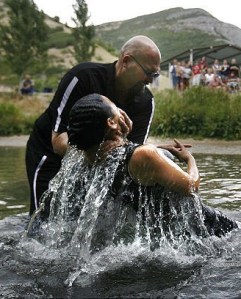
baptismBut the fact that this salvation is freely given to us, does not mean we have no responsibility in the matter.  We must obey His commandments, among which is as Acts 2:38 says: “Repent and be baptized every one of you in the name of Jesus Christ for the forgiveness of your sins…”  Jesus said in Mark 16:16 “Whoever believes and is baptized will be saved, but whoever does not believe will be condemned.”  Peter said in 1 Peter 3:21: “Baptism, which corresponds to this, now saves you, not as a removal of dirt from the body but as an appeal to God for a good conscience, through the resurrection of Jesus Christ.”

Paul gives the best explanation in Romans 6:3-5: “Do you not know that all of us who have been baptized into Christ Jesus were baptized into his death? We were buried therefore with him by baptism into death, in order that, just as Christ was raised from the dead by the glory of the Father, we too might walk in newness of life.”

Staying the Course

If baptism were the end-all of the Christian’s commitment, how easy that would be.  But how easy is it to remain righteous in a world that seems to become more and more wicked?  Well, to be sure, Christians today (especially young people) face new and different challenges in that regard.  But there really is nothing new under the sun (Ecclesiastes 1:9).  We know that is true from reading the Scriptures about the time before the flood (Genesis 6:5-8), about Sodom and Gomorrah (Genesis 18:16-19:29), about God’s patience with the depraved wickedness of the Canaanites (Genesis 15:15-21) – and events all throughout history.  But as Peter tells us as God’s children, Christians “are a chosen race, a royal priesthood, a holy nation, a people for his own possession, that you may proclaim the excellencies of him who called you out of darkness into his marvelous light” (1 Peter 2:9).

Paul proclaimed the great promise in Romans 2:6-8: “…to those who by patience in well-doing seek for glory and honor and immortality, he will give eternal life; but for those who are self-seeking and do not obey the truth, but obey unrighteousness, there will be wrath and fury.”  The Apostle aptly described our course in Romans 12:2:

Do not be conformed to this world, but be transformed by the renewal of your mind, that by testing you may discern what is the will of God, what is good and acceptable and perfect.

/Bob’s boy
___________________
image © V. Gilbert & Arlisle F. Beers

Please note: I did not design the reading plan that I am following in my blog.  All of my comments in this blog, however, are solely my responsibility.  When reading ANY commentary, you should ALWAYS refer first to the scripture, which is God’s unchanging and unfailing word. Reading schedules, as well as a link to the site where you can get the reading plan that I’m currently following for yourself can be found on the “Bible Reading Schedules” page of my website at http://graceofourlord.com.  For questions and help, please see the “FAQ” and “Summaries” pages there.

Psalms 37:21-40 – The Lord Loves Justice

Eastman Johnson - The Lord is my Shepard - Oil...

Eastman Johnson – The Lord is my Shepard – Oil on wood -16.625 x 13.125 in – c 1863 – Scanned from Eastman Johnson: Painting America – fig 76 pg 141 (Photo credit: Wikipedia)

This entire psalm is quite elegant.  To begin with, it is an acrostic.  Verse 1 begins with the first letter of the Hebrew alphabet, verse three with the second letter, and so on.   It is not intuitively apparent, but in addition to being alphabetic, it is an elaborate chiasmus, where verses repeat themes, ideas, etc. in an A-B-B-A structure.  in this case, the entire psalm appears to do so as in this example:

verses 1-11  The Lord is faithful to the righteous
verses 12-15 Righteousness will prevail
verses 16-20 The Lord upholds the righteous
verses 21-24 Righteousness delights the Lord
verses 25-31 The Lord upholds the righteous
verses 32-33 Righteousness will prevail
verses 34-40 The Lord is faithful to the righteous

Robert Alden suggests a much more elaborate Chiasmus within as follow (Alden, Robert l., “Everyman’s Bible Commentary, Vol I”, Moody Publishers, 1958):

“1-8    A    The righteous are exhorted to ignore
the wicked and trust God
9      B    Wait and inherit the land
10-15    C    The righteous inherit but the Lord
destroys the plotting wicked
16    D    The poor are blessed though poor
17    E    The Lord upholds the righteous
18a    F    The Lord guides the righteous
18b    G    The righteous inherit
19    H    The righteous    receive
20a    I    The wicked perish
20b    J    The wicked are like a sacrifice
20c    J    The wicked are like a sacrifice
21a    I    The wicked give not
21b    H    The righteous give
22    G    The blessed inherit
23    F    The Lord guides the righteous
24    E    The Lord upholds
25-26    D    The blessed may be poor but not forsaken
27-33    C    The Lord loves the righteous who
will live and inherit, but the plotting
wicked will die
34    B    Wait and inherit the land
35-40    A    God destroys the wicked but saves the righteous

The basic message of the psalm is the safety and blessing of those who trust in God and the insecurity of the ungodly.”

The second half of this psalm implores us to turn away from the evil ways of the world and strive to do good, give generously, wait for the Lord, and keep His way (verses 21, 27, 34).  Verse 28 says that the Lord loves justice and will not forsake his saints.  The psalmist says he was young and now is old but has never seen the righteous forsaken, or God’s children begging for bread.  There is future for the man of peace, he says.

He is their stronghold in the time of trouble.
the Lord helps them and delivers them;
He delivers them from the wicked and saves them,
because they take refuge in him.

Taking refuge in the Lord means more than just turning to Him in times of trouble.  It means trusting in God, not only when we are fearful, down-trodden or discouraged, but keeping that trust alive through all of the good times and the bad, the joy and the sorrow – all of the days of our lives.   A faith based solely on expectations of protection and comfort is worthless if it is not there also when we must weather the storms.  The key is to remember that He does not abandon us.  Repeated again and again the scriptures exclaim that we must often “wait for the Lord.”  It is the ability to do that with the assurance of hope that keeps us strong and carries us through difficulty.

Read or listen to audio of ESV version of this selection from this link.

/Bob’s boy
___________________
some images © V. Gilbert & Arlisle F. Beers

Please note: I did not design the reading plan that I am following in my blog.  All of my comments in this blog, however, are solely my responsibility.  When reading ANY commentary, you should ALWAYS refer first to the scripture, which is God’s unchanging and unfailing word. Reading schedules, as well as a link to the site where you can get the reading plan that I’m currently following for yourself can be found on the “Bible Reading Schedules” page of my website at http://graceofourlord.com.  For questions and help, please see the “FAQ” and “Summaries” pages there.

Job 14 – Man Flees Like a Shadow

Job concludes his fourth speech with a soliloquy on the brevity of life.  Although, as we have said before, it is often dark in these early chapters, the poetry in Job is clearer and more beautifully eloquent and evident the further along we go.  Of man being few of days and full of trouble, verse 2 says

He comes out like a flower and withers;
he flees like a shadow and continues not

Job still does not understand; and he continues to wonder why God seems to be angry with him.

Oh …that you would conceal me until your wrath be past,
that you would appoint me a set time, and remember me…
All the days of my service I would wait,
till my renewal should come

rushing waterJob feels totally hopeless and is mistakenly certain that it is God who has brought him to this state.  His pitiful condition elicits a heart-wrenching cry of desperation:

But the mountain falls and crumbles away,
and the rock is removed from its place;
the waters wear away the stones;
the torrents wash away the soil of the earth;
so you destroy the hope of man

Job still has not cursed God, but the words are certainly accusatory.  We have to wonder whether God will tire of this.  To that question at least, we will at last get an answer.  But not just yet.

Read or listen to audio of ESV version of this selection from this link.

/Bob’s boy
___________________
some images © V. Gilbert & Arlisle F. Beers

Please note: I did not design the reading plan that I am following in my blog.  All of my comments in this blog, however, are solely my responsibility.  When reading ANY commentary, you should ALWAYS refer first to the scripture, which is God’s unchanging and unfailing word. Reading schedules, as well as a link to the site where you can get the reading plan that I’m currently following for yourself can be found on the “Bible Reading Schedules” page of my website at http://graceofourlord.com.  For questions and help, please see the “FAQ” and “Summaries” pages there.

Psalms 54 and 56 – The Lord Upholds My Life

The superscription of Psalm 54 denotes a time when the Ziphites determined to betray David to Saul in order to gain his favor (1 Samuel 23:15-24).  It is a song of prayer to God for deliverance and praise to Him for being that one on whom we can depend in times of need.  David had just fled Keilah after he and his men had saved them from the Philistines.  The Lord had confirmed to him that even after saving them, they would give him up to Saul (1 Samuel 23:1-14).

woods-001The superscription in Psalm 56 directs the chief musician that the song is performed according to one called “the Dove.”  Adam Clarke translates the Teribinths as the “remote woods.”  We do not know what a “Michtam” is, but many suppose that it means this is “a golden psalm of David,” – golden equating to “precious.”

It also refers to the Philistines seizing him in Gath.  The scriptures do speak of David going to Gath.  One of those times was in 1 Samuel 21, but there is no record of the Philistines seizing him.  But that should not be considered cause to doubt the superscription’s accuracy.  We can be certain that there are many events in David’s life that are not chronicled in the scriptures, just as in the lives of other Biblical patriarchs.  The psalm itself is a song about trust in the Lord, even through times of great trouble and fear, and of maintaining one’s faith throughout it all.

Read or listen to audio of ESV version of this selection from this link.

/Bob’s boy
___________________
some images © V. Gilbert & Arlisle F. Beers

Please note: I did not design the reading plan that I am following in my blog.  All of my comments in this blog, however, are solely my responsibility.  When reading ANY commentary, you should ALWAYS refer first to the scripture, which is God’s unchanging and unfailing word. Reading schedules, as well as a link to the site where you can get the reading plan that I’m currently following for yourself can be found on the “Bible Reading Schedules” page of my website at http://graceofourlord.com.  For questions and help, please see the “FAQ” and “Summaries” pages there.

Proverbs 23 – Buy Truth

At first glance, verse 23 of this chapter seems odd and I actually have given it little thought in the past:

Buy truth, and do not sell it;
buy wisdom, instruction, and understanding

The meaning of this may be obvious to some, but it was not so to me. Acquiring wisdom, instruction, understanding, and especially truth – even at great cost – is certainly advisable, desirable, and to be cherished.  We search diligently for the truth because that is the way of the Lord.  But what is meant by “do not sell it?”  I think it means that we should not let go of truth.  We should not turn away from it, compromise it, and we certainly should not not allow it to be taken from us or perverted – not at any price.

sun-001The price of truth may seem high at times.  It sometimes costs people in terms of relationships – not everyone likes the truth, so they will not acknowledge it.  The truth is light, and those who dwell in darkness hate the light (John 3:20).  It will certainly at times cost us in terms of earthly pleasures.  It has cost people their jobs, their freedom – even in our time.  It cost Stephen and many other Christians their lives (Acts 7:51-60, Romans 8:36).  The truth is not always popular with others, but we as His priests (1 Peter 2:9), are commanded to always speak it to others.  The key is to do as as Ephesians 4:15 says: “speaking the truth in love.”

Read or listen to audio of ESV version of this selection from this link.

/Bob’s boy
___________________
some images © V. Gilbert & Arlisle F. Beers

Please note: I did not design the reading plan that I am following in my blog.  All of my comments in this blog, however, are solely my responsibility.  When reading ANY commentary, you should ALWAYS refer first to the scripture, which is God’s unchanging and unfailing word. Reading schedules, as well as a link to the site where you can get the reading plan that I’m currently following for yourself can be found on the “Bible Reading Schedules” page of my website at http://graceofourlord.com.  For questions and help, please see the “FAQ” and “Summaries” pages there.

Psalm 119:105-112; Psalm 37:1-20 – Trust in the Lord, and do good

nunThis stanza of Psalm 119 begins each line with the fourteenth letter of the Hebrew Aleph-bet, “nun.” The most well-known part of this stanza is verse 105: “Your word is a lamp to my feet and a light to my path.”    This is the eternal truth about God’s word – it is our guiding light for life.

We have broken up Psalm 37 into two readings.  These first 20 verses are written to those of Gold’s people who are trying to live right in a land full of people who increasingly turn their backs on God’s law.  It is a hymn that calls for the righteous not to lose heart when the wicked always seem to prosper as well as seeming to be doing their best to find ways to persecute the righteous.  Christians probably can relate to this reality of living among  pagans in a pagan land much better in this decade that at any time in the last century.  It is natural for those who try to live right to be saddened at times when they see all around them the increasing acceptance of living a wicked and unrighteous life.  Verse 3 is the answer – keep doing what is right no matter what, and trust in the Lord.  The wicked will “soon fade like the grass and wither like the green herb” (verse 2); and as for the righteous, “their heritage will remain forever” (verse 18).

We’ll look at the second half of this psalm, and make a slight examination of its structure on Friday.

Read or listen to audio of ESV version of this selection from this link.

/Bob’s boy
___________________
some images © V. Gilbert & Arlisle F. Beers

Please note: I did not design the reading plan that I am following in my blog.  All of my comments in this blog, however, are solely my responsibility.  When reading ANY commentary, you should ALWAYS refer first to the scripture, which is God’s unchanging and unfailing word. Reading schedules, as well as a link to the site where you can get the reading plan that I’m currently following for yourself can be found on the “Bible Reading Schedules” page of my website at http://graceofourlord.com.  For questions and help, please see the “FAQ” and “Summaries” pages there.

Understanding the Cross of Christ – Part 5 (The Anointed One and His Sacrifice)

This series began in Part One as a search for a more meaningful answer to an aspiring young Christian’s question: “Why did God send His only son to die?”  The short answer “to save us from our sins,” while correct, really only serves to raise more questions.  In part 2, we looked at what sin is, why it matters so much to God, and why it should matter to us.  In part 3, we delved into God’s response to sin.  In all of that discussion, we have made great mention of the fact that God has a plan for our salvation.  In part 4, we looked at how Jesus really fits into that plan.  But what were God’s people looking for in a Messiah?  And why did God plan such a horrible death for Him?

The “Missed” Messiah

John 1:29-41

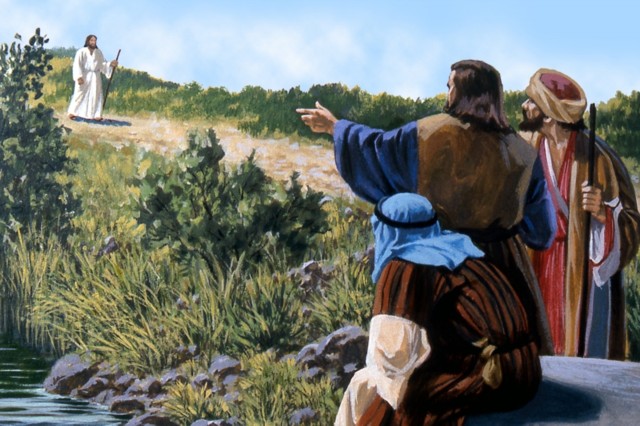
John the Baptist told his disciples that Jesus was the Lamb of God, the Messiah, God’s Son, who would give his life for his followers — John 1:29-41

The Jews had been waiting for the Messiah to come for thousands of years.  But what kind of Messiah were they expecting – especially during the time that Jesus actually did come?  By and large, what many of them were hungry for in a Messiah was one that would lead Israel to greatness as a power in the world.  After all, he was to be the son of David.  They wanted him to be a great military leader that would first defeat the Romans who ruled and oppressed them.

But for people at that time,  getting them out from under the thumb of Roman rule was just the beginning.  They wanted a king that would eventually lead them to be the kind of power in the world that Israel enjoyed being during the reign of David – mighty and feared – possibly even to replace the Romans as the great power of the world.

In Matthew 2:1-5, when Herod learned of the birth of the Christ, the chief priests and scribes quoted Micah 5:2 in Matthew 2:6, saying:

“And you, O Bethlehem, in the land of Judah,
are by no means least among the rulers of Judah;
for from you shall come a ruler
who will shepherd my people Israel.”

So Herod feared for his position, because he too assumed this Messiah would be a king of an earthly kingdom.  In John 6:15, when Jesus was at the height of his popularity with the people, the multitudes were ready to make that kingship a reality in their own way:

“Perceiving then that they were about to come and take him by force to make him king, Jesus withdrew again to the mountain by himself.”

And in Acts 1:6, just before Jesus ascended to heaven, the apostles (not yet having received the Holy Spirit) demonstrated that they still didn’t “get it” either: (“So when they had come together, they asked him, ‘Lord, will you at this time restore the kingdom to Israel?’”).  So focused were so many of the people of that time on an earthly kingship for the Messiah, that they overlooked completely prophecies such as that of the “Suffering Servant” in Isaiah 53 or others such as Psalm 16:8-11 (“you will not abandon my soul to Sheol, or let your holy one see corruption”) that clearly predicted a different course for God’s anointed.

Sadly, many of those who longed most for the coming of the Messiah completely missed Him, when he was right under their very noses.

Why Death on a Cross?

Although the crucifixion of Jesus is the most famous of all time, it was not an uncommon means of execution from about 500 BC until the 4th century AD – one that was used by the Romans, certain Greek-Macedonian states, and the Carthaginian empire, to name a few.  The Jews of Jesus’ time would have been very familiar with this means of execution.  This brutal and very public display of execution was usually reserved for those who committed the most heinous of crimes.  It was abolished by Emperor Constantine I in about 337 AD.

English: The Crucifixion, Genoa Svenska: "...

English: The Crucifixion, Genoa Svenska: “Korsfästelsen”. Chiesa del Gesù, Genua. (Photo credit: Wikipedia)

So with respect to fulfilling the Scriptures concerning the suffering that the Messiah would have to endure, crucifixion fit into that plan perfectly, as only an execution inflicted with torture could.  A quick death by some other means (such as beheading in the case of the apostle James (Acts 12:1-5) ), while certainly painful, would not serve to accomplish the intense suffering prophesied in such passages as in Isaiah 53, nor the wounding predicted in that same passage and others such as Zechariah 12:10.  Accompanied by the beatings and scourging (Matthew 27:25-26, John 19:1), it also fulfilled the prophecy in Isaiah 52:13-14 of the Messiah being so disfigured from them that He was hardly recognizable.  Moreover, being “lifted up” on the cross was the fate Jesus prophesied for Himself (John 3:14-15, Matthew 20:17-19, John 8:28), as well as that prophesied in Isaiah 52:13.

What Did the Death of Jesus Really Cost?

It is important to understand how much love was involved in the sacrifice of Jesus on that cross.  Almost everyone in our society has at least heard John 3:16 quoted (“For God so loved the world, that he gave his only Son, that whoever believes in him should not perish but have eternal life”).  But how often is that verse quoted without much thought behind it?   After all, He was the Son of God, right?  It is easy to forget how much He gave up, and how human He became for us.  To be sure, God reveals to us what we need to know, but He does not reveal everything there is to know about many things; and that includes His relationship as the Father to Jesus as the Son.

Jesus clearly speaks of himself and God as separate entities (John 5:30).  God also does the same in such verses as Matthew 3:16-17 (“This is my beloved Son, with whom I am well pleased.”).   Yet John 1:1 makes it clear that Jesus (“the Word”) was God.  Peter (2 Peter 1:1) and Paul (Titus 2:11-13) both tell us that Jesus is “God and Savior.”  Philippians 2:5-6 speaks of Jesus having been in the form of God and having equality with God.  Even Thomas, having his doubt removed after the resurrection, recognized this as he exclaimed in John 20:28“My Lord and my God!”   So the answer, in our limited ability to understand such things, is that Jesus was both God and a separate being – the Son.

The relevance of all of this to the willing sacrifice of Jesus is that God’s love for us prompted Him to have His only Son – and in a very real sense (the depths of which we cannot fully understand) a part of Himself – to come into this world as a physical man, to live and love as a man, to feel pain and sorrow just as we do, and to suffer and die a cruel and tortuous death at the hands of the very people He was trying to save.

In Part 6, we will conclude this series with a look at more of what Jesus’ death and resurrection accomplished, as well as what is required of us to gain our salvation.

/Bob’s boy
___________________
image © V. Gilbert & Arlisle F. Beers

Please note: I did not design the reading plan that I am following in my blog.  All of my comments in this blog, however, are solely my responsibility.  When reading ANY commentary, you should ALWAYS refer first to the scripture, which is God’s unchanging and unfailing word. Reading schedules, as well as a link to the site where you can get the reading plan that I’m currently following for yourself can be found on the “Bible Reading Schedules” page of my website at http://graceofourlord.com.  For questions and help, please see the “FAQ” and “Summaries” pages there.