Psalm 119:129-136; Psalm 15 – He Who Walks Blamelessly

peThis stanza of Psalm 119 begins each verse with the 17th letter of the Aleph-Bet, “pe” or “peh.”  The pictograph for this letter resembles a mouth, which (as often occurs with these stanzas) goes with part of the text (note verse 131).   Verse 135 (“Make your face shine upon your servant”) reminds us of the Lord’s blessing on Aaron in Numbers 6:23-25.

Some commentators have speculated that Psalm 15 was written by David after his first failed attempt to move the Ark of the Covenant (1 Chronicles 13) and before the second (1 Chronicles 15).  That seems as likely a guess as any.  But as for relevance to us today, it seems clear that the psalm reminds us that in our walk with the Lord, He cares very much about whether we are truthful, honorable, generous, and compassionate to each other (verses 2-3, 5).

Read or listen to audio of ESV version of this selection from this link.

/Bob’s boy
___________________
some images © V. Gilbert & Arlisle F. Beers

Please note: I did not design the reading plan that I am following in my blog.  All of my comments in this blog, however, are solely my responsibility.  When reading ANY commentary, you should ALWAYS refer first to the scripture, which is God’s unchanging and unfailing word. Reading schedules, as well as a link to the site where you can get the reading plan that I’m currently following for yourself can be found on the “Bible Reading Schedules” page of my website at http://graceofourlord.com.  For questions and help, please see the “FAQ” and “Summaries” pages there.

O T Facts (Second Book of Law) – Exodus

Exodus

The book’s name comes from the Greek noun exodos, meaning “a going out” or “departure.”  God leads His people out of Egypt by way of Moses, has the Tabernacle constructed, and dwells among His people.

On the first Passover, the Israelites who painted their doorways with blood were passed over when the angel of death came through the land of Egypt (Exodus 11).

On the first Passover, the Israelites who painted their doorways with blood were passed over when the angel of death came through the land of Egypt (Exodus 11).

Exodus 3 – the burning bush – God calls Moses to do His will

Exodus 4 – Moses returns to Egypt

Exodus 7:14 – 10:29 – Plagues 1 through 9

Exodus 11-12 – 10th plague and the Passover

Exodus 14 – Crossing of the Red Sea

Exodus 19 – Arrival at Mount Sinai

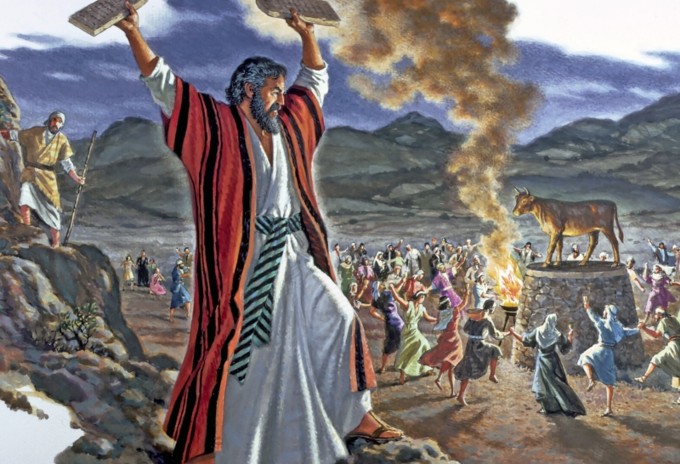
golden_calfExodus 20 – The Ten Commandments given

Exodus 24 – The Covenant Confirmed

Exodus 25 – 31 – Instructions for the Tabernacle, Ark of the Covenant

Exodus 32 – Covenant breach \ the golden calf

Exodus 36 -39 – Tabernacle Constructed

Moses makes the tabernacle in the wilderness

Moses makes the tabernacle in the wilderness

Exodus 40 – Assembly of the Tabernacle \ the Glory of the Lord

/Bob’s boy
___________________
image © V. Gilbert & Arlisle F. Beers

Please note: I did not design the reading plan that I am following in my blog.  All of my comments in this blog, however, are solely my responsibility.  When reading ANY commentary, you should ALWAYS refer first to the scripture, which is God’s unchanging and unfailing word. Reading schedules, as well as a link to the site where you can get the reading plan that I’m currently following for yourself can be found on the “Bible Reading Schedules” page of my website at http://graceofourlord.com.  For questions and help, please see the “FAQ” and “Summaries” pages there.

Psalms 50 – God Himself is Judge

This is the first of 12 “songs of Asaph.”  Asaph was one of David’s chief musicians (1 Chronicles 16:7), and undoubtedly did write some of the psalms (2 Chronicles 29:30), although it is not certain that he wrote all 12 of these, or simply was known to sing some of them.  Most commentators agree however that this one was likely written by him.  Adam Clarke said “The style of David is more polished, flowing, correct, and majestic, than that of Asaph, which is more stiff and obscure.”

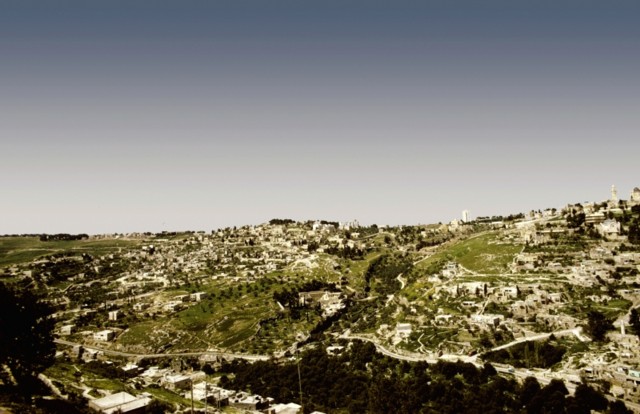
Mount Zion, Aceldama, Akeldama, or Hakeldamia, the Field of Blood.

Mount Zion, Aceldama, Akeldama, or Hakeldamia, the Field of Blood.

Some say that this is a prophetic psalm concerning the Messiah, and that does have some merit.  Verse 2 (“Out of Zion, the perfection of beauty,God shines forth”) seems akin to Isaiah 2:3 (“For out of Zion shall go the law, and the word of the Lord from Jerusalem”).  In the latter, “the word” obviously is Jesus (John 1:14).  And in verses 8-14, God tells His chosen ones that He neither needs nor wants their sacrifices (which we are reminded in Hebrews 10:5-7).

He rebukes the wicked among them in verses 16-22 for believing they can live their lives doing any sort of sinful act, as long as they make their sacrifices to atone for it.  God hates fake worship; and the verses are just as relevant for us today.  Too many of us live as pagans Monday through Saturday night, yet still consider themselves Christians on Sunday, as long as they go to worship services.  God will judge us for how we live our daily lives, and His salvation is for he who “orders his way rightly” (verse 23).

Read or listen to audio of ESV version of this selection from this link.

/Bob’s boy
___________________
some images © V. Gilbert & Arlisle F. Beers

Please note: I did not design the reading plan that I am following in my blog.  All of my comments in this blog, however, are solely my responsibility.  When reading ANY commentary, you should ALWAYS refer first to the scripture, which is God’s unchanging and unfailing word. Reading schedules, as well as a link to the site where you can get the reading plan that I’m currently following for yourself can be found on the “Bible Reading Schedules” page of my website at http://graceofourlord.com.  For questions and help, please see the “FAQ” and “Summaries” pages there.

Job 16 – God Has Worn Me Out?

In the speech that Eliphaz had finished, the only new invective was that of adding to the list of Job’s supposed sins that he  is also an extreme hypocrite due to his refusal to admit his wickedness.  Job addresses them as the “miserable comforters” they are and declares that if their roles were reversed, he would try to ease their pain instead of making them more miserable.  He would rather they would have just kept silent as when they first arrived.

Depressed_002In the following verses, while he says that God has worn him out, and that his state bears witness of his sins in the eyes of those around him, he seems to have at last concluded that it is not God Himself that has done all of these things to him.  Instead, he says that God has allowed it to happen, and that he has given him up to the hands of the wicked and evil that are tormenting him (verse 11).   And the fact that he still believes that he is not wicked both confuses and saddens him.

How utterly hopeless a feeling it must be to believe that in the face of all that tragedy, not only has mankind turned their backs on him, but the Lord has abandoned him as well.  Now, it sounds like all that he has to look forward to is a few more years just waiting to die.  Job is deep in the clutches of depression, the depth of which we could never really know.

But that is not the whole story here.  In the midst of all this depression and despair, Job not only has hope, he is certain about his assurance.  Job feels that God has abandoned him to evil, yet he speaks with certainty in verses 19-21 of one who will intercede for him: “Even now, behold, my witness is in heaven, and he who testifies for me is on high.” And then: “my eye pours out tears to God, that he would argue the case of a man with God.”

Through it all, Job know through divine inspiration, that it is God Himself that will intercede for him.

Read or listen to audio of ESV version of this selection from this link.

/Bob’s boy
___________________
some images © V. Gilbert & Arlisle F. Beers

Please note: I did not design the reading plan that I am following in my blog.  All of my comments in this blog, however, are solely my responsibility.  When reading ANY commentary, you should ALWAYS refer first to the scripture, which is God’s unchanging and unfailing word. Reading schedules, as well as a link to the site where you can get the reading plan that I’m currently following for yourself can be found on the “Bible Reading Schedules” page of my website at http://graceofourlord.com.  For questions and help, please see the “FAQ” and “Summaries” pages there.

Psalms 57 – Cry Out to God Most High

According to the superscription of this psalm, it was one  written by David when he fled from Saul “in the cave” – possibly on the occasion of either 1 Samuel 22:1 or 1 Samuel 24:1-3, more likely the former.  It is hard to imagine the despair that David felt as he had to hide himself in fear for his very life, appealing to God “My soul is in the midst of lions; I lie down amid fiery beasts…”

Public domain image from www.public-domain-image.comVerse one is another of the several verses found in the psalms (17:8, 36:7, and 63:7, for example) and elsewhere that refer to a place of safety as being “in the shadow of your wings.”  In verses 1-6, David makes his “cry out to God most high” in prayer for His help.  But even in so doing, he expresses his faith in the Lord saying “I will take refuge, till the storms of destruction pass by.”  When we have done all that we can do, we must learn to trust in Him.

Then in verses 7-11, he finishes his prayer renewed with strength, and praises God for his comfort and steadfast love.  The refrain of the song, found in verse 5 is returned to in verse 11:

Be exalted, O God, above the heavens!
Let your glory be over all the earth!

It is a song that is a model for prayer most appropriate at times of despair, fear, or oppression – any time that we need to “cry out to God most high” as we often do, remembering as we make our plea, that He hears us and that He deserves our praise for all that He is and does.

Read or listen to audio of ESV version of this selection from this link.

/Bob’s boy
___________________
some images © V. Gilbert & Arlisle F. Beers

Please note: I did not design the reading plan that I am following in my blog.  All of my comments in this blog, however, are solely my responsibility.  When reading ANY commentary, you should ALWAYS refer first to the scripture, which is God’s unchanging and unfailing word. Reading schedules, as well as a link to the site where you can get the reading plan that I’m currently following for yourself can be found on the “Bible Reading Schedules” page of my website at http://graceofourlord.com.  For questions and help, please see the “FAQ” and “Summaries” pages there.

Proverbs 25 – The Glory of God

I have to admit that sometimes it is my inclination, whenever I encounter a verse or two that I just don’t understand, to just move on to another.  And I am certain also that I am not alone in that regard, especially when it comes to the Book of Proverbs.  There is so much wisdom contained in these words from God that we cannot simply open our eyes and our minds and just breathe them all in with complete understanding the way they are “breathed out” by God.  Verse 2 is just such a verse for me.

It is the glory of God to conceal things,
but the glory of kings is to search things out

heavens_005But this one gnawed at me, and I was determined not to just let it go for now.  After searching my heart, the scriptures, and more than a couple of commentaries, I am still not sure I totally get it.  But maybe I am closer than when I started.  Deuteronomy 29:29 reads “The secret things belong to the Lord our God, but the things that are revealed belong to us and to our children forever, that we may do all the words of this law.”  What secret things?  And what would God conceal?

So let’s try to make this just as clear as mud now.  In 2 Corinthians 12:2-4, Paul tells the Corinthians of an experience of “a man” in third person, of which he is clearly the subject – that of being caught up into heaven.  The text says it happened 14 years earlier, which would make it around 41-42 A.D. – after leaving Damascus. We are not told of any specific vision Paul had at that time, although he surely had many.

The salient point for this discussion however is where verse 4 says “he heard things that cannot be told, which man may not utter.”   It is also true that Jesus told us that God has concealed understanding of the mysteries of the kingdom from those who consider themselves wise – and that he has revealed them to the “little children” (Matthew 11:25, Matthew 13:10-17).

Speculating from now until judgment day as to what Paul saw and heard will not get us any closer to the truth – except to know that there are things not of this “world” that we do not yet know, and some that many or all of us perhaps never will.  But we can all search for the truth in God’s word with our hearts and minds open; and we may find a truth that was hidden from us the last time we searched.  That is the reason we do daily Bible reading; and it is the reason that it is fruitful to do so.  We will never run out of something to learn.

Lean not upon your own understanding…

Read or listen to audio of ESV version of this selection from this link.

/Bob’s boy
___________________
some images © V. Gilbert & Arlisle F. Beers

Please note: I did not design the reading plan that I am following in my blog.  All of my comments in this blog, however, are solely my responsibility.  When reading ANY commentary, you should ALWAYS refer first to the scripture, which is God’s unchanging and unfailing word. Reading schedules, as well as a link to the site where you can get the reading plan that I’m currently following for yourself can be found on the “Bible Reading Schedules” page of my website at http://graceofourlord.com.  For questions and help, please see the “FAQ” and “Summaries” pages there.

Psalm 119:121-128; Psalm 76 – Who Can Stand Before You?

ayinThis stanza of Psalm 119 begins each line with the 16th letter of the Hebrew Aleph-Bet, “ayin.”  The psalmist repeats three times the reference to himself as God’s servant.  In 121, he declares his faithfulness to God as that servant, asking Him for deliverance from those which oppress him.  In verse 126, he urges the Lord to act now because his laws have been broken.  Whether this refers to a specific occasion or simply the general state of God’s people at the time, we are not told, but it hardly matters.  It is a prayer to God for His justice.

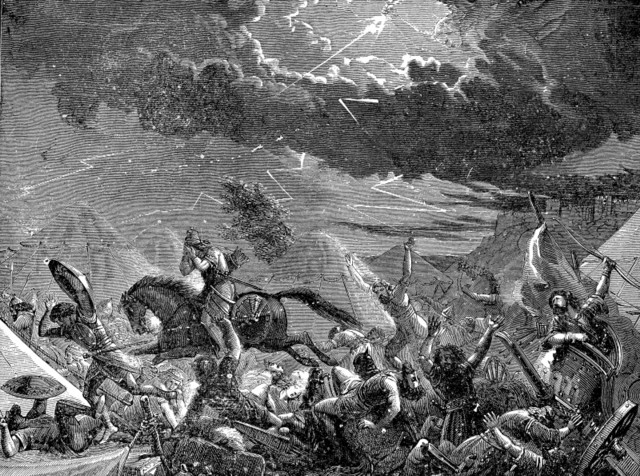
It is the general consensus of most commentators that Psalm 76 centers around God’s destruction of Sennacherib‘s army during the time of Hezekiah.  This would make “Asaph” in the superscription actually be those Levite descendants which were so named.  The complete destruction and defeat described in verses 3-8 fits this line of thought.

Sennacherib's army

Miraculous destruction of Sennacherib’s army.

Salem in verse 2 is the name of the kingdom city of Melchizedek (Genesis 14:18), and it is used synonymously with Jerusalem, especially in reference to Adonizedek (see Joshua 10:1-3).  The references to the wrath of man praising God in verse 10, and the following verses about the victory of God’s people over the kings of man, echo well the insolence of Sennacherib being his downfall.  His anger with God’s people brought him to pit an assault on God’s people with an army led by blasphemous representatives (2 Kings 18:17-36).   Sennacherib’s defiance and mockery of the Lord were followed by Isaiah’s prophecy of his downfall and the subsequent crushing of his army by the angel of the Lord (2 Kings 19:14-36, Isaiah 37:36).

Read or listen to audio of ESV version of this selection from this link.

/Bob’s boy
___________________
some images © V. Gilbert & Arlisle F. Beers

Please note: I did not design the reading plan that I am following in my blog.  All of my comments in this blog, however, are solely my responsibility.  When reading ANY commentary, you should ALWAYS refer first to the scripture, which is God’s unchanging and unfailing word. Reading schedules, as well as a link to the site where you can get the reading plan that I’m currently following for yourself can be found on the “Bible Reading Schedules” page of my website at http://graceofourlord.com.  For questions and help, please see the “FAQ” and “Summaries” pages there.

O T Facts (First Book of Law) – Genesis

In this installment of our Old Testament Facts series, we will focus today on the first book of the Pentateuch – Genesis, the first “Book of Law.”   This is not intended to be an exhaustive list of events of this book.  Rather, it is presented as a summary of events that seem most relevant to worship of the Lord and the ultimate coming of Jesus the Christ.

Creation_003Genesis

The book of the beginning and of new beginnings

Genesis 1 – Creation of the universe

Genesis 2 – Adam and Eve created

Genesis 3 – “The fall” – sin enters the world; first promise of the Messiah (Gen 3:15)

Genesis 4 – Cain murders Abel

Genesis 6–9 – Noah and the flood

Mamre, near Hebron. Abraham's home at one time

Mamre, near Hebron. Abraham’s home at one time

Genesis 12 and 15 – God’s covenant with Abraham (promise of land, a “great nation” and the Messiah)

Genesis 21 – Birth of Isaac

Genesis 32:28, Gen 35 – God names Jacob “Israel” (meaning God fights)

Genesis 37 – Joseph sold into slavery

Genesis 41 – Joseph rises to power in Egypt under Pharoah

Genesis 46 – Joseph brings his family to Egypt, is reunited with Jacob

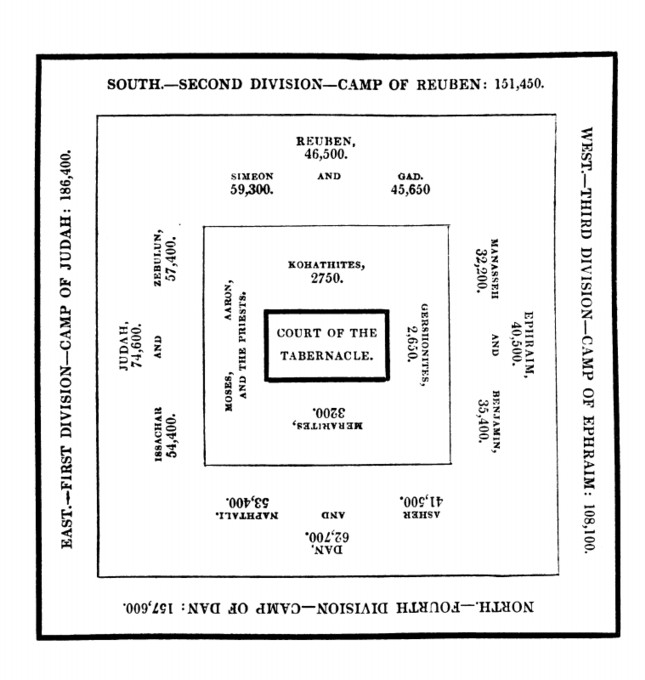
Tabernacle - arrangement of tribes

Tabernacle – arrangement of tribes

Genesis 48 – Jacob (Israel) blesses Joseph’s sons Ephraim and Manasseh, claims them as “his” (Gen 48:5-6), again favoring the younger (Ephraim) over the first-born (Genesis 48:14-20).

Genesis 49 – Jacob blesses his sons, but declares that Simeon and Levi (their descendants) will be scattered among the other tribes (Gen 49:5-7).  So the Twelve Tribes of Israel are named – to include Ephraim and Manasseh (Genesis 49:3-28).  Jacob’s death and burial (Genesis 49:29-50:14).

Genesis 50:22-26 – Death of Joseph – end of Genesis

/Bob’s boy

___________________
image © V. Gilbert & Arlisle F. Beers

Please note: I did not design the reading plan that I am following in my blog.  All of my comments in this blog, however, are solely my responsibility.  When reading ANY commentary, you should ALWAYS refer first to the scripture, which is God’s unchanging and unfailing word. Reading schedules, as well as a link to the site where you can get the reading plan that I’m currently following for yourself can be found on the “Bible Reading Schedules” page of my website at http://graceofourlord.com.  For questions and help, please see the “FAQ” and “Summaries” pages there.

Psalms 51 – The sacrifices of God are a broken spirit

EnstromAccording to the superscript, the occasion of this psalm was when the prophet Nathan came to rebuke David for his sinful affair with Bathsheba and the premeditated murder of her husband and David’s loyal soldier and friend, Uriah the Hittite (2 Samuel 12:1-14).  It is a psalm of prayer from one who has committed grievous sin, and who makes no excuse for it.  As a prayer, the psalm is a great model for us, because it shows us the correct attitude one must have toward his own sins, and in asking God for His forgiveness.

God does not take sin lightly, but He does forgive us for our sins when we come to Him with a truly repentant and contrite heart.    It is with a properly broken spirit that David says “I know my transgressions, and my sin is ever before me. Against you, you only, have I sinned and done what is evil in your sight.”  David knows that no sacrifice or burnt offering would appease God in this case, and that God has no interest in it; and he says that “the sacrifices of God are a broken spirit; a broken and contrite heart, O God, you will not despise” (verse 17).

Read or listen to audio of ESV version of this selection from this link.

/Bob’s boy
___________________
some images © V. Gilbert & Arlisle F. Beers

Please note: I did not design the reading plan that I am following in my blog.  All of my comments in this blog, however, are solely my responsibility.  When reading ANY commentary, you should ALWAYS refer first to the scripture, which is God’s unchanging and unfailing word. Reading schedules, as well as a link to the site where you can get the reading plan that I’m currently following for yourself can be found on the “Bible Reading Schedules” page of my website at http://graceofourlord.com.  For questions and help, please see the “FAQ” and “Summaries” pages there.

Job 15 – Eliphaz Accuses Job

pointing_fingerEliphaz takes the floor again and accuses Job of both impiety and of turning his spirit against God with his words (verse 13) – which Eliphaz only considers as Job’s craftiness, trying to justify himself in the face of his sins.  He rebukes Job for his attitude toward him and his other two friends, speaking indignantly of it and implying that Job seems to believe that he is smarter than they are (verse 9).

Eliphaz then goes into detail about his own knowledge of the ways of wicked men and their abominable behavior and utter disregard for either their fellow man or the Lord Himself.  In verse 21, he states that the wicked who are prosperous will be brought down very low because of their sins.  And in the remainder of the chapter, he implies that Job has much worse to dread in the coming days because of his lack of fear for the Lord.  It is a very bleak picture that this “friend” paints for Job, and a stinging assault on his integrity, which is all that Job feels he has left.  And now Eliphaz would take even that away from him.

How thoughtless and destructive man’s words can be for his fellow man even when they are at their lowest.

Read or listen to audio of ESV version of this selection from this link.

/Bob’s boy
___________________
some images © V. Gilbert & Arlisle F. Beers

Please note: I did not design the reading plan that I am following in my blog.  All of my comments in this blog, however, are solely my responsibility.  When reading ANY commentary, you should ALWAYS refer first to the scripture, which is God’s unchanging and unfailing word. Reading schedules, as well as a link to the site where you can get the reading plan that I’m currently following for yourself can be found on the “Bible Reading Schedules” page of my website at http://graceofourlord.com.  For questions and help, please see the “FAQ” and “Summaries” pages there.