
Psalm 119-169-176, Psalm 87 – This one was born there

tawWe conclude our study of Psalm 119 with this final stanza that begins each verse with the 22nd letter of the Aleph-Bet, the Hebrew letter “taw.”  Most appropriately, this stanza of the psalm has the psalmist acknowledging what we knew all along – that he, like everyone, is a sinner and in need of God’s mercy and forgiveness (verse 176).

Psalm 87 is another psalm of the sons of Korah.  The hymn, “Glorious Things of Thee Are Spoken,” by John Newman and Franz Joseph Haydn, is based on this psalm.  It is a prophecy of a time when Jerusalem will become the birthplace of all nations through Him that will arise from there, as in birth.  “Rahab” mentioned in verse three is another word for Egypt, and all of the other cities listed there are bitter enemies of Israel.  It is an illustration of the fact that all nations will serve God one day.

Read or listen to audio of ESV version of this selection from this link.

/Bob’s boy
___________________
some images © V. Gilbert & Arlisle F. Beers

Please note: I did not design the reading plan that I am following in my blog.  All of my comments in this blog, however, are solely my responsibility.  When reading ANY commentary, you should ALWAYS refer first to the scripture, which is God’s unchanging and unfailing word. Reading schedules, as well as a link to the site where you can get the reading plan that I’m currently following for yourself can be found on the “Bible Reading Schedules” page of my website at http://graceofourlord.com.  For questions and help, please see the “FAQ” and “Summaries” pages there.
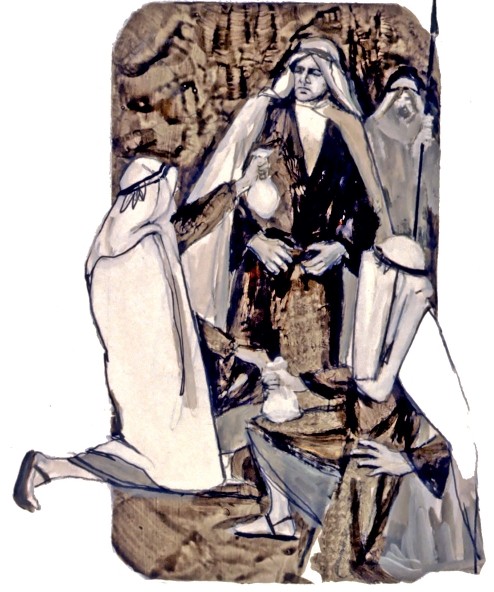
Book of Numbers (Part 3) – Balak, Balaam, and Boundaries

The key events of chapters 20 -35, as listed below, include some very important events, as well as some defining moments. In chapter 20, both Miriam and Aaron die.  This chapter is also where Moses strikes the rock for the second time – this time not following God’s command – the event for which neither Moses nor Aaron will be allowed to enter the Promised Land. Other key events in the following chapters include that of the bronze snake, apostasy at Peor (see this previous post for comments on those two events), victories over Canaan, prescription of the land boundaries, and much more.

The Move From Kadesh to the Plains of Moab

Balak and Balaam

  • Messengers from King Balak of Moab offer riches to the prophet Balaam to come to Moab and curse the Israelites (Numbers 22:1-20).

    Messengers from King Balak of Moab offer riches to the prophet Balaam to come to Moab and curse the Israelites (Numbers 22:1-20).

    Balaam rejects Balak’s first summons – Numbers 22:7-14

  • Balaam and the donkey – Numbers 22:22-35
  • Balak meets with Balaam – Numbers 22:36-40

Balaam blesses Israel

Baal worship at Peor – Numbers 25:1-18

The Second Census – Numbers 26

Laws for the land

Schedule of feasts and sacrifices

The serious commitment of vows

Vengeance on Midian – Numbers 31

Settlement in TransJordan – Numbers 32

Locating events in the Book of Numbers

Locating events in the Book of Numbers

Summary of Journey  (Egypt to Canaan) – Numbers 33

Boundaries ordained for Canaan

/Bob’s boy
___________________
image © V. Gilbert & Arlisle F. Beers

Please note: I did not design the reading plan that I am following in my blog.  All of my comments in this blog, however, are solely my responsibility.  When reading ANY commentary, you should ALWAYS refer first to the scripture, which is God’s unchanging and unfailing word. Reading schedules, as well as a link to the site where you can get the reading plan that I’m currently following for yourself can be found on the “Bible Reading Schedules” page of my website at http://graceofourlord.com.  For questions and help, please see the “FAQ” and “Summaries” pages there.

Psalm 82 – Rescue the Weak and Needy

scales01This psalm is a community lament against the unjust rulers of Israel.  Because of the unfortunate rendering of the word “gods” in the text, some have supposed this to be a reference to angels on earth.  But it merely refers to those who are in a position of authority on earth by God’s will and are therefore His representatives – whether they behave as such or not.    The psalm is a plea to God for justice for those who are weak and for the poor who suffer at the hands of those who are blessed with better stations in life.  Because God does indeed demonstrate throughout the scriptures how very much He cares for the poor, the psalmist is rightly certain that this plea will be heard and answered by the judge most high:

“Arise O God, judge the earth;
for you shall inherit all the nations!”

Read or listen to audio of ESV version of this selection from this link.

/Bob’s boy
___________________
some images © V. Gilbert & Arlisle F. Beers

Please note: I did not design the reading plan that I am following in my blog.  All of my comments in this blog, however, are solely my responsibility.  When reading ANY commentary, you should ALWAYS refer first to the scripture, which is God’s unchanging and unfailing word. Reading schedules, as well as a link to the site where you can get the reading plan that I’m currently following for yourself can be found on the “Bible Reading Schedules” page of my website at http://graceofourlord.com.  

Job 21 – Why Should I Not Be Impatient?

evil01Job’s disagreement with his three friends intensifies with indignation an it is born of sound reasoning.  He first tells them to keep their tongues and listen to his rebuttal, then urges them to continue to mock him if they must afterward.  He flatly disagrees with their assessment of the fortunes of those who are wicked, as well as its affect on their children:

Why do the wicked live,
reach old age, and grow mighty in power?
Their offspring are established in their presence,
and their descendants before their eyes.
Their houses are safe from fear,
and no rod of God is upon them.

He asks them for more personal knowledge of how often the wicked are repaid in this life for their deeds, or when they have known God to dole out pain in His anger.  He disputes their claim that God stores up their iniquity for their children,  Job believes in a just God and he makes that clear when he asks who among them will teach God knowledge of justice against the wicked.  One, he says dies with his life full, while another dies without tasting prosperity – but they are dust in the end just the same.

He asks them to ferret out testimony from any front – the wicked are indeed spared from calamity often and escape wrath with frequency in this life, and their stance on this matter does not bear up under scrutiny.  At last he closes this speech with the condemnation they deserve:

“How then will you comfort me with empty nothings?
There is nothing left of your answers but falsehood.”

Read or listen to audio of ESV version of this selection from this link.

/Bob’s boy
___________________
some images © V. Gilbert & Arlisle F. Beers

Please note: I did not design the reading plan that I am following in my blog.  All of my comments in this blog, however, are solely my responsibility.  When reading ANY commentary, you should ALWAYS refer first to the scripture, which is God’s unchanging and unfailing word. Reading schedules, as well as a link to the site where you can get the reading plan that I’m currently following for yourself can be found on the “Bible Reading Schedules” page of my website at http://graceofourlord.com.  For questions and help, please see the “FAQ” and “Summaries” pages there.

Psalms 74 – Arise O God, Defend Your Cause

Nebuchadnezzar_002It is hard to imagine that this lament psalm could have been written about anything other than the fall of Jerusalem.  In fact, Burton Coffman’s assessment (Coffman, James Burton. “Commentary on Psalms 74”, “Coffman Commentaries on the Old and New Testament”) was that it must have been one of three occasions.  The first possibility is of course the 587 BC destruction of the Temple and the city by Nebuchadnezzar (2 Kings 24).   The second seems much less likely – the 351 BC suppression of a Jewish uprising by Persian King Artaxerxes.  Although the third possibility seems a bit more credible – the profaning of the Temple by Antiochus Epiphanes in 167 B.C – the first seems to fit much better (verse 7 notwithstanding).

Though the superscription assigns this psalm to Asaph, in actuality it would be the “sons” (descendants) of Asaph that were responsible; and the likelihood that it is a prophetic psalm seems quite high.  The psalmist appears to obviously see the destruction to come, yet pleads for hope that it may not all come to pass.  He asks God to remember the covenant and Mount Zion; and to “redeem the tribe” of His heritage.

This moving psalm is very appropriate for any community lament, as the psalmist combines fervor for God’s justice and vengeance against those who scoff, with praise for His power, might, and sovereignty:

Yet God my King is from of old,
working salvation in the midst of the earth…
Yours is the day, yours also the night;
you have established the heavenly lights and the sun.
You have fixed all the boundaries of the earth;
you have made summer and winter.

Read or listen to audio of ESV version of this selection from this link.

/Bob’s boy
___________________
some images © V. Gilbert & Arlisle F. Beers

Please note: I did not design the reading plan that I am following in my blog.  All of my comments in this blog, however, are solely my responsibility.  When reading ANY commentary, you should ALWAYS refer first to the scripture, which is God’s unchanging and unfailing word. Reading schedules, as well as a link to the site where you can get the reading plan that I’m currently following for yourself can be found on the “Bible Reading Schedules” page of my website at http://graceofourlord.com.  For questions and help, please see the “FAQ” and “Summaries” pages there.
 

Proverbs 30 – Lest He Rebuke You

Chapter 30 begins another section of the book of Proverbs, actually ending the format that began in chapter 10.  The superscription says that these are “the words of Agur son of Jakeh.”  Some believe this may be a nickname for Solomon, but that seems unlikely, as the writing style is completely dissimilar.  There is nothing else in the scriptures that mentions this Agur.  The claim by this writer that he is stupid is surely not true.  The wisest thing that this blogger notes in his writing is from verses 5-6:

Every word of God proves true;
he is a shield to those who take refuge in him.
Do not add to his words,
lest he rebuke you and you be found a liar.

Creation_005All of the word of God is important without question.  But when word tells us essentially the same thing more than once in different Scriptures, it behooves us to take notice that it must be singularly important. Deuteronomy 4:2 says “You shall not add to the word that I command you, nor take from it, that you may keep the commandments of the Lord your God that I command you.”  Deuteronomy 12:32: “Everything that I command you, you shall be careful to do. You shall not add to it or take from it.”  The warning becomes much stronger in Revelation 22:18-19, and the consequences are spelled out in no uncertain terms.

No matter what the intentions, people have often found themselves in precarious positions by trying to “help God out.”  That goes for trying to so by our actions (as Abraham did by going into Hagar in an effort to fulfill God’s promise of offspring.  And it can be justifiably applied to the interpretation of Scriptures.  God’s word tells us plainly that God created the heavens and the earth by speaking it into existence (Genesis 1, Psalm 33:9, Romans 4:17).  Yet some people, because of either their weakness of faith in God and His divine word, and/or a desire to please men in their vanity about their own wisdom feel the need to suggest that God needed to use evolution to achieve His purpose.

Since the beginning, man has never gone wrong by putting his faith in the unchanging word of God, and that time-tested truth can always be counted on.

Read or listen to audio of ESV version of this selection from this link.

/Bob’s boy
___________________
some images © V. Gilbert & Arlisle F. Beers

Please note: I did not design the reading plan that I am following in my blog.  All of my comments in this blog, however, are solely my responsibility.  When reading ANY commentary, you should ALWAYS refer first to the scripture, which is God’s unchanging and unfailing word. Reading schedules, as well as a link to the site where you can get the reading plan that I’m currently following for yourself can be found on the “Bible Reading Schedules” page of my website at http://graceofourlord.com.  For questions and help, please see the “FAQ” and “Summaries” pages there.

Psalm 119-161-168, Psalm 81 – If You Would But Listen

shinThis stanza of Psalm 119 begins each verse with the 21st letter of the Aleph-Bet, “Shin” (also sin).  In the middle of the psalmist’s praise to God here, despite the persecution he endures, he proclaims his innocence while stating to God that “all my ways are before you.  These should not be taken a the words of one who thinks himself without sin, but one with a clean conscience.

Psalm 81 is thought to be related to one of the times of feast, possibly the Feast of Tabernacles, but its lament is suitable for any time and could apply just as well to the times in the cycle of the Judges, Babylonian captivity, or even in anticipation of the destruction of Jerusalem – “O Israel, if you would but listen to me!”

Read or listen to audio of ESV version of this selection from this link.

/Bob’s boy
___________________
some images © V. Gilbert & Arlisle F. Beers

Please note: I did not design the reading plan that I am following in my blog.  All of my comments in this blog, however, are solely my responsibility.  When reading ANY commentary, you should ALWAYS refer first to the scripture, which is God’s unchanging and unfailing word. Reading schedules, as well as a link to the site where you can get the reading plan that I’m currently following for yourself can be found on the “Bible Reading Schedules” page of my website at http://graceofourlord.com.  For questions and help, please see the “FAQ” and “Summaries” pages there.

Book of Numbers (Part 2) – Spies and Rebellion

The Book of Numbers gives us more details and fills in other information in Leviticus and the other Books of the Law.  The  key events for chapter 1:11 through chapter 19 are as follows:

Israel sets out from Sinai to Kadesh

  • The Gershonites and Merarites carry the Tabernacle – Numbers 10:17
  • The Kohathites carry the holy things – Numbers 10:21
  • The glory of the Lord was over them – Numbers 10:34
  • The people complained – God angered at their ingratitude and irreverence, fire at Taberah and plague at  Kibroth-hattaavah – Numbers 11

Miriam and Aaron Speak Against Moses

Moses sent twelve spies into Canaan to see what it was like. Ten gave a bad report of the danger, while Joshua and Caleb gave a good report. (Numbers 13).

Moses sent twelve spies into Canaan to see what it was like. Ten gave a bad report of the danger, while Joshua and Caleb gave a good report. (Numbers 13).

Spies Sent Out to Canaan

Law-giving at Kadesh – (Numbers 15)

Rebellion of rebellion of Korah, Dathan, and Abiram

Aaron’s budding staff – Numbers 17

Duties and privileges of priests and Levites

Cleansing From Death’s Uncleanness

/Bob’s boy
___________________
image © V. Gilbert & Arlisle F. Beers

Please note: I did not design the reading plan that I am following in my blog.  All of my comments in this blog, however, are solely my responsibility.  When reading ANY commentary, you should ALWAYS refer first to the scripture, which is God’s unchanging and unfailing word. Reading schedules, as well as a link to the site where you can get the reading plan that I’m currently following for yourself can be found on the “Bible Reading Schedules” page of my website at http://graceofourlord.com.  For questions and help, please see the “FAQ” and “Summaries” pages there.

Psalms 73 – The Prosperity of the Wicked

Psalm 73 begins Book III, which is composed of psalms 73-83, known as the Asaph group. The rest of the psalms in Book III are supposed to be written by the Sons of Korah.  the first part of the psalm starts with a note about the psalmist’s envy of the wicked and their prosperity.

It is a characteristic generality that Satan has us draw, for not all wicked people behave as this describes, nor do all prosper.  But it is sometimes hard for the poor servant of the Lord who struggles from day-to-day to watch the easy life of those who never know what it is to struggle, and then behave and speak irreverently to God, and even to deny him.

poverty_01In that respect (economic snobbery not withstanding) the wealthy are not as fortunate as the poor because it is not very easy for those who do not depend on God for their daily bread to acknowledge their dependence on Him for anything else.  We do well to remember the 40 years that the Lord’s people spent in the wilderness with God providing their manna daily to teach them to depend on the Lord for all things.

With that, we should count ourselves blessed if we lack in earthly riches, for our reward comes later.

Whom have I in heaven but you?
And there is nothing on earth that I desire besides you…
For behold, those who are far from you shall perish;

you put an end to everyone who is unfaithful to you.
But for me it is good to be near God; I have made the Lord God my refuge,

that I may tell of all your work

Read or listen to audio of ESV version of this selection from this link.

/Bob’s boy
___________________
some images © V. Gilbert & Arlisle F. Beers

Please note: I did not design the reading plan that I am following in my blog.  All of my comments in this blog, however, are solely my responsibility.  When reading ANY commentary, you should ALWAYS refer first to the scripture, which is God’s unchanging and unfailing word. Reading schedules, as well as a link to the site where you can get the reading plan that I’m currently following for yourself can be found on the “Bible Reading Schedules” page of my website at http://graceofourlord.com.  For questions and help, please see the “FAQ” and “Summaries” pages there.

Job 20 – Out of My Understanding

Job's Comforters, from the Butts set. Pen and ...

Job’s Comforters, from the Butts set. Pen and black ink, gray wash, and watercolour, over traces of graphite (Photo credit: Wikipedia)


Zophar is taken aback at Job’s responses to his friends’ criticisms and says so:


“I hear censure that insults me, and out of my understanding a spirit answers me.”


So, being unable to answer Job’s legitimate question as to what his sin might be, Zophar, goes on the attack, making things up as he goes along.  Since Job had been a man of means in the past, he uses his position of wealth as the basis for imagining his crimes (verses 10, 15, 17 and 19).   He predicts Job’s violent death, the destruction of his house, and heaven and earth rising up against him (verse 27).


Poetic though he may be, Zophar is cruel and his speech is in the evil spirit.  He supposes that Job must have been greedy and oppressed the poor, and losing everything – indeed his very life – is just reward.


Read or listen to audio of ESV version of this selection from this link.


/Bob’s boy


___________________


some images © V. Gilbert & Arlisle F. Beers


Please note: I did not design the reading plan that I am following in my blog.  All of my comments in this blog, however, are solely my responsibility.  When reading ANY commentary, you should ALWAYS refer first to the scripture, which is God’s unchanging and unfailing word. Reading schedules, as well as a link to the site where you can get the reading plan that I’m currently following for yourself can be found on the “Bible Reading Schedules” page of my website at http://graceofourlord.com.  For questions and help, please see the “FAQ” and “Summaries” pages there.