Psalm 109 – Help Me, O Lord My God

Ziklag area, a Philistine city where David hid from Saul.

Ziklag area, a Philistine city where David hid from Saul.

Psalm 109 is another of what are considered “imprecatory” psalms, which bible critics and skeptics love to denigrate. They are psalms that call for God’s righteous judgment on the enemies of the psalmist, who have done, or intend to do harm wrongfully to the psalmist and others (please see this previous post for our comments on the subject). One must always keep in mind that this is the word of God when reading some of these commentaries; and the Holy Spirit does have a reason for its inclusion.

For one thing, it should be noted that the psalmist (likely David, as the superscription says) is speaking not only of someone who has done, and intends to continue to do, great undeserved evil to him. This is someone who is leading others to do the same to the helpless, poor, and needy (i.e. verse 16 – “but pursued the poor and needy and the brokenhearted, to put them to death”). The psalmist is asking for God’s righteous judgment upon incredibly evil men. Furthermore, the pleas for help come from a faithful servant that has already told us in the psalm of his attempts to show love and kindness to these evil ones. One must be very careful about criticizing the pleas for justice contained in these psalms. God does not expect those in the psalmist’s position to have no emotion about such evil.

Finally, the connection of at least part of this psalm to prophecy, especially where Judas is concerned, cannot be ignored. Note verse 8 and its connection to Acts 1:17-20.

Read or listen to audio of ESV version of this selection from this link.

/Bob’s boy
___________________
some images © V. Gilbert & Arlisle F. Beers

Please note: I did not design the reading plan that I am following in my blog.  All of my comments in this blog, however, are solely my responsibility.  When reading ANY commentary, you should ALWAYS refer first to the scripture, which is God’s unchanging and unfailing word. Reading schedules, as well as a link to the site where you can get the reading plan that I’m currently following for yourself can be found on the “Bible Reading Schedules” page of my website at http://graceofourlord.com.  

Proverbs 18 – A High Wall

English: The photograph image of Nikola Tesla ...

English: The photograph image of Nikola Tesla (1856-1943) at age 34. (Photo credit: Wikipedia)

Nikola Tesla was born to Serbian parents in what is now modern-day Croatia. Undoubtedly a genius of a man, he was educated in such places as the Austrian Polytechnic in Graz, Austria, earning top grades. He had an eidetic memory, and spoke 8 languages. But along the way, his heart became ensnared in gambling to such a degree that he lost vast sums, putting himself in financial ruin. Nevertheless, Tesla did finally make it to France, where he began in 1882 working for the Continental Edison Company, transferring to New York City in 1884 to work for Edison himself.

After a falling out with Edison over an alleged broken promise of a $50,000 reward for his improvements to Edison’s motors and generators (Edison reportedly gave him an insulting $10 raise instead), he left to form his own companies, one of which was the Tesla Electric Company – formed with the backing of an attorney and a director of Western Union. Tesla’s inventions, patents, experiments, etc. gained him much wealth, and included such things as pioneering the use of AC current practically, X-ray experimentation, and radio technology (he lost a patent battle with Marconi in 1904). He made many other scientific contributions, and many more are rumored – though some have not yet been substantiated.

One of the oldest X-Ray photographs known - an X-Ray of Tesla's hand

One of the oldest X-Ray photographs known – an X-Ray of Tesla’s hand

During his glory years, he lived in lavish hotels and celebrated his birthdays by throwing lavish parties to which he invited the press to announce his inventions and experiments – often making what some considered to be wild claims. Tesla had some disturbing views on what he termed “human pity” working against the “ruthless workings of nature,” which compelled him to support “selected breeding” and eugenics. But puzzlingly, some historians have described him as a “humanist!” But the genius innovator-turned-high-roller (who had sold his AC patents) died impoverished at age 84 in his hotel room.

Tesla was wealthy, but his vast intellect was just as much a part of his wealth (and indeed, probably more important to his own mind). But he died alone, broke, and no better off for any of it. Proverbs 18:11-12 read as follows:

A rich man’s wealth is his strong city,
and like a high wall in his imagination.
Before destruction a man’s heart is haughty,
but humility comes before honor

The “high wall” of Tesla’s wealth and intelligence provided him no advantage in the end, nor did his pride. He had tried in vain to lay up his treasures on earth. It reminds us, of course, of the parable Jesus told of the rich fool in Luke 12:13-21 (part of which follows below) that tells of a man intent on accumulating wealth and making plans for using it, in which God tells the man:

“Fool! This night your soul is required of you, and the things you have prepared, whose will they be?”

Read or listen to audio of ESV version of this selection from this link.

/Bob’s boy
___________________
some images © V. Gilbert & Arlisle F. Beers

Please note: I did not design the reading plan that I am following in my blog.  All of my comments in this blog, however, are solely my responsibility.  When reading ANY commentary, you should ALWAYS refer first to the scripture, which is God’s unchanging and unfailing word. Reading schedules, as well as a link to the site where you can get the reading plan that I’m currently following for yourself can be found on the “Bible Reading Schedules” page of my website at http://graceofourlord.com.  For questions and help, please see the “FAQ” and “Summaries” pages there.

Psalm 126-127 – Unless the Lord Builds the House…

Dwight D. Eisenhower, President of the United ...

Dwight D. Eisenhower, President of the United States. (Photo credit: Wikipedia)

These two psalms are two of the 15 psalms (Psalms 120-134) that are known as the Songs of Ascents (see this previous post for more information). Psalm 126 is a community lament that many ascribe to the people returning from captivity, but there is nothing in it that really affirms or denies that. Charles Spurgeon described it as “a narrative” (verses 1-2), “a song” (verse 3), ” a prayer” (verse 4), and “a promise” (verses 5-6). The promise is still true today – those who do the work of the kingdom (though they may suffer while doing it) will reap the rewards of their toil.

The next song of Ascents is 127, for which the superscription notes that Solomon is the author. Again, these superscriptions are not inspired, but those particularly of the Psalms are quite old and generally reliable. James Burton Coffman (citing George Rawlinson, Franz Delitzsch, and Derek Kidner) lists 4 reasons that seem to confirm Solomon’s authorship (Coffman, James Burton. “Commentary on Psalms 127”. “Coffman Commentaries on the Old and New Testament”):

1) “In the Hebrew text, there is found in Psalms 127:2 here an allusion to the name Jedidiah, which Solomon received from Nathan (2 Samuel 12:25). That reference is in the English words ‘his beloved’; and Kidner referred to this as perhaps Solomon’s ‘concealed signature.'”

2) “The second reason cited by Delitzsch is that the giving of his beloved ‘sleep’ may be construed as a reference to the great wisdom which God gave to Solomon in that dream (while he slept) ‘At Gibeon (1 Kings 3:5-9).'”

3) “The third reason is ‘The Proverbs-like form of the psalm.'”

4) “Rawlinson states that the words `[~’etseb],’ `[~ne’urim],’ and `[~yedidow]’ found in the text are Solomonic words; also, this psalm agrees with the sentiment of Proverbs 10:22.”

The tie to Proverbs 10:22 that Rawlinson spoke of is indeed in line with verses 5-6. But it is the first two verses that caught our eye as we digested the comforting poetic words of God. Coffman noted that it was verse one upon which he witnessed Dwight David Eisenhower being sworn into office as President of the United States:

“Unless the Lord builds the house,
those who build it labor in vain.
Unless the Lord watches over the city,
the watchman stays awake in vain.

It is a reminder that despite all appearances to mortal man, nothing gets done without God’s blessing, and so verse 2:

It is in vain that you rise up early
and go late to rest,
eating the bread of anxious toil;
for he gives to his beloved asleep.

Even Jesus took time for proper rest. Would the Lord have you toil day after day without doing likewise? We are to do our work each day to the best of our ability, with reverence and thanksgiving to the Lord. And then we are to take our rest – because the Lord has given that to us. Our work is in good hands.

Read or listen to audio of ESV version of this selection from this link.

/Bob’s boy
___________________
some images © V. Gilbert & Arlisle F. Beers

Please note: I did not design the reading plan that I am following in my blog.  All of my comments in this blog, however, are solely my responsibility.  When reading ANY commentary, you should ALWAYS refer first to the scripture, which is God’s unchanging and unfailing word. Reading schedules, as well as a link to the site where you can get the reading plan that I’m currently following for yourself can be found on the “Bible Reading Schedules” page of my website at http://graceofourlord.com.  


Book of Nehemiah – Putting Up a Wall

English: Building the Wall of Jerusalem; as in...

English: Building the Wall of Jerusalem; as in Nehemiah; illustration from Sunrays quarterly (Photo credit: Wikipedia)

There has been much speculation about the author of the Book of Nehemiah. Many believe that the same person that wrote it also wrote the Book of Ezra, but the fact is that we just do not know that; and this writer strongly disagrees. Also, the insistence by many that part of Nehemiah was written by someone other than the prophet himself seems very misguided. For one thing, the opening sentence declares the scripture as “The words of Nehemiah the son of Hacaliah.”

Secondly, although there are a very few select references to “Nehemiah, the governor,” practically the entire book is written in the first person voice. As we have mentioned before, it hardly matters, but there are often good reasons for a lapse into third person narrative mode, particularly when recounting detailed historical events. And it should be noted that the prophet is still writing in the first person throughout the final chapter.

Thanks to Verse one of the first chapter, we do know to the month and year when the news of the destruction of Jerusalem’s wall was brought to Nehemiah. The month of “Chislev” was the ninth month (November/December). “The twentieth year” refers to the twentieth year of the reign of Artaxerxes, which would make it 445 B. C. The reference to Hanani as Nehemiah’s brother in verse 2 is repeated in Nehemiah 7:2, and it seems to mean the relationship was in the literal sense of the word.

Why was the news of the wall’s destruction so devastating to Nehemiah? A city’s walls were much more than a defensive structure. It had tremendous symbolic value, and was a large part of what made a city a real and recognizable city. Without it, civil and sociological progress and status would all be hindered. Jerusalem would be no more significant than a large encampment. Without a wall, there could not even be a single city gate! Beyond their functional use, the gates themselves were significant as gathering places and for conducting business in an important city. Now, they too were gone.

The Persian Empire had reached its height under Cyrus the Great, having added to its borders by swallowing up the Babylonian Empire, including Elam, and its capital, Susa in 540 B.C. It was there that Nehemiah resided as the book opens, serving as the cupbearer to king Artaxerxes (Nehemiah 1:1, Nehemiah 1:11). The Persians had added Israel and Judah to their holdings, and they were known as “Beyond the River” (Nehemiah 2:7). Having released the people of Judah, who had become known as Jews, per the decree of Cyrus, the former captives had begun returning in waves. Following the news from Hanani and the others, Nehemiah obtained the king’s permission to go to Jerusalem, and set out on his journey (Nehemiah 2:7-8).
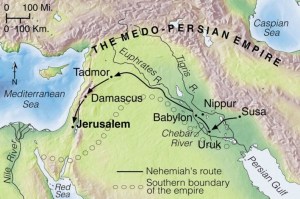
Nehemiah worked in Susa as a personal assistant for the king of the vast Medo-Persian Empire. When he heard that the rebuilding projects in Jerusalem were progressing slowly, he asked the king if he could go there to help his people complete the task of rebuilding their citys walls. The king agreed to let him go; so he left as soon as possible, traveling along much the same route Ezra had taken.

Nehemiah worked in Susa as a personal assistant for the king of the vast Medo-Persian Empire. When he heard that the rebuilding projects in Jerusalem were progressing slowly, he asked the king if he could go there to help his people complete the task of rebuilding their citys walls. The king agreed to let him go; so he left as soon as possible, traveling along much the same route Ezra had taken.

Chapters 8-10 hold very important significance. The passage includes what is known as the Great Water Gate Revival (a gathering in the square before the Water Gate) and the covenant renewal. A key part of this was the reading of the Law. For many of them, this would be the first time they had ever heard the entire Law of Moses read to them; and it was a very emotional and profound experience.

The Book of Nehemiah is a passionate story of a man’s determination to get something very important done. But it must be remembered that it was the execution of God’s will. God was determined to get the people back entrenched in the work of serving Him as God’s people in their own land after the exile. And when God wants something done, it gets done. Fairly short work was made of what seemed at the outset to many to be a monumental task that could easily take years. The wall was finished in 52 days (Nehemiah 6:15)! But the Book is full of historical detail and makes more complete the renewal of reinstating Mosaic Law that Ezra had begun in the previous chapter.

/Bob’s boy
___________________
image © V. Gilbert & Arlisle F. Beers

Please note: I did not design the reading plan that I am following in my blog.  All of my comments in this blog, however, are solely my responsibility.  When reading ANY commentary, you should ALWAYS refer first to the scripture, which is God’s unchanging and unfailing word. Reading schedules, as well as a link to the site where you can get the reading plan that I’m currently following for yourself can be found on the “Bible Reading Schedules” page of my website at http://graceofourlord.com.  

Psalm 115 – To Your Name Give Glory

Jesus giving the Farewell discourse to his ele...

Jesus giving the Farewell discourse to his eleven remaining disciples, from the Maesta by Duccio, 1308-1311. (Photo credit: Wikipedia)

Psalm 115 is the third song in what is known as the “Hallel” – sometimes today called “Hallelujah Psalms.” They were sung traditionally at the end of the Passover celebration, and other feasts and occasions. It is considered likely that one or more of these were also the hymns sung by Jesus and his disciples on the night of the Last Supper (Matthew 26:29-35, Mark 14:26).

As a song of praise, it has roughly four parts. Verses 1-3 are both praise and a plea to God for his help. Verses 4-8 continue that praise as God is exalted and contrasted with the useless idols of pagans. Verses 9-13 call for God’s people to trust in the Lord as their defender. Verses 14-18 call upon God to bless His people, praising Him and professing everlasting love.

The psalmist glorifies the Lord as the Creator of all things, and who will bless the house of Israel and the house of Aaron – metaphors for all of God’s people, as well as His consecrated. Beautiful, encouraging poetry, a sample of which follows from verses 15-16:

May you be blessed by the Lord,
who made heaven and earth!
The heavens are the Lord’s heavens,
but the earth he has given to the children of man.

Read or listen to audio of ESV version of this selection from this link.

/Bob’s boy
___________________
some images © V. Gilbert & Arlisle F. Beers

Please note: I did not design the reading plan that I am following in my blog.  All of my comments in this blog, however, are solely my responsibility.  When reading ANY commentary, you should ALWAYS refer first to the scripture, which is God’s unchanging and unfailing word. Reading schedules, as well as a link to the site where you can get the reading plan that I’m currently following for yourself can be found on the “Bible Reading Schedules” page of my website at http://graceofourlord.com.

“Understanding the Cross of Christ”
is now available as an eBook by Bob’s Boy’s Publications (free in Kobo format). Details here.

Job 30 – My Soul Is Poured Out Within Me

In the previous chapter, Job recounted the days before his tragedies when he not only was respected, but had the ability to help those in need.  Chapter 30, on the other hand, begins with “but now…,” as he enumerates many of the ways his life has changed for the worse.

Job's Evil Dreams (illustration)

Job’s Evil Dreams (illustration) (Photo credit: Wikipedia)

Now the losses that Job refers to involve his relationship with God, as well as the relationships he longs to have back with his fellow-man. Once again, Job’s character shines through his suffering and his mourning. Indeed, verses 9 and 16 begin recounting more of these reversals in fortune with “and now…” and “but now,” with verses 16-17 demonstrating some of the chapter’s most poetic, if pathetic, verses:

“And now my soul is poured out within me;
days of affliction have taken hold of me.
The night racks my bones,
and the pain that gnaws me takes no rest”

Verses 1-9 describe the lot of those who refused to work and were too proud too beg. This left them scrounging in the desert for sustenance, shunned by society. Even these looked at Job in disdain. But verse 24 demonstrates his deepest despair, as Job mourns his perceived loss of relationship with God: “Yet does not one in a heap of ruins stretch out his hand, and in his disaster cry for help?”  Job retains his love for God, though he believes that the Lord has abandoned him.

Read or listen to audio of ESV version of this selection from this link.

/Bob’s boy
___________________
some images © V. Gilbert & Arlisle F. Beers

Please note: I did not design the reading plan that I am following in my blog.  All of my comments in this blog, however, are solely my responsibility.  When reading ANY commentary, you should ALWAYS refer first to the scripture, which is God’s unchanging and unfailing word. Reading schedules, as well as a link to the site where you can get the reading plan that I’m currently following for yourself can be found on the “Bible Reading Schedules” page of my website at http://graceofourlord.com.  For questions and help, please see the “FAQ” and “Summaries” pages there.

Psalm 88 – My Soul Is Full of Troubles

1894 sculpture by William Wetmore Story - Angel of Grief

1894 sculpture by William Wetmore Story – Angel of Grief

As one of the lament psalms, this one is truly written by one whose condition is most pitiable. In a vote for the saddest psalm of the book, Psalm 88 could easily win. Opinions vary as to the origin of the psalm. Some believe it was written by one of the exiles to Babylon during the worst of his times. Others have postulated that it is the song of a dying leper. I read a first-hand account of a visit to a leper colony that occurred over 50 years ago, and I shall spare you the details of that account. Suffice to say that I find it very plausible that such indeed could be the source of the psalm.

One thing to note is that although the psalm begins and ends with the deepest despair and no real hope that things will get any better, the cries made by the psalmist to the Lord are accompanied by faith nevertheless. And the psalmist makes it clear that he will continue in his faith to the bitter end, fully expecting to begin each new day with his prayers to the Lord.

2 Timothy 3:16 tells us that “all Scripture is breathed out by God and profitable for teaching, for reproof, for correction, and for training in righteousness…” So why is this psalm in the Bible? What teaching or training could such bleak words hold for us today? I believe Derek Kidner offers as good an explanation as I have heard (Tyndale Old Testament Commentaries (Book 16),IVP Academic; Reprint edition (April 17, 2009)). Burton Coffman aptly summarizes Kidner’s words (which I will leave you with) as follows:

“(1) This psalm reveals the truth that Christians may sometimes be subjected to the most unrelenting and terrible misfortunes in passing through this earthly life. It happened to Job; it happened to this psalmist; and it can happen to any child of God.

What a joyful thing it is that… the Christian today has the advantage of the blessed hope of the resurrection ‘in Christ’ and the hope of eternal glory in heaven.

(2) There is the lesson of this psalm that no matter how discouraging and terrible one’s lot in life may be, he should not fail to lay the matter before the Lord in prayer. God always answers the prayers of his saints, even if their specific requests must be denied, as in the case of Paul’s ‘thorn in the flesh.’

(3) Our lives upon earth are only a moment compared to the ceaseless ages of eternity; and our attitude during the very worst of experiences should be the same as that of Job, who cried, ‘Though he slay me, yet will I trust him’ (Job 13:15)”

Read or listen to audio of ESV version of this selection from this link.

/Bob’s boy
___________________
some images © V. Gilbert & Arlisle F. Beers

Please note: I did not design the reading plan that I am following in my blog.  All of my comments in this blog, however, are solely my responsibility.  When reading ANY commentary, you should ALWAYS refer first to the scripture, which is God’s unchanging and unfailing word. Reading schedules, as well as a link to the site where you can get the reading plan that I’m currently following for yourself can be found on the “Bible Reading Schedules” page of my website at http://graceofourlord.com.  

Proverbs 17 – Laugh More!

OK, so we know that Solomon was the wisest man who ever lived (1 Kings 3:11-12).  So we should not be surprised when something he wrote (or any other scripture, for that matter) is validated by secular science, as is the case with verse 22 of this chapter (“a joyful heart is good medicine, but a crushed spirit dries up the bones”).

English: Watching a comedic television show he...

English: Watching a comedic television show helps provoke laughter (Photo credit: Wikipedia)

As far back as I can remember, my mother was a subscriber to “Reader’s Digest,” and one of my favorite parts was a joke section called “Laughter the Best Medicine.” That saying was always accepted as a general home-spun truism by most people – one of those things that “everybody knows.” But according to the Mayo Clinic (http://www.mayoclinic.com/health/stress-relief/SR00034), laughter not only relieves stress, it has positive effects on your physical health in many ways.

According to this staff article, laughter “…enhances your intake of oxygen-rich air, stimulates your heart, lungs and muscles, and increases the endorphins that are released by your brain.” Other benefits include relieving one’s stress response, stimulating circulation and relaxing muscles, improving the immune system, relieving pain, and lessening depression and anxiety, I can vouch for those last two, as I have noticed the positive effects on my anxiety caused by even a single genuine laugh.

The trouble is, when we most need it the most, we often do not feel like laughing. But we should not just toss the thought aside. Next time these troubles threaten to engulf us, let’s try seeking out laughter in some way – whether it is a comedy on TV, a funny movie, a favorite companion, or even simple things like reading jokes somewhere. Give laughter a try – it’s Biblical!

Read or listen to audio of ESV version of this selection from this link.

/Bob’s boy
___________________
some images © V. Gilbert & Arlisle F. Beers

Please note: I did not design the reading plan that I am following in my blog.  All of my comments in this blog, however, are solely my responsibility.  When reading ANY commentary, you should ALWAYS refer first to the scripture, which is God’s unchanging and unfailing word. Reading schedules, as well as a link to the site where you can get the reading plan that I’m currently following for yourself can be found on the “Bible Reading Schedules” page of my website at http://graceofourlord.com.  For questions and help, please see the “FAQ” and “Summaries” pages there.

Psalm 117, 124 – If Not For the Lord

storm_002Both of these psalms are short hymns of great praise. Psalm 117 is the next to the last in what as known as the “Hallel” (Psalms 113-118) praising God and calling for all nations to do so (“For great is his steadfast love toward us, and the faithfulness of the Lord endures forever. Praise the Lord!”). The word “us” applies to people of all nations, and Paul quotes this passage when speaking to Jews and Gentiles in Romans 15:10-11.

Psalm 124 is one of the fifteen “Psalms of Acsents” (see this previous post for a brief explanation). This particular psalm is one of praise to God for deliverance. Here, the analogies are made to escaping from death by drowning (verses 4-5), and then as a bird escaping from a predator or a trap (verses 6-7). It is a reminder to those of the singing congregation of the grace, mercy, and power of the Lord:

If it had not been the Lord who was on our side—
let Israel now say—
if it had not been the Lord who was on our side
when people rose up against us,
then they would have swallowed us up alive,

God does not always answer our prayers the way we would like for Him to. Sometimes, the answer is no. Sometimes, it may even be “not yet” or “I have something else in mind.” Sometimes, that “something else” becomes clear to us later as the better thing to have happened. But sometimes, we come to Him in great distress, and He answers “yes.” When the dust settles after such a situation, do we give Him the praise and the glory? Or do we just move on as if the “luck of the draw” was simply on our side?

Verse 8 is a reminder that it is from God whom all blessings flow:

Our help is in the name of the Lord,
who made heaven and earth

Read or listen to audio of ESV version of this selection from this link.

/Bob’s boy
___________________
some images © V. Gilbert & Arlisle F. Beers

Please note: I did not design the reading plan that I am following in my blog.  All of my comments in this blog, however, are solely my responsibility.  When reading ANY commentary, you should ALWAYS refer first to the scripture, which is God’s unchanging and unfailing word. Reading schedules, as well as a link to the site where you can get the reading plan that I’m currently following for yourself can be found on the “Bible Reading Schedules” page of my website at http://graceofourlord.com.  

Book of Ezra – Rebuilding the Temple

English: The Jews Return to Jerusalem in the T...

English: The Jews Return to Jerusalem in the Time of Cyrus; as in Ezra 1:1-11; illustration from a Bible card published by the Providence Lithograph Company (Photo credit: Wikipedia)

The Book of Ezra is one of the books of the Old Testament that is generally classified as one of the books of history. The book is only 10 chapters long; and the first 6 chapters are written about events that occurred before Ezra came on the scene, beginning in 539 B.C. (Ezra did not arrive until 458 B.C.). Although Ezra 7:27 – 9:15 is written in the first person, indicating that Ezra wrote them, the first six chapters (as well as chapter 10) are written in the third person, leaving open the possibility of a different author for those chapters.

Ezra 7:27 – 9:15 is often called the Ezra Memoir. It hardly matters, but the reader should keep in mind the possibility that Ezra wrote that portion in that voice to differentiate the time periods, pointing out that the first six chapters predated him. Chapter 10 is largely a historical record. It documented those who had “broken faith,” taking foreign wives and having children with them. It is thought by some that the author of Ezra wrote the book of Nehemiah. Early rabbinical writings indicate that the two books were counted together as one book. Ezra’s arrival in 458 B.C., over 80 years after the book began, preceded the arrival of Nehemiah (445 B.C.) by 13 years.

English: Ezra Reads the Law to the People (Neh...

English: Ezra Reads the Law to the People (Neh. 8:1-12) Русский: Священник Ездра читает народу Закон (Неем. 8:1-12) (Photo credit: Wikipedia)

As the first verse of the book tells us, that the word of the Lord by the mouth of Jeremiah might be fulfilled,” the book begins with the time of captivity coming to an end. Ezra begins the story of the small remnant of Jews that returned to their ravaged land, including the building and dedication of the second temple . Ezra 2:64, following a more detailed account, tells us that their number “together was 42,360, 65 besides their male and female servants, of whom there were 7,337, and they had 200 male and female singers. Their horses were 736, their mules were 245, their camels were 435, and their donkeys were 6,720.” The book tells of the remnant’s struggle to regain and retain their identity as a chosen people.

For more information on the Proclamation of Cyrus and a link to the archaeological artifact known as the Cyrus Cylinder, which was found in the ruins of Babylon in 1879, see this previous post.

Key Events

  • Cyrus king of Persia captures Babylon     (539 B.C.)     Dan. 5:30–31
  • King Cyrus issues a decree freeing Jewish exiles to return     (538–537 B.C.)     Ezra 1–2
    • The remnant of Jewish exiles, led by Sheshbazzar, return  Jerusalem     (~537 B.C.)     Ezra 1:11
  • The rebuilding of the altar     (537 B.C.)      Ezra 3:1–2
  • The remnant rebuilds the Temple at its original location      (536 B.C. – 516 B. C.)     Ezra 3:8–6:22
    • Opposition and conspiracies against rebuilding / rebuilding ceases      (530-5B.C.)      Ezra 4:24
    • Rebuilding resumes (2nd year of the reign of Darius)     (520 B.C.)     Ezra 5:2; Hag. 1:14
    • Construction completed      (516 B.C.)       Ezra 6:15
  • Ezra the Priest leaves Babylon and comes to Jerusalem to teach the people and establish Mosaic Law (arrives in the 7th year of the reign of Artaxerxes)    (Ezra 7–8)
    • King Artaxerxes gives Ezra the authority to establish the law of Moses     Ezra 7
    • Ezra sets out for Jerusalem with more remnants, bringing royal gifts for the temple      Ezra 8
  • Ezra confronts the issue of Intermarriage / marriage to idolaters      Ezra 9–10
    • The people agree to dissolve the marriages      Ezra 10:1–17
    • Assembly of men from Judah and Benjamin in Jerusalem      (458 B.C.)      Ezra 10:9
    • Investigation  lasts 3 months   (458–457 B.C.)     Ezra 10:16–17
    • The guilty are documented      Ezra 10:18–44
/Bob’s boy
___________________
image © V. Gilbert & Arlisle F. Beers

Please note: I did not design the reading plan that I am following in my blog.  All of my comments in this blog, however, are solely my responsibility.  When reading ANY commentary, you should ALWAYS refer first to the scripture, which is God’s unchanging and unfailing word. Reading schedules, as well as a link to the site where you can get the reading plan that I’m currently following for yourself can be found on the “Bible Reading Schedules” page of my website at http://graceofourlord.com.