Proverbs 17 – The Lord Tests hearts

crucible

Proverbs 17:3: “The crucible is for silver, and the furnace is for gold, and the Lord tests hearts.”

A crucible is a container that is used to melt metal on a furnace. A crucible for silver would usually be made of clay/graphite, and would have to withstand extremely high temperatures, possibly ranging from 1800 – 2500 degrees Fahrenheit.  In the process of refining these precious metals, the impurities float to the surface as “dross” where they can be removed.  The extreme heat makes the precious metals better – richer, and even more pure.

The Lord does test our hearts (1 Chronicles 29:17), for He looks upon man in a different way than other men do (1 Samuel 16:7).  And James tells us that we should “count it all joy” when we encounter trials (James 1:2-4).  So what do we do when those times of trial seem too much to bear?

Ahhh… that’s the part that is most difficult to accept, at least it is for this blogger.  Let’s look closely at what James says in verses 5-8:

“If any of you lacks wisdom, let him ask God, who gives generously to all without reproach, and it will be given him. But let him ask in faith, with no doubting, for the one who doubts is like a wave of the sea that is driven and tossed by the wind. For that person must not suppose that he will receive anything from the Lord; he is a double-minded man, unstable in all his ways.”

Most of my life, I have failed to put verses 5-8 together with verses 4-6.  James is trying to tell us that if we do not know how to “let steadfastness have its full effect,” if we do not seem to be able to cope -to stand the heat, we should ask for God to give us the wisdom to do so.  He has promised to give it “without reproach.”  And God always keeps His promises.  That means He does not disapprove of our asking for it.  He will not chastise us for our weakness, nor will he belittle us for any ineptitude on our part.  But we must ask with faith, not just believing, but knowing that God will deliver that wisdom to us.  That is the kind of faith for which I must continually pray.  I am still working on it.

Read or listen to audio of ESV version of this selection from this link.

/Bob’s boy
___________________
some images © V. Gilbert & Arlisle F. Beers

Please note: I did not design the reading plan that I am following in my blog.  All of my comments in this blog, however, are solely my responsibility.  When reading ANY commentary, you should ALWAYS refer first to the scripture, which is God’s unchanging and unfailing word. Reading schedules, as well as a link to the site where you can get the reading plan that I’m currently following for yourself can be found on the “Bible Reading Schedules” page of my website at http://graceofourlord.com.  For questions and help, please see the “FAQ” and “Summaries” pages there.

Proverbs 16 – Commit Your Work to the Lord

“All the ways of a man are pure in his own eyes,

but the Lord weighs the spirit.”  (Proverbs 16:2)

English: Head-piece to the first epistle of Pa...

English: Head-piece to the first epistle of Paul the apostle to the Corinthians, vignette with water pouring from a crucifix standing over a flaming bowl on a ledge with grain in clouds; letterpress in two columns below and on verso. 1800. Inscriptions: Lettered below image with production detail: “P J de Loutherbourg invt et delt”, “J. Heath direx”. Print made by James Heath. Dimensions: height: 480 millimetres; width: 380 millimetres. (Photo credit: Wikipedia)

Nobody I know begins their day with the intention of conducting themselves in their daily routine in a manner that will be harmful to others, or displeasing to the Lord.  This is not to say that none of us ever do wrong willfully, but most of the time we believe that we are doing what is right.  Being pure of actions in our own eyes can also mean that we try to get what we need, and do what we must, with as little thought to others as possible.  But Paul says in 1 Corinthians 4:4:

For I am not aware of anything against myself,

but I am not thereby acquitted. It is the Lord who judges me.

So how then should we go about our business?  The answer comes in verse three:

Commit your work to the Lord,

and your plans will be established.

If we begin each day in prayer to God for His divine guidance to direct our hearts in conducting our daily affairs, He will not withhold the wisdom we need in doing so.

Read or listen to audio of ESV version of this selection from this link.

/Bob’s boy
___________________

5VB2BPSBSZV4

some images © V. Gilbert & Arlisle F. Beers

Please note: I did not design the reading plan that I am following in my blog.  All of my comments in this blog, however, are solely my responsibility.  When reading ANY commentary, you should ALWAYS refer first to the scripture, which is God’s unchanging and unfailing word. Reading schedules, as well as a link to the site where you can get the reading plan that I’m currently following for yourself can be found on the “Bible Reading Schedules” page of my website at http://graceofourlord.com.  For questions and help, please see the “FAQ” and “Summaries” pages there.

A Soft Answer Turns Away Wrath

How often is our own anger provoked by someone else that makes us feel insignificant – that our worth counts for nothing?  We would do well to remember this when we encounter someone whose wrath is obvious in both their demeanor and tone.  Consider Gideon’s response to the men of Ephraim in Judges 8:1-3 when they complained that he had only called them out belatedly.  But Gideon’s praise of their accomplishments turned away they wrath.

David and Jonathan were best friends, but Jonathan's crippled son Mephibosheth could have claimed his grandfather Saul's throne. Despite that, David was kind to him, and brought him into the palace to live (2 Samuel 9).

David and Jonathan were best friends, but Jonathan’s crippled son Mephibosheth could have claimed his grandfather Saul’s throne. Despite that, David was kind to him, and brought him into the palace to live (2 Samuel 9).

Now look instead to David’s encounter with Nabal in 1 Samuel 25:10-13, where he insulted David and his mighty men.  It was only Abigail’s soft and wise words in 1 Samuel 25:23-30 that quieted David’s anger, and kept him from doing what he would surely come to regret.

Sometimes the soft answer that is needed in such situations is simply that of kindness.  Everyone wants and deserves to feel that they are important – that what they need, and what they feel matters.  It does matter to God.  It mattered to Jesus (Matthew 7:12).  Shouldn’t it matter to us?

Read or listen to audio of ESV version of this selection from this link.

/Bob’s boy
___________________
some images © V. Gilbert & Arlisle F. Beers

Please note: I did not design the reading plan that I am following in my blog.  All of my comments in this blog, however, are solely my responsibility.  When reading ANY commentary, you should ALWAYS refer first to the scripture, which is God’s unchanging and unfailing word. Reading schedules, as well as a link to the site where you can get the reading plan that I’m currently following for yourself can be found on the “Bible Reading Schedules” page of my website at http://graceofourlord.com.  For questions and help, please see the “FAQ” and “Summaries” pages there.
Proverbs 14 – A Scoffer Seeks Wisdom in Vain

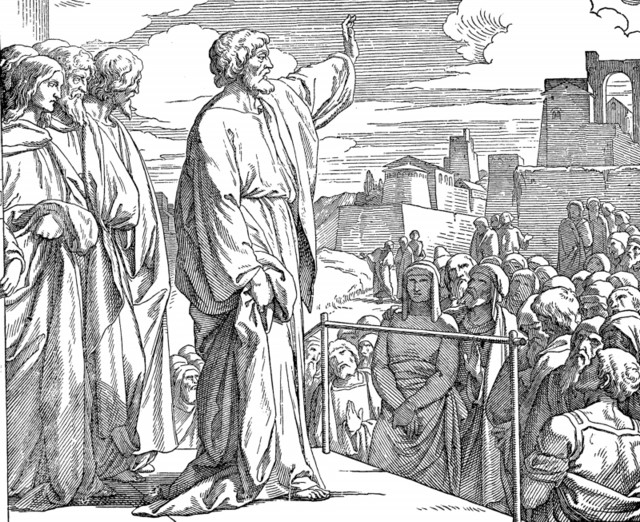
Paul preaches on Mars' Hill.

Paul preaches on Mars’ Hill.

Verse 6 of Proverbs chapter 14 states that “A scoffer seeks wisdom in vain, but knowledge is easy for a man of understanding.”  It is one of the great curiosities, and one could also say tragedies, of human nature that men have often come into a position in which they could gain real knowledge if not for their own pride.  Herod had a great opportunity, and Luke 23:8 tells us that he was even glad when he saw Jesus, “for he had long desired to see him, because he had heard about him, and he was hoping to see some sign done by him.” But instead he treated Him with contempt and mocked him.  He could have had answers to all that matters, but he came away with nothing.  One could also point to some of those at the Areopagus on the occasion of Paul’s address in Acts 17:16-28.

Those who insist on leaning upon their own understanding risk being doomed to the same fate as any fool.  Jesus, speaking of his parables in Matthew 13, quoting Isaiah 6:9-10 said “You will indeed hear but never understand, and you will indeed see but never perceive.”

Read or listen to audio of ESV version of this selection from this link.

/Bob’s boy
___________________
some images © V. Gilbert & Arlisle F. Beers

Please note: I did not design the reading plan that I am following in my blog.  All of my comments in this blog, however, are solely my responsibility.  When reading ANY commentary, you should ALWAYS refer first to the scripture, which is God’s unchanging and unfailing word. Reading schedules, as well as a link to the site where you can get the reading plan that I’m currently following for yourself can be found on the “Bible Reading Schedules” page of my website at http://graceofourlord.com.  For questions and help, please see the “FAQ” and “Summaries” pages there.

Proverbs – On Becoming Wise

Facebook logo Español: Logotipo de Facebook Fr...

Facebook logo Español: Logotipo de Facebook Français : Logo de Facebook Tiếng Việt: Logo Facebook (Photo credit: Wikipedia)

Verse 3 is the watchword verse for those of us who are prone to speak without considering; but these days, to email or post on Facebook fits just as well in our world.  It is much too easy for us to “say” something to someone electronically that we would NEVER speak aloud to someone in person.  Whoever guards his mouth preserves his life; he who opens wide his lips comes to ruin.  Today, it is easy to bring relationships to ruin by opening wide our keyboards.  Perhaps the eleventh commandment should be “Thou shalt not click the ‘Send’ button for 24 hours, then read aloud first.”  The twelfth should certainly be “Thou shalt not click ‘Reply All.'”

reply allVerse 20’s advice is just as easily understood as it is less often heeded:

“Whoever walks with the wise becomes wise,
but the companion of fools will suffer harm
.”

Or as Paul told the Corinthians in 15:33, “‘Do not be deceived: “Bad company ruins good morals.’”  Adam Clarke said “To walk with a person implies love and attachment; and it is impossible not to imitate those we love. So we say, “Show me his company, and I’ll tell you the man.” Let me know the company he keeps, and I shall easily guess his moral character.”

Gill explained it saying that “(he who walks with the wise) converses frequently with them in private about spiritual and experimental things, and walks with them in public in all the commandments and ordinances of the Lord; he by those means grows wiser and wiser, gains a large stock of spiritual knowledge and experience…”  By the same token, the foolish companions will often precede their foolish ideas with a reminder that speaks for itself – “nobody will ever know…”  God does.

Read or listen to audio of ESV version of this selection from this link.

/Bob’s boy
___________________
some images © V. Gilbert & Arlisle F. Beers

Please note: I did not design the reading plan that I am following in my blog.  All of my comments in this blog, however, are solely my responsibility.  When reading ANY commentary, you should ALWAYS refer first to the scripture, which is God’s unchanging and unfailing word. Reading schedules, as well as a link to the site where you can get the reading plan that I’m currently following for yourself can be found on the “Bible Reading Schedules” page of my website at http://graceofourlord.com.  For questions and help, please see the “FAQ” and “Summaries” pages there.

Proverbs 12 – The Way of a Fool

Because of the nature of the book of Proverbs, and the impossibly of commenting on all of a single chapter in these short paragraphs,we choose to pick one or two verses on which to focus.. Please see our  previous post on study tips for Proverbs.

Today this blog will focus on a single short verse from chapter 12. verse 15 reads:

“The way of a fool is right in his own eyes, but a wise man listens to advice.”  

This has been the plague of men (and women) since  time began; and the more learned we become the worse it gets.  During the cycle of the Judges 17:6 and 21:25 in Israel,  the text says “In those days there was no king in Israel. Everyone did what was right in his own eyes.”  The people would fall into apostasy over and over again until God rescued them and they would start the cycle all over again.   People worshiped their idols and turned away from God until things got so bad that they ended up crying out to him, and then he would save and deliver them.  This continued throughout the kingship of David and even the author of this book.

Even Solomon allowed the women that he turned to lead him into idolatry.  God often has tolerated foolishness by the self-deception of man since time immemorial and has allowed him to continue to make those kinds of mistakes because we have our own freedom to make our mistakes.The wise man listens to the advice and wisdom of our God, His son, and the Holy Spirit.

We are brought up in a world that teaches our children macro-evolution that we are no more than advanced animals that, this world is all there is, and that the Bible is little more than a book of fables.  So-called educated men make it their purpose in life to convince people who there is no purpose in life.  But His evidence is all around us, including His attributes (Romans 1:20).  We exchange the wisdom of God for the foolishness of man that we call wisdom, in order to justify our own unrighteousness and worship our own idols of sin and depravity (Romans 1:22-23). We tell the child there is no God and that he was foolish to believe there is and then we  wonder why so many lose heart and hope.

We must give true wisdom to our children though God’s word to combat the lies that this world tells them about who we are and where we come from; and teach them where they can go.

Read or listen to audio of ESV version of this selection from this link.

/Bob’s boy
___________________
some images © V. Gilbert & Arlisle F. Beers

Please note: I did not design the reading plan that I am following in my blog.  All of my comments in this blog, however, are solely my responsibility.  When reading ANY commentary, you should ALWAYS refer first to the scripture, which is God’s unchanging and unfailing word. Reading schedules, as well as a link to the site where you can get the reading plan that I’m currently following for yourself can be found on the “Bible Reading Schedules” page of my website at http://graceofourlord.com.  For questions and help, please see the “FAQ” and “Summaries” pages there.

Proverbs 11 – The Integrity of the Upright

For helpful tips on reading the Book of Proverbs, see this previous post.

This is our day of the week for Proverbs this year, and today it is to Proverbs Chapter 11 that we turn.  And it is on three verses that we will focus. Verses 3, 5, and 6 all seem to say the same thing; and in truth they all convey much the same meaning, but there are some differences.  Let’s examine them all three, and then we’ll try to tie them all together.  First, let’s look at verse three:

“The integrity of the upright guides them,
but the crookedness of the treacherous destroys them.”

integrity

integrity (Photo credit: glsims99)

Integrity is a characteristic of the upright (those who live their lives according to God’s will).  It is that integrity which guides them in their daily lives.  The crookedness of the unfaithful is the converse.  The lack of integrity (here, “crookedness”) is a characteristic of those who are treacherous (the NKJV, the unfaithful).  That lack of integrity will destroy them.  Now verse five:

“The righteousness of the blameless keeps his way straight,
but the wicked falls by his own wickedness.”

None of us are truly “blameless” in the sense of being without sin.  What it means here is living a life that is above reproach – living in such a manner that would encourage others to serve God, rather than being a stumbling block.  Righteousness is being justified by the grace of Jesus Christ (Romans 3:20-24).  It is not earned, but it is freely given.  We can fall away from that righteousness (Romans 11:22, Galatians 5:4), but it is that righteousness that will keep the “blameless” on the right path. The wicked, on the other hand, fall by their own wickedness (more about that in a moment).  Finally, verse 6:

“The righteousness of the upright delivers them,
but the treacherous are taken captive by their lust.”

The grace of the Lord saves those who live according to His word.  But the treacherous are taken captive by their lust.  The NKJV substitutes “unfaithful,” but the “treacherous” defines it better – those who deceive, who pretend to have integrity, but secretly do not live that way.

cross-005Integrity is a commodity that seems to be in short supply at times.  But is integrity in every detail of our lives important?  What would you do for a million dollars?  Is your integrity for sale?  Sadly, the answer for many is yes.  Especially when it comes to “little things.”  A little “white lie” is sometimes necessary, right?  And so what if I really knew the clerk at the big store chain gave me too much money back?  Not my fault their employees can’t count change, is it?  But Jesus gave us the truth about this in Luke 16:10: “One who is faithful in a very little is also faithful in much, and one who is dishonest in a very little is also dishonest in much.

There are few people who want to be thought of by others as lacking in integrity.  So most people at least pretend to have it.  By the same token, even those that have wicked or deceptive intent, do not want to be thought of as such by others.  And so, the wicked, the deceivers, the unfaithful sometimes live out lives for a long time fooling many of the faithful (and the unfaithful as well) into believing they are something they are not.  But they are trapped by their own lust – their own wickedness brings them down.

Psalm 7:14-16 tells us how it comes about, speaking of the wicked who conceive evil and give birth to lies:

“He makes a pit, digging it out,
and falls into the hole that he has made.
His mischief returns upon his own head…”

Read or listen to audio of ESV version of this selection from this link.

/Bob’s boy
___________________
some images © V. Gilbert & Arlisle F. Beers

Please note: I did not design the reading plan that I am following in my blog.  All of my comments in this blog, however, are solely my responsibility.  When reading ANY commentary, you should ALWAYS refer first to the scripture, which is God’s unchanging and unfailing word. Reading schedules, as well as a link to the site where you can get the reading plan that I’m currently following for yourself can be found on the “Bible Reading Schedules” page of my website at http://graceofourlord.com.  For questions and help, please see the “FAQ” and “Summaries” pages there.

Proverbs 10 – Integrity and Love

Today, we begin our weekly Tuesday reading of the chapters in Proverbs which look more like what we would expect from the book.  Chapter 10 has 32 verses; but for today, this blog will look closer at just three that deal with integrity and love. For tips on getting the most out of Proverbs, see this previous post.

“Whoever walks in integrity walks securely,but he who makes his ways crooked will be found out.” (Proverbs 10:9)

heart001If we consistently try to do the right thing in all situations, refusing to compromise on truth, honor, and good will toward others, it fosters a peace within us.  When we know that our intentions are pure, our conscience gives us serenity.  We know that we will bring no justifiable harm upon ourselves because of our own actions, nor will we be as likely to bring others to harm.  But, as 1 Timothy 5:25-26 agrees, those who scheme and connive, who try to hide their corrupt actions and their deceitful heart cannot keep such a secret forever.  How many times in the last few years have we known of someone, famous or not so famous, whose scandalous behavior over a period of years finally came out?  The shame they brought upon themselves was bad enough, but what about the people close to them that were hurt?  Integrity matters – to God, and to us.

“Hatred stirs up strife, but love covers all offenses.” (Proverbs 10:12)

“The one who conceals hatred has lying lips, and whoever utters slander is a fool.” (Proverbs 10:18)

It is easy to move many people to discord, gossip, and to be hurtful to one another by our own hateful thoughts, words, or actions. Sometimes people do so without realizing they are doing wrong.  It is a matter of the heart; and the cure is love. James 5:20 and 1 Peter 4:8 repeat that “love covers a multitude of sins.”  When we seek to think of, and to do good to, others in a manner that shows we truly care about them, that love affects us  as well.  The reason that “love covers all offenses” is that it changes us – our hearts, our minds, and our lives.  It makes us better and happier men and women.  It was this wisdom that Jesus was trying to convey when he said that loving your neighbor was the second greatest commandment in Matthew 22:37-39.

The first part of verse 18 makes it clear that it is not enough to just hide ones hatred for someone and keep ones mouth shut about it.  Your words then betray you and make you worse than a mere hater, because you become a liar as well.  The change must come from within the heart.  The second part of the verse (“whoever utters slander is a fool”) ties the two verses together.  The answer is not to just “let it all out” and speak ill of those for whom you hold ill will, for by doing so, you harm them as well as yourself.

Wisdom demands that we examine our own thoughts and actions, and let the Lord speak to us through His word, helping us to shape our lives and our hearts.  What can we do this week to show someone we care about them?

Read or listen to audio of ESV version of this selection from this link.

/Bob’s boy

Please “like” us on Facebook at  https://www.facebook.com/bobsboy01

___________________
some images © V. Gilbert & Arlisle F. Beers

Please note: I did not design the reading plan that I am following in my blog.  All of my comments in this blog, however, are solely my responsibility.  When reading ANY commentary, you should ALWAYS refer first to the scripture, which is God’s unchanging and unfailing word. Reading schedules, as well as a link to the site where you can get the reading plan that I’m currently following for yourself can be found on the “Bible Reading Schedules” page of my website at http://graceofourlord.com.  For questions and help, please see the “FAQ” and “Summaries” pages there.

Five Tips for Reading the Book of Proverbs

Having completed the first nine chapters of Proverbs, we now settle in to our regular reading schedule for this year (you can find details on this year’s schedule in this previous post).  Monday is Psalm 119 day.  On Tuesdays, we will read a chapter of Proverbs, Job on Thursdays, and different Psalms on Wednesdays and Fridays.  Today’s blog is focused on the subject of “Tuesdays.”

Proverbs 3:13

Proverbs 3:13 (Photo credit: heymarchetti)

So now that on every Tuesday we will be reading Proverbs, some good questions arise.  How can we get the most out of reading these other chapters?  Proverbs is, after all, a very different book from any other in the entire Bible.  There is no intuitive continuity of thought in each of the remaining chapters – seemingly just one “proverb” after another.  And really, just what is a proverb  anyway?  Is it just a wise saying, like “Early to bed and early to rise…?”  Like all Scripture, this book is inspired – it contains the wisdom of God!  One writer said that “God in His wisdom provided the book of Proverbs as a help in navigating life,” and that is an excellent description of them.  But one that we like even better was written by David Kidner is his commentary:

It is a book which seldom takes you to church. Like its own figure of Wisdom, it
calls across to you in the street about some everyday matter, or points things out
at home. Its function in Scripture is to put godliness into working clothes; to
name business and society as spheres in which we are to acquit ourselves with
credit to our Lord, and in which we are to look for his training.”

Proverbs 1:7

Proverbs 1:7 (Photo credit: heymarchetti)

That is so true.  But even one chapter of this great book can seem very overwhelming if you try to take all of it in at once. There is wisdom to be had in this book that could fill volumes; and we may find proverbs in these chapters that apply to the circumstances and/or difficulties in our lives at any time.  But not every proverb in every chapter is going to seem applicable to our lives at all times.  And certainly any attempt to “blog” on an entire chapter of Proverbs in just a few short paragraphs would be woefully inadequate.

So we will be taking a different approach, focusing on selected verses in a chapter each Tuesday; and we suggest that you take a different approach to Proverbs as well.  And since there are only 22 chapters left, we will start again (with chapter 10 and following) later in the year, in order to focus on a few other verses.

Here are some tips for the Book of Proverbs as we go through the year:

  • As you read a chapter in Proverbs each week, underline, highlight, or copy and paste one or two verses that stand out as particularly relevant to your life at the time.
  • After reading the chapter, go back over those verses you singled out, and find one or two that seem really meaningful to you.  Work on memorizing one or both of those two verses during the week.
  • Consider speaking about that verse with someone you care for, a friend, or even posting a comment on one of these pages.  Your thoughts on the subject may be helpful to someone else!
  • Don’t forget to mark some of those that you simply do not understand in some different manner ( a separate list, different color highlight, etc.), so that you can look at some other time.  You will be surprised what a difference a fresh look and a different perspective can make.

Finally, and most importantly, begin applying the proverbs that you have singled out in your daily life.  As we “put godliness into working clothes” in 2013, we will surely have grown in wisdom by the end of this year!

/Bob’s boy

Please “like” us on Facebook at  https://www.facebook.com/bobsboy01

Summing Up

Each weekend, I am now posting a small PDF of one week of chapter summaries (on the website’s “Summaries” page), current to the beginning of the previous week.  I have posted the summary for Week 1 (January 2013 Week 1) of the schedule I am following this year.  This short PDF documents contains condensed comments about Proverbs 1, 2, 3, 9, and 10 with hyperlinks to the ESV version of each chapter for listening or reading.

___________________
image © V. Gilbert & Arlisle F. Beers

Please note: I did not design the reading plan that I am following in my blog.  All of my comments in this blog, however, are solely my responsibility.  When reading ANY commentary, you should ALWAYS refer first to the scripture, which is God’s unchanging and unfailing word. Reading schedules, as well as a link to the site where you can get the reading plan that I’m currently following for yourself can be found on the “Bible Reading Schedules” page of my website at http://graceofourlord.com.  For questions and help, please see the “FAQ” and “Summaries” pages there.

Proverbs 9 – The Way of Wisdom

Lady wisdom (2)

Lady wisdom (2) (Photo credit: Wikipedia)

Together with Proverbs 1:7, verse 10 serves as a parenthetical summary of these first nine chapters, as this section of Proverbs ends and ushers in the actual Proverbs of the remaining chapters.  But here, the “fear of the Lord,” it expounds, is the beginning of wisdom – these chapters have taught the difference between knowledge and wisdom.  And the second part of the verse explains it succinctly – “the knowledge of the Holy One is insight.”  Here, Lady Wisdom and Lady Folly are each calling out to mankind (even the simple) to come to a banquet they have prepared, the former of which offers a path to insight (verse 6).

Verse 7 states that one who corrects a scoffer will get abuse, and the scoffer will hate those that reprove him.  This is because of the condition of the heart.  Such people who are hostile to God cannot receive the truth unless they change their heart, and only God can help with that (Romans 8:7-8).   Conversely, reprove a wise man and he will love you; and he will be wiser if you instruct him (verses 8-9).  A righteous man will increase in learning, with instruction.  Perhaps the greatest wisdom of this chapter is in verse 12 “If you are wise, you are wise for yourself; if you scoff, you alone will bear it” (Job 22:2).  Those who reject the Lord do so at their own peril.

Verses 13-18 contain the final description of the call of Lady Folly.  She is loud, seductive, and knows nothing.  She implores the same simple ones to come, with the lie that “Stolen water is sweet, and bread eaten in secret is pleasant.”  But her guests have been led down the path of destruction with the dead.

Read or listen to audio of ESV version of this selection from this link.

/Bob’s boy
___________________
some images © V. Gilbert & Arlisle F. Beers

Please note: I did not design the reading plan that I am following in my blog.  All of my comments in this blog, however, are solely my responsibility.  When reading ANY commentary, you should ALWAYS refer first to the scripture, which is God’s unchanging and unfailing word. Reading schedules, as well as a link to the site where you can get the reading plan that I’m currently following for yourself can be found on the “Bible Reading Schedules” page of my website at http://graceofourlord.com.  For questions and help, please see the “FAQ” and “Summaries” pages there.