Proverbs 12 – According To Good Sense

Nelson Mandela was born Rolihlahla Mandela in July of 1918 in the village of Mvezo, in Transkei, South Africa. “Rolihlahla” in the language of his country means “pulling the branch of a tree,” but more commonly translates as “troublemaker,” and it fit like a glove. Before the death of his father when he was nine years old, he was baptized into the Methodist Church. He went on to become the first in his family to attend school. After the death of his father (and probably because of the prejudice of the British ruling class educational system) he was coerced into taking the first name “Nelson.”

Nelson Mandela & Mikhail Gorbatchov

Nelson Mandela & Mikhail Gorbatchov (Photo credit: Anastasios Fakinos)

At the law firm where he clerked, Mandela befriended a member of the ANC and Communist Party, as well as Nat Bregman, a Jewish communist who became his first white friend. Attending communist talks and parties, Mandela was encouraged that whites and blacks were blending together as equals. However, he said later that he did not join the Party because its atheism conflicted with his Christian faith, and because the South African “Apartheid” struggle was racially based rather than a product of class warfare.

Becoming increasingly political, Mandela marched in support of a successful bus boycott, and continued his higher education, working on his BA at night. Deciding that armed resistance was inevitable, he was arrested for subversive activities, and served 27 years in prison before public pressure brought an end to the oppression and persecution of the South African’s he so dearly loved. After his release, he then became the first black President in the history of the nation, and quickly became the patron saint of the oppressed people of the world.

Nelson Mandela outlasted Communism, as well as the oppression and persecution of Apartheid, and his story brings to mind the wisdom of at least two of the Proverbs in chapter 12:

The wicked are overthrown and are no more,
but the house of the righteous will stand.

A man is commended according to his good sense,
but one of twisted mind is despised.

Read or listen to audio of ESV version of this selection from this link.

/Bob’s boy
___________________
some images © V. Gilbert & Arlisle F. Beers

Please note: I did not design the reading plan that I am following in my blog.  All of my comments in this blog, however, are solely my responsibility.  When reading ANY commentary, you should ALWAYS refer first to the scripture, which is God’s unchanging and unfailing word. Reading schedules, as well as a link to the site where you can get the reading plan that I’m currently following for yourself can be found on the “Bible Reading Schedules” page of my website at http://graceofourlord.com.  For questions and help, please see the “FAQ” and “Summaries” pages there.

Proverbs 11:14 – Guidance

Where there is no guidance, a people falls,
but in an abundance of counselors there is safety

Everyone at some time in their life needs guidance from others.  When we are children, we need the guidance of our parents, of course (though we often begin to think otherwise as teenagers).  It is often desirable to obtain the guidance of counselors at school or the guidance for planning our education that can be provided at college.  We often seek guidance from professionals who are experts in various fields, such as financial planners, attorneys, and accountants.  And sometimes we merely need the advice of a trusted friend.

Ephesus, in modern Turkey, is the best-preserved classical city on the Mediterranean, and one of the best places in the world to get the feeling for what life was like for early Christians in Roman times.

Ephesus, in modern Turkey, is the best-preserved classical city on the Mediterranean, and one of the best places in the world to get the feeling for what life was like for early Christians in Roman times.

God, in His wisdom, has always known what is best for us; and He certainly knows the value that other people with experience in different matters bring to our lives when we need them.  Though not the only reason, this is one good reason that God’s word is so full of admonishment about the commandments to listen to the elders of our congregation – those whose job it is to “shepherd the flock” (1 Peter 5:2).

The scriptures list some specific qualifications in 1 Timothy 3:1-7 and Titus 1:5-9 that those who are to serve as elders should have.  Many of these qualifications have to do with how he is thought of by others in the community, which is not surprising, since one’s reputation is most often a product of his behavior. The result of experience combined with admirable behavior is the sort of wisdom that God’s word teaches throughout the Book of Proverbs.

The leadership of our shepherds  is one that comes with an awesome responsibility, for they will be held accountable for their failure to lead the flock in a manner that is responsible in the Lord’s eyes.  They must constantly be on guard to ensure the scriptural teaching of God’s word, and for seeing to the spiritual well-being of His sheep.  Paul considered this responsibility so great that he summoned the Ephesian elders to meet with him over many miles journey as he bid them farewell in Acts 20:18-35.

It is absolutely true that many small but strong congregations function well without the benefit of qualified elders.  But where there are sufficient numbers in a congregation that qualified men are available to serve, it is imperative that such men are carefully chosen so that the souls of the local people are well nurtured and protected from false teaching which may lead to apostasy.

Read or listen to audio of ESV version of this selection from this link.

/Bob’s boy
___________________
some images © V. Gilbert & Arlisle F. Beers

Please note: I did not design the reading plan that I am following in my blog.  All of my comments in this blog, however, are solely my responsibility.  When reading ANY commentary, you should ALWAYS refer first to the scripture, which is God’s unchanging and unfailing word. Reading schedules, as well as a link to the site where you can get the reading plan that I’m currently following for yourself can be found on the “Bible Reading Schedules” page of my website at http://graceofourlord.com.  For questions and help, please see the “FAQ” and “Summaries” pages there.

Proverbs 10:3 – Nourishment

“The LORD does not let the righteous go hungry, but he thwarts the craving of the wicked.”

Passover_feastAt first reading, this verse may seem to be about physical nourishment as in food.  But it seems clear that  it relates more correctly to the hunger for righteousness, as in the beatitude of Matthew 5:6 (“Blessed are those who hunger and thirst for righteousness, for they shall be satisfied”).  The Lord will fulfill that need for the righteous, just as he will not withhold wisdom from those who ask for it (James 1:5).  But as the text states, He will thwart the craving of the wicked.  This may not mean that evil never finds its way, but God will not give those who seek it any aid in doing so.

This translation, however, does not preclude the other interpretation stated above.  We should well remember Jesus’ words of comfort in  Matthew 6:25“Therefore I tell you, do not be anxious about your life, what you will eat or what you will drink, nor about your body, what you will put on. Is not life more than food, and the body more than clothing?”

Read or listen to audio of ESV version of this selection from this link.

/Bob’s boy
___________________
some images © V. Gilbert & Arlisle F. Beers

Please note: I did not design the reading plan that I am following in my blog.  All of my comments in this blog, however, are solely my responsibility.  When reading ANY commentary, you should ALWAYS refer first to the scripture, which is God’s unchanging and unfailing word. Reading schedules, as well as a link to the site where you can get the reading plan that I’m currently following for yourself can be found on the “Bible Reading Schedules” page of my website at http://graceofourlord.com.  For questions and help, please see the “FAQ” and “Summaries” pages there.

Proverbs 31 – The Excellent Wife

Proverbs 31’s superscription states that the psalmist was one King Lemeul.  There have been found no written records of any such king, but that does not necessarily preclude him from having been a king of some state.  There are some who claim that Lemeul was Bathsheba’s pet name for Solomon, but there is nothing to substantiate that claim.

godly womenVerses 1-9 are the mother’s words to the king, admonishing him not to ruin his reign with the self-indulgence of wanton sex and strong drink, as other kings not so wise have done. Instead, she instructs him further, a great king should see that those who are poor and in need of care are attended to properly – a truly excellent king.

The words of the chapter beginning in verse 10 are a most fitting conclusion for the Book of Proverbs.  So much of the written words in the book have been concerned with the evils of wicked women – prostitutes, bad wives, etc.  Now this writer goes into great detail praising the virtues of a truly excellent woman.

It reads like a laundry list of admirable qualities, but it would be a most unfair mistake to take it as a recipe for determining the goodness or worth of any woman.  Rather it is best to consider the qualities as those that any good woman should seek in their lives.  No woman (or man) is going to be that good at all things all of the time. These verses are an acrostic poem that runs the alphabet with a list of the traits of an “excellent woman.” She cares for those who need her – her family, and she also cares about those who are poor and in need. Notice verse 23 is the only one in the poem about the woman’s husband. He is known at the gates, as he sits among the elders of the land. The man would himself be a worthy man for sure, but a large part of why he is successful is because of his wife.

Read or listen to audio of ESV version of this selection from this link.

/Bob’s boy
___________________
some images © V. Gilbert & Arlisle F. Beers

Please note: I did not design the reading plan that I am following in my blog.  All of my comments in this blog, however, are solely my responsibility.  When reading ANY commentary, you should ALWAYS refer first to the scripture, which is God’s unchanging and unfailing word. Reading schedules, as well as a link to the site where you can get the reading plan that I’m currently following for yourself can be found on the “Bible Reading Schedules” page of my website at http://graceofourlord.com.  For questions and help, please see the “FAQ” and “Summaries” pages there.
Book of Numbers (Part 3) – Balak, Balaam, and Boundaries

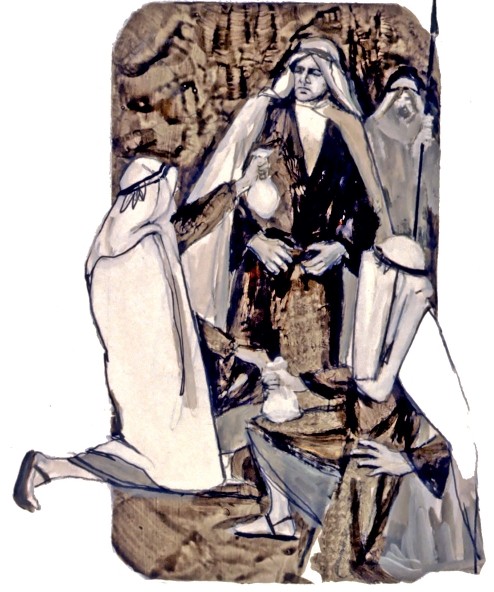
The key events of chapters 20 -35, as listed below, include some very important events, as well as some defining moments. In chapter 20, both Miriam and Aaron die.  This chapter is also where Moses strikes the rock for the second time – this time not following God’s command – the event for which neither Moses nor Aaron will be allowed to enter the Promised Land. Other key events in the following chapters include that of the bronze snake, apostasy at Peor (see this previous post for comments on those two events), victories over Canaan, prescription of the land boundaries, and much more.

The Move From Kadesh to the Plains of Moab

Balak and Balaam

  • Messengers from King Balak of Moab offer riches to the prophet Balaam to come to Moab and curse the Israelites (Numbers 22:1-20).

    Messengers from King Balak of Moab offer riches to the prophet Balaam to come to Moab and curse the Israelites (Numbers 22:1-20).

    Balaam rejects Balak’s first summons – Numbers 22:7-14

  • Balaam and the donkey – Numbers 22:22-35
  • Balak meets with Balaam – Numbers 22:36-40

Balaam blesses Israel

Baal worship at Peor – Numbers 25:1-18

The Second Census – Numbers 26

Laws for the land

Schedule of feasts and sacrifices

The serious commitment of vows

Vengeance on Midian – Numbers 31

Settlement in TransJordan – Numbers 32

Locating events in the Book of Numbers

Locating events in the Book of Numbers

Summary of Journey  (Egypt to Canaan) – Numbers 33

Boundaries ordained for Canaan

/Bob’s boy
___________________
image © V. Gilbert & Arlisle F. Beers

Please note: I did not design the reading plan that I am following in my blog.  All of my comments in this blog, however, are solely my responsibility.  When reading ANY commentary, you should ALWAYS refer first to the scripture, which is God’s unchanging and unfailing word. Reading schedules, as well as a link to the site where you can get the reading plan that I’m currently following for yourself can be found on the “Bible Reading Schedules” page of my website at http://graceofourlord.com.  For questions and help, please see the “FAQ” and “Summaries” pages there.

Proverbs 30 – Lest He Rebuke You

Chapter 30 begins another section of the book of Proverbs, actually ending the format that began in chapter 10.  The superscription says that these are “the words of Agur son of Jakeh.”  Some believe this may be a nickname for Solomon, but that seems unlikely, as the writing style is completely dissimilar.  There is nothing else in the scriptures that mentions this Agur.  The claim by this writer that he is stupid is surely not true.  The wisest thing that this blogger notes in his writing is from verses 5-6:

Every word of God proves true;
he is a shield to those who take refuge in him.
Do not add to his words,
lest he rebuke you and you be found a liar.

Creation_005All of the word of God is important without question.  But when word tells us essentially the same thing more than once in different Scriptures, it behooves us to take notice that it must be singularly important. Deuteronomy 4:2 says “You shall not add to the word that I command you, nor take from it, that you may keep the commandments of the Lord your God that I command you.”  Deuteronomy 12:32: “Everything that I command you, you shall be careful to do. You shall not add to it or take from it.”  The warning becomes much stronger in Revelation 22:18-19, and the consequences are spelled out in no uncertain terms.

No matter what the intentions, people have often found themselves in precarious positions by trying to “help God out.”  That goes for trying to so by our actions (as Abraham did by going into Hagar in an effort to fulfill God’s promise of offspring.  And it can be justifiably applied to the interpretation of Scriptures.  God’s word tells us plainly that God created the heavens and the earth by speaking it into existence (Genesis 1, Psalm 33:9, Romans 4:17).  Yet some people, because of either their weakness of faith in God and His divine word, and/or a desire to please men in their vanity about their own wisdom feel the need to suggest that God needed to use evolution to achieve His purpose.

Since the beginning, man has never gone wrong by putting his faith in the unchanging word of God, and that time-tested truth can always be counted on.

Read or listen to audio of ESV version of this selection from this link.

/Bob’s boy
___________________
some images © V. Gilbert & Arlisle F. Beers

Please note: I did not design the reading plan that I am following in my blog.  All of my comments in this blog, however, are solely my responsibility.  When reading ANY commentary, you should ALWAYS refer first to the scripture, which is God’s unchanging and unfailing word. Reading schedules, as well as a link to the site where you can get the reading plan that I’m currently following for yourself can be found on the “Bible Reading Schedules” page of my website at http://graceofourlord.com.  For questions and help, please see the “FAQ” and “Summaries” pages there.

Proverbs 29 – Arguing With a Fool

Proverbs 29:9 reads:  “If a wise man has an argument with a fool, the fool only rages and laughs, and there is no quiet.”

English:

English: (Photo credit: Wikipedia)

Almost everyone has heard some “wise sayings” that might sound similar to this verse.  One that was popular a few years ago was “Never argue with an idiot.  They drag you down to their level; and then they beat you with experience.”  Another one that has been attributed to everyone from Mark Twain to George Bernard Shaw is “Never wrestle with a pig.  You both just get dirty, and the pig likes it.”  Both have a ring of truth in them that makes them a bit appealing for their humor.

In the book of Proverbs, the word “fool” is sometimes used simply for an unbeliever.  Sometimes it is used for a person who lacks good sense, or who uses poor judgment. Sometimes they are interchangeable.   But whether the “opponent” is a fool by reason of his non-belief in the truth, or because of a stubborn will, or whatever reason, it really makes no difference.  No good comes from arguing with them.  2 Timothy 2:23 tells us “Have nothing to do with foolish, ignorant controversies; you know that they breed quarrels.”  The 24th and 25th verse explain that “the Lord’s servant must not be quarrelsome but kind to everyone, able to teach, patiently enduring evil, correcting his opponents with gentleness.” When discussion becomes an argument, listening comes to an end, and with that, opportunity for salvation can get lost.

Read or listen to audio of ESV version of this selection from this link.

/Bob’s boy
___________________
some images © V. Gilbert & Arlisle F. Beers

Please note: I did not design the reading plan that I am following in my blog.  All of my comments in this blog, however, are solely my responsibility.  When reading ANY commentary, you should ALWAYS refer first to the scripture, which is God’s unchanging and unfailing word. Reading schedules, as well as a link to the site where you can get the reading plan that I’m currently following for yourself can be found on the “Bible Reading Schedules” page of my website at http://graceofourlord.com.  For questions and help, please see the “FAQ” and “Summaries” pages there.

Proverbs 28 – Character

Sunrise_over_MauiThis chapter has plenty of verses comparing the righteous to the unrighteous.  Verse 1 (“The wicked flee when no one pursues, but the righteous are bold as a lion”) and verse 6 (“Better is a poor man who walks in his integrity than a rich man who is crooked in his ways”) caught our attention.  The former perhaps having more to do with conscience than the latter.  But both obviously addressing matters of character.

Always trying to do the right thing definitely has multiple benefits from the perspective of both verses.  Peace of mind, confidence, and never having to look over your shoulder are worth a lot.  The satisfaction that  comes from having that kind of character is priceless.  By “walking in integrity,” we come out ahead now, and we surely will come out ahead when our walk in this world is done.  Many radio and TV show “man on the street” type of interviews often revolve around the question of  “what would you do for a million dollars?”  Money can’t buy any of those important things we just mentioned, so why should our integrity be for sale?

Read or listen to audio of ESV version of this selection from this link.

/Bob’s boy
___________________
some images © V. Gilbert & Arlisle F. Beers

Please note: I did not design the reading plan that I am following in my blog.  All of my comments in this blog, however, are solely my responsibility.  When reading ANY commentary, you should ALWAYS refer first to the scripture, which is God’s unchanging and unfailing word. Reading schedules, as well as a link to the site where you can get the reading plan that I’m currently following for yourself can be found on the “Bible Reading Schedules” page of my website at http://graceofourlord.com.  For questions and help, please see the “FAQ” and “Summaries” pages there.

Proverbs 27 – On Trusted Friends

Proverbs 18:24 reads: “A man of many companions may come to ruin, but there is a friend who sticks closer than a brother.”  We all know that there are different degrees of friendship.  There are some that are little more than acquaintances in reality.  At different times in our lives, there may be those whose company we enjoy immensely; and we may we even spend countless hours with such.  But when times get tough, can these friends be counted on to stand by us?  The truth is – not always.  Verse 10 of chapter 27 advises:

“Do not forsake your friend and your father’s friend,
and do not go to your brother’s house in the day of your calamity

friendship01The first part of the verse has a couple of things to take away from it.  First, it entreats us to know our true friends.  “Your friend and your father’s friend” exemplifies a very long-standing relationship.  Fair-weather friends and mere companions will come and they will certainly go.  But one who remains our friend over a very long time has stood the test of time because that friend will have been there through the good times as well as the bad.  The other thing to take away from it is more important – that we do not forsake such friends.  We are to be the sort of friend that stands the test of time for them, for there will come a time when they need us to be there for them.   How sad if we should fail them in that time.

Having understood and lived according to the first part of the verse, the second part is self-evident.   When we have built such a relationship in concert with such a friend, it is to that friend that we will turn in time of tragedy, and often that may means doing so rather than turning to a relative.  How much better for the Christian today, if the friendship has been built with a “brother” (or sister) in Christ -with the type of friend that will encourage us, as well as hold us accountable to our commitment to the Lord?

Read or listen to audio of ESV version of this selection from this link.

/Bob’s boy
___________________
some images © V. Gilbert & Arlisle F. Beers

Please note: I did not design the reading plan that I am following in my blog.  All of my comments in this blog, however, are solely my responsibility.  When reading ANY commentary, you should ALWAYS refer first to the scripture, which is God’s unchanging and unfailing word. Reading schedules, as well as a link to the site where you can get the reading plan that I’m currently following for yourself can be found on the “Bible Reading Schedules” page of my website at http://graceofourlord.com.  For questions and help, please see the “FAQ” and “Summaries” pages there.

Understanding the Cross – now available as eBook

Understanding_the_Cross_coverThe expanded version of our series “Understanding the Cross of Christ” is now available at Amazon.com in Kindle format at this link, in ePub format at Kobo, and for Nook at  BarnesandNobel.com!

/Bob’s boy
___________________
image © V. Gilbert & Arlisle F. Beers

Please note: I did not design the reading plan that I am following in my blog.  All of my comments in this blog, however, are solely my responsibility.  When reading ANY commentary, you should ALWAYS refer first to the scripture, which is God’s unchanging and unfailing word. Reading schedules, as well as a link to the site where you can get the reading plan that I’m currently following for yourself can be found on the “Bible Reading Schedules” page of my website at http://graceofourlord.com.