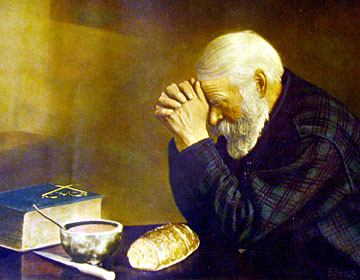
Psalms 51 – The sacrifices of God are a broken spirit

EnstromAccording to the superscript, the occasion of this psalm was when the prophet Nathan came to rebuke David for his sinful affair with Bathsheba and the premeditated murder of her husband and David’s loyal soldier and friend, Uriah the Hittite (2 Samuel 12:1-14).  It is a psalm of prayer from one who has committed grievous sin, and who makes no excuse for it.  As a prayer, the psalm is a great model for us, because it shows us the correct attitude one must have toward his own sins, and in asking God for His forgiveness.

God does not take sin lightly, but He does forgive us for our sins when we come to Him with a truly repentant and contrite heart.    It is with a properly broken spirit that David says “I know my transgressions, and my sin is ever before me. Against you, you only, have I sinned and done what is evil in your sight.”  David knows that no sacrifice or burnt offering would appease God in this case, and that God has no interest in it; and he says that “the sacrifices of God are a broken spirit; a broken and contrite heart, O God, you will not despise” (verse 17).

Read or listen to audio of ESV version of this selection from this link.

/Bob’s boy
___________________
some images © V. Gilbert & Arlisle F. Beers

Please note: I did not design the reading plan that I am following in my blog.  All of my comments in this blog, however, are solely my responsibility.  When reading ANY commentary, you should ALWAYS refer first to the scripture, which is God’s unchanging and unfailing word. Reading schedules, as well as a link to the site where you can get the reading plan that I’m currently following for yourself can be found on the “Bible Reading Schedules” page of my website at http://graceofourlord.com.  For questions and help, please see the “FAQ” and “Summaries” pages there.

Psalm 55 – Cast Your Burden on the Lord

prayingmanA good portion of this psalm relates to betrayal by a once close and trusted friend; and Spurgeon seems right to assess it as reading “like a song of the times of Absalom and Ahithophel.”  Some have also seen it as a prophetic foretelling of the prayers of Jesus in the face of His betrayal and imminent death; and that certainly does fit as well.  There is no reason why it cannot be both, as most of the Royal psalms do refer to present as well as prophetic circumstances.  Consider verses 3-6:

…in anger they bear a grudge against me.
My heart is in anguish within me;
the terrors of death have fallen upon me.
Fear and trembling come upon me,
and horror overwhelms me.
And I say, “Oh, that I had wings like a dove!
I would fly away and be at rest;

But as a lament, much of it also seems to have application to the despair that overwhelms one because of the oppression of the world and the ultimate enemy – the devil himself, who lays in wait, constantly seeking to beat us down, and causes us grievous harm in ways we may not understand as being from his work at the time they occur.  As such, it is like a great many other psalms, which have tremendous power and application in our own prayers when we often wonder how we can carry on through our suffering:

Give ear to my prayer, O God,
and hide not yourself from my plea for mercy!
Attend to me, and answer me;
I am restless in my complaint and I moan
because of the noise of the enemy

Read or listen to audio of ESV version of this selection from this link.

/Bob’s boy
___________________
some images © V. Gilbert & Arlisle F. Beers

Please note: I did not design the reading plan that I am following in my blog.  All of my comments in this blog, however, are solely my responsibility.  When reading ANY commentary, you should ALWAYS refer first to the scripture, which is God’s unchanging and unfailing word. Reading schedules, as well as a link to the site where you can get the reading plan that I’m currently following for yourself can be found on the “Bible Reading Schedules” page of my website at http://graceofourlord.com.  For questions and help, please see the “FAQ” and “Summaries” pages there.

Psalm 119:113-120; Psalm 75 – The Righteous Shall Be Lifted Up

samekhThis stanza of Psalm 119 begins each line with the Hebrew letter “samekh.”  The psalmist decries the “double-minded” in the first verse.  This refers to those who claim to believe in God, but will not stay committed to Him and\or those whose faith is in low quantity and easily shaken.  Elijah spoke of these in 1 Kings 18:21 at his showdown with the prophets of Baal, asking the people “how long will you go limping between two different opinions?”  They wanted to believe in God but enjoy the sinfulness that life among Baal-worshipers afforded them.  James spoke of the double-minded as those who doubt or whose faith is not strong (James 1:5-8), saying they are unstable in all ways.

The directions to the choirmaster in the superscription of Psalm 75 say that it is to the tune of “Do not Destroy,” just as in Psalm 57.  It also says that it is a psalm og Asaph – a song.  Asaph was one of those in charge of David’s “service of song” in the Tabernacle (1 Chronicles 6:31-40).

Earth_003The psalm appears to speak in the voice of the psalmist in parts and in that of God in others.  The picture painted is of an unstable world that totters, but it is God who keeps it steady – not the boastful and the wicked who believe in their hearts that they are in control of things.  All through the ages, there have been proud societies that are often evil and oppressive to the righteous and to the weak – those who are insolent, with “haughty neck.”  But the truth is in verses 7-8:

“but it is God who executes judgment,
putting down one and lifting up another.
For in the hand of the Lord there is a cup
with foaming wine, well mixed,
and he pours out from it,
and all the wicked of the earth
shall drain it down to the dregs”

Read or listen to audio of ESV version of this selection from this link.

/Bob’s boy
___________________
some images © V. Gilbert & Arlisle F. Beers

Please note: I did not design the reading plan that I am following in my blog.  All of my comments in this blog, however, are solely my responsibility.  When reading ANY commentary, you should ALWAYS refer first to the scripture, which is God’s unchanging and unfailing word. Reading schedules, as well as a link to the site where you can get the reading plan that I’m currently following for yourself can be found on the “Bible Reading Schedules” page of my website at http://graceofourlord.com.  For questions and help, please see the “FAQ” and “Summaries” pages there.

Psalms 37:21-40 – The Lord Loves Justice

Eastman Johnson - The Lord is my Shepard - Oil...

Eastman Johnson – The Lord is my Shepard – Oil on wood -16.625 x 13.125 in – c 1863 – Scanned from Eastman Johnson: Painting America – fig 76 pg 141 (Photo credit: Wikipedia)

This entire psalm is quite elegant.  To begin with, it is an acrostic.  Verse 1 begins with the first letter of the Hebrew alphabet, verse three with the second letter, and so on.   It is not intuitively apparent, but in addition to being alphabetic, it is an elaborate chiasmus, where verses repeat themes, ideas, etc. in an A-B-B-A structure.  in this case, the entire psalm appears to do so as in this example:

verses 1-11  The Lord is faithful to the righteous
verses 12-15 Righteousness will prevail
verses 16-20 The Lord upholds the righteous
verses 21-24 Righteousness delights the Lord
verses 25-31 The Lord upholds the righteous
verses 32-33 Righteousness will prevail
verses 34-40 The Lord is faithful to the righteous

Robert Alden suggests a much more elaborate Chiasmus within as follow (Alden, Robert l., “Everyman’s Bible Commentary, Vol I”, Moody Publishers, 1958):

“1-8    A    The righteous are exhorted to ignore
the wicked and trust God
9      B    Wait and inherit the land
10-15    C    The righteous inherit but the Lord
destroys the plotting wicked
16    D    The poor are blessed though poor
17    E    The Lord upholds the righteous
18a    F    The Lord guides the righteous
18b    G    The righteous inherit
19    H    The righteous    receive
20a    I    The wicked perish
20b    J    The wicked are like a sacrifice
20c    J    The wicked are like a sacrifice
21a    I    The wicked give not
21b    H    The righteous give
22    G    The blessed inherit
23    F    The Lord guides the righteous
24    E    The Lord upholds
25-26    D    The blessed may be poor but not forsaken
27-33    C    The Lord loves the righteous who
will live and inherit, but the plotting
wicked will die
34    B    Wait and inherit the land
35-40    A    God destroys the wicked but saves the righteous

The basic message of the psalm is the safety and blessing of those who trust in God and the insecurity of the ungodly.”

The second half of this psalm implores us to turn away from the evil ways of the world and strive to do good, give generously, wait for the Lord, and keep His way (verses 21, 27, 34).  Verse 28 says that the Lord loves justice and will not forsake his saints.  The psalmist says he was young and now is old but has never seen the righteous forsaken, or God’s children begging for bread.  There is future for the man of peace, he says.

He is their stronghold in the time of trouble.
the Lord helps them and delivers them;
He delivers them from the wicked and saves them,
because they take refuge in him.

Taking refuge in the Lord means more than just turning to Him in times of trouble.  It means trusting in God, not only when we are fearful, down-trodden or discouraged, but keeping that trust alive through all of the good times and the bad, the joy and the sorrow – all of the days of our lives.   A faith based solely on expectations of protection and comfort is worthless if it is not there also when we must weather the storms.  The key is to remember that He does not abandon us.  Repeated again and again the scriptures exclaim that we must often “wait for the Lord.”  It is the ability to do that with the assurance of hope that keeps us strong and carries us through difficulty.

Read or listen to audio of ESV version of this selection from this link.

/Bob’s boy
___________________
some images © V. Gilbert & Arlisle F. Beers

Please note: I did not design the reading plan that I am following in my blog.  All of my comments in this blog, however, are solely my responsibility.  When reading ANY commentary, you should ALWAYS refer first to the scripture, which is God’s unchanging and unfailing word. Reading schedules, as well as a link to the site where you can get the reading plan that I’m currently following for yourself can be found on the “Bible Reading Schedules” page of my website at http://graceofourlord.com.  For questions and help, please see the “FAQ” and “Summaries” pages there.

Psalms 54 and 56 – The Lord Upholds My Life

The superscription of Psalm 54 denotes a time when the Ziphites determined to betray David to Saul in order to gain his favor (1 Samuel 23:15-24).  It is a song of prayer to God for deliverance and praise to Him for being that one on whom we can depend in times of need.  David had just fled Keilah after he and his men had saved them from the Philistines.  The Lord had confirmed to him that even after saving them, they would give him up to Saul (1 Samuel 23:1-14).

woods-001The superscription in Psalm 56 directs the chief musician that the song is performed according to one called “the Dove.”  Adam Clarke translates the Teribinths as the “remote woods.”  We do not know what a “Michtam” is, but many suppose that it means this is “a golden psalm of David,” – golden equating to “precious.”

It also refers to the Philistines seizing him in Gath.  The scriptures do speak of David going to Gath.  One of those times was in 1 Samuel 21, but there is no record of the Philistines seizing him.  But that should not be considered cause to doubt the superscription’s accuracy.  We can be certain that there are many events in David’s life that are not chronicled in the scriptures, just as in the lives of other Biblical patriarchs.  The psalm itself is a song about trust in the Lord, even through times of great trouble and fear, and of maintaining one’s faith throughout it all.

Read or listen to audio of ESV version of this selection from this link.

/Bob’s boy
___________________
some images © V. Gilbert & Arlisle F. Beers

Please note: I did not design the reading plan that I am following in my blog.  All of my comments in this blog, however, are solely my responsibility.  When reading ANY commentary, you should ALWAYS refer first to the scripture, which is God’s unchanging and unfailing word. Reading schedules, as well as a link to the site where you can get the reading plan that I’m currently following for yourself can be found on the “Bible Reading Schedules” page of my website at http://graceofourlord.com.  For questions and help, please see the “FAQ” and “Summaries” pages there.

Psalm 119:105-112; Psalm 37:1-20 – Trust in the Lord, and do good

nunThis stanza of Psalm 119 begins each line with the fourteenth letter of the Hebrew Aleph-bet, “nun.” The most well-known part of this stanza is verse 105: “Your word is a lamp to my feet and a light to my path.”    This is the eternal truth about God’s word – it is our guiding light for life.

We have broken up Psalm 37 into two readings.  These first 20 verses are written to those of Gold’s people who are trying to live right in a land full of people who increasingly turn their backs on God’s law.  It is a hymn that calls for the righteous not to lose heart when the wicked always seem to prosper as well as seeming to be doing their best to find ways to persecute the righteous.  Christians probably can relate to this reality of living among  pagans in a pagan land much better in this decade that at any time in the last century.  It is natural for those who try to live right to be saddened at times when they see all around them the increasing acceptance of living a wicked and unrighteous life.  Verse 3 is the answer – keep doing what is right no matter what, and trust in the Lord.  The wicked will “soon fade like the grass and wither like the green herb” (verse 2); and as for the righteous, “their heritage will remain forever” (verse 18).

We’ll look at the second half of this psalm, and make a slight examination of its structure on Friday.

Read or listen to audio of ESV version of this selection from this link.

/Bob’s boy
___________________
some images © V. Gilbert & Arlisle F. Beers

Please note: I did not design the reading plan that I am following in my blog.  All of my comments in this blog, however, are solely my responsibility.  When reading ANY commentary, you should ALWAYS refer first to the scripture, which is God’s unchanging and unfailing word. Reading schedules, as well as a link to the site where you can get the reading plan that I’m currently following for yourself can be found on the “Bible Reading Schedules” page of my website at http://graceofourlord.com.  For questions and help, please see the “FAQ” and “Summaries” pages there.

Psalms 49 – Why Should I Fear in Times of Trouble?

This song is one of the few passages in the Old Testament that speaks so clearly about eternal life.  Focusing at first on the type of wealthy people who arrogantly live as if they will last forever in their position, verses 7-8 comment that no man can ransom his own life, or that of another, because the price is too great.  Of course, Jesus was no ordinary man, and he did pay the ransom for us (1 Timothy 2:6).

cross03The ESV does a poor job in translating verse 11 as saying “their graves are their homes forever.”  The NASB and other versions correctly translate it as “their inner thought is that their houses are forever,” dramatically changing the meaning to illustrate the point the psalmist intended – that they placed their trust in their wealth instead of in God.

Verse 13 expands the focus to all of those who have foolish confidence.  Obviously talking about those who live wicked lives, the psalmist allows that they will never escape death.  But he is confident that God will ransom his soul and receive him (verse 15).  Rich, poor, living on easy street, or enrolled in the school of hard knocks – it’s all the same in the end.  All of our fears will amount to nothing if we have served the Lord.

Read or listen to audio of ESV version of this selection from this link.

/Bob’s boy
___________________
some images © V. Gilbert & Arlisle F. Beers

Please note: I did not design the reading plan that I am following in my blog.  All of my comments in this blog, however, are solely my responsibility.  When reading ANY commentary, you should ALWAYS refer first to the scripture, which is God’s unchanging and unfailing word. Reading schedules, as well as a link to the site where you can get the reading plan that I’m currently following for yourself can be found on the “Bible Reading Schedules” page of my website at http://graceofourlord.com.  For questions and help, please see the “FAQ” and “Summaries” pages there.

Psalm 44 – Why are you sleeping, O Lord?

This lament psalm has been the subject of much speculation as to when it was written, and under what circumstances.  Some of the proposed answers for those questions have been the reign of Jehoiachin (2 Kings 24), the time of the Macabees (inter-testamental), the reign of Hezekiah (2 Kings 18), and even the time of Babylonian captivity (2 Kings 25). It is reasonable however to more narrowly define the circumstances in terms of a group or community of people who are simply persecuted unjustly.

The time and circumstances really do not matter though.  It begins in verses 1-8 as a wonderful hymn of praise to God.  From there, it becomes much like several other lament psalms that cry for help from God, while it appears to the psalmist that God not only is ignoring their pain, but may well be responsible for some of it; and the psalmist cannot understand what they could have done to deserve such.   We may even read in shock at the way the psalmist addresses the Lord, as in verses 23-24:  Awake! Why are you sleeping, O Lord?  Rouse yourself!  …Why do you hide your face? Why do you forget our affliction and oppression?

In that respect, the psalm is of great value to God’s people today in a couple of ways.  First, it demonstrates without a doubt that even in keeping with God’s will, godly and righteous people do often suffer undeservedly.  The apostle Paul pointed this out very well in Romans 8:36, as he linked the sufferings of persecuted 1st century Christians with that of God’s people in this psalm, quoting verse 22:

“For your sake we are being killed all the day long;
we are regarded as sheep to be slaughtered.”

Rembrandt - Apostle Paul - WGA19120

Rembrandt – Apostle Paul – WGA19120 (Photo credit: Wikipedia)

The second thing that we can take away from this psalm, which is the inspired word of God, is that when we are hurting it is not wrong to cry out to Him – and yes even to express the unfairness of it all and our grieving disappointment that He has not yet taken away our pain.    It may be His will that we have that pain eased soon, or He may have more important plans for us and for those we influence.  But no, it is not sinful to be hurt, nor to plead for His mercy for us.  But keeping our eyes on the promise to which He will surely be faithful, we can know that He loves us even in those times.  And we should keep close Paul’s words that follow in Romans 8:37-39:

“in all these things we are more than conquerors through him who loved us. For I am sure that neither death nor life, nor angels nor rulers, nor things present nor things to come, nor powers, nor height nor depth, nor anything else in all creation, will be able to separate us from the love of God in Christ Jesus our Lord.”

Read or listen to audio of ESV version of this selection from this link.

/Bob’s boy
___________________
some images © V. Gilbert & Arlisle F. Beers

Please note: I did not design the reading plan that I am following in my blog.  All of my comments in this blog, however, are solely my responsibility.  When reading ANY commentary, you should ALWAYS refer first to the scripture, which is God’s unchanging and unfailing word. Reading schedules, as well as a link to the site where you can get the reading plan that I’m currently following for yourself can be found on the “Bible Reading Schedules” page of my website at http://graceofourlord.com.  For questions and help, please see the “FAQ” and “Summaries” pages there.

Psalm 119:97-104; Psalm 65

mem-01

Today’s stanza of the acrostic Psalm 119 is centered around the 13th letter of the Hebrew Aleph-bet “mem.”  For more information about this psalm, see this previous post.   The Isaac Watts hymn “Oh How I Love Thy Law” is based on this stanza.  The main point of the stanza is that study and meditation on God’s word does indeed bring wisdom.   The psalmist says he is wiser than his enemies, his teachers and the aged because of God’s word.

Psalm 65 is deemed in its superscription to be a song of David.  It is, however, a song of praise to God, beginning in the first few verses with His goodness, holiness, for His justice, and because He hears our prayers.  Verses 5 and following continue praise for the one true and living God as the one hope for all people who dwell on the earth.  The inspired writer emphasizes this again in verse 8.  The following verses praise the one who set the earth in its perfect position and tilt, the designer of all that man knows as science for His power, might, and wisdom in creating the world, as well as His continued care for it and all who dwell therein.

Read or listen to audio of ESV version of this selection from this link.

/Bob’s boy
___________________
some images © V. Gilbert & Arlisle F. Beers

Please note: I did not design the reading plan that I am following in my blog.  All of my comments in this blog, however, are solely my responsibility.  When reading ANY commentary, you should ALWAYS refer first to the scripture, which is God’s unchanging and unfailing word. Reading schedules, as well as a link to the site where you can get the reading plan that I’m currently following for yourself can be found on the “Bible Reading Schedules” page of my website at http://graceofourlord.com.  For questions and help, please see the “FAQ” and “Summaries” pages there.

Psalms 48 – Great Is the Lord!

The Pool of Hezekiah, Jerusalem

The Pool of Hezekiah, Jerusalem (Photo credit: Wikipedia)

Psalm 48 is considered by some to be the last of a trilogy (46, 47, 48), all three of which appear to express praise and rejoicing for their deliverance from Sennacherib‘s army.  Some believe the occasion in question was deliverance during Hezekiah’s reign in 701 BC (2 Kings 19).  Others believe it to be concerning events during the reign of Jehoshaphat (2 Chronicles 20:1-28).   Either way, this is a prayer of praise and thanksgiving to God for deliverance.

But it is more than that.  Verses 8-14 speak of God dwelling in His city forever, of how His praise reaches to the ends of the earth.  But we know that the literal Jerusalem would be destroyed in 70 A.D. after Israel rejected the Messiah; and we also know that most of the literal earth hardly was in the habit of praising God.  The key is in the second part of verse 8 – “the city of our God, which God will establish forever.”  This is clearly a reference to the New Jerusalem that will fulfill this passage by way of our Lord Jesus.

Read or listen to audio of ESV version of this selection from this link.

/Bob’s boy
___________________
some images © V. Gilbert & Arlisle F. Beers

Please note: I did not design the reading plan that I am following in my blog.  All of my comments in this blog, however, are solely my responsibility.  When reading ANY commentary, you should ALWAYS refer first to the scripture, which is God’s unchanging and unfailing word. Reading schedules, as well as a link to the site where you can get the reading plan that I’m currently following for yourself can be found on the “Bible Reading Schedules” page of my website at http://graceofourlord.com.  For questions and help, please see the “FAQ” and “Summaries” pages there.