Into Heaven – Acts 1

In verse 6, it is clear  that the apostles still do not understand what the Lord’s kingdom is all about, as they ask Jesus if he would “at this time restore the kingdom to Israel?” Jesus doesn’t rebuke or correct them, but gives them an answer that applies to the way things really are: “It is not for you to know times or seasons that the Father has fixed by his own authority.” He then tells them that after they receive power from the Holy Spirit they will be “my witnesses in Jerusalem and in all Judea and Samaria, and to the end of the earth.”

Jesus Ascension to Heaven 64

Jesus Ascension to Heaven 64 (Photo credit: Waiting For The Word)

It was at this point, Luke says, that Jesus was lifted up and a cloud took Him out of their sight. Verse 10 says that they were gazing into heaven watching. “Into heaven” simply means “upward,” and F. F. Bruce made a particularly important observation:

“We need not be alarmed by suggestions that the ascension story is bound up with a pre-Copernican conception of the universe, and that the former is therefore as obsolete as the latter. Anyone appearing to leave the earth’s surface must appear to spectators to be ascending” (F. F. Bruce, “The New Testament Documents: Are they Reliable?” William B. Eerdmans Publishing, 1959).

This is so true. We do not know where heaven is in relation to our finite universe, and that is not something we will likely ever know in our earthly lives. The two men that we find standing with them, asking what the apostles are looking at, are obviously angels; and their dress confirms it from other accounts (Matthew 28:3, John 20:12).

(This year’s reading plan for Luke, Acts, and 1 and 2 Chronicles averages just 15 verses per day – 5 days per week!)
Schedule for this week
Read or listen to audio of today’s selection from Acts here
Read or listen to audio of today’s selection from 2 Chronicles here

/Bob’s boy
___________________
some images © V. Gilbert & Arlisle F. Beers

All of my comments in this blog, however, are solely my responsibility.  When reading ANY commentary, you should ALWAYS refer first to the scripture, which is God’s unchanging and unfailing word. Reading schedules, as well as a link to the site where you can get the reading plan that I’m currently following for yourself can be found on the “Bible Reading Schedules” page of my website at http://graceofourlord.com.  

Enhanced by Zemanta

O Theophilus – Acts 1

English: page of the Acts of the Apostles from...

English: page of the Acts of the Apostles from the last edition of the bible originally translated by Johann Dietenberger, published in Augsburg 1776 (Photo credit: Wikipedia)

Luke begins the book of The Acts of the Apostles by addressing Theophilus again. He summarizes what he had told him in “the first book” — the Gospel of Luke, emphasizing the charge Jesus had given to the apostles after his resurrection, and the fact that He spent 40 days speaking with them about the kingdom of God. He also made a point to say that Jesus provided “many proofs” during that time. It was an important point, and one that Paul also stressed at times (1 Corinthians 15:5-7). Peter also said plainly that they were “eyewitnesses of His majesty” (2 Peter 1:16).

He further told Theophilus that Jesus had ordered them not to leave Jerusalem, but to wait for the promise of the Father, “which you heard from me.” It was in Luke 24:49 that Jesus said “I am sending the promise of my Father upon you. But stay in the city until you ware clothed with power from on high.” Here, he says “John baptized with water, but you will be baptized with the Holy Spirit not many days from now.”

It is that baptism which will ensure that Jesus’ apostles have all of the knowledge they need to grow the Lord’s church.

(This year’s reading plan for Luke, Acts, and 1 and 2 Chronicles averages just 15 verses per day – 5 days per week!)
Schedule for this week
Read or listen to audio of today’s selection from Acts here
Read or listen to audio of today’s selection from 2 Chronicles here

/Bob’s boy
___________________
some images © V. Gilbert & Arlisle F. Beers

All of my comments in this blog, however, are solely my responsibility.  When reading ANY commentary, you should ALWAYS refer first to the scripture, which is God’s unchanging and unfailing word. Reading schedules, as well as a link to the site where you can get the reading plan that I’m currently following for yourself can be found on the “Bible Reading Schedules” page of my website at http://graceofourlord.com.  

Enhanced by Zemanta

A Year in Luke’s Writings! – 2014 Reading Plan

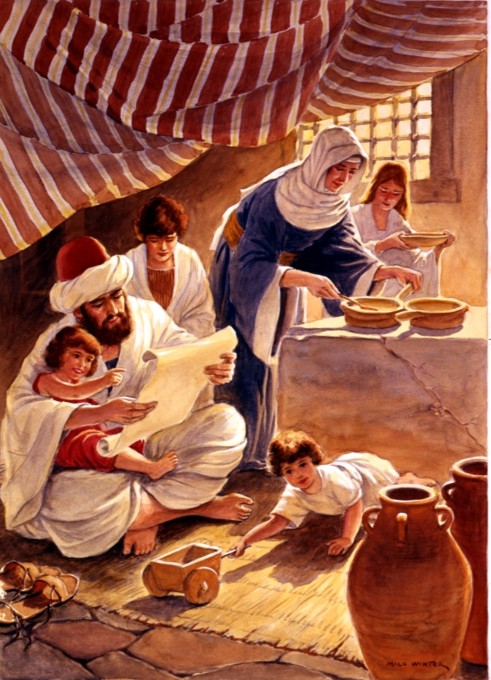
Father reads the Scriptures from a scroll to his family as the mother prepares food to eat.

Father reads the Scriptures from a scroll to his family as the mother prepares food to eat.

Once again, this year we will be following someone else’s reading plan, and once again, it is singularly special! It was not finished at the time of this writing, but I will post the schedule on the “Schedules” tab as soon as I get it.

Here is what I can tell you about it. We will be spending the entire year studying the Book of Luke and the Book of Acts.  The plan’s designer appropriately calls it “Cause and Effect.” We will be reading at the pace of a chapter a week. An easy schedule? Perhaps, but some of the chapters are quite long, and there is no shortage of material to study.

First, 24 chapters of Luke – all focused on the life, death, burial, and Resurrection of the savior, Jesus the Christ. And 28 chapters of the Book of the Acts of the Apostles – from the first gospel sermon ever to the imprisonment of Paul in Rome. It is going to be another great year in God’s word, I can  promise you! And we will start tomorrow!

Science museum, Vancouver

Science museum, Vancouver

But, as our regular readers know, since our reading plans are 5 days per week, we have always done something different on Sundays. And 2014 will be no exception. We will still be writing on various subjects and about several different books of the Bible throughout the year. But we will be doing two things on a fairly regular basis.

First, we will have more frequent articles centered on the subject of Apologetics- articles designed to help the christian strengthen his or her faith in God’s word, and hopefully, help prepare to comply with 1 Peter 3:15: “…always being prepared to make a defense to anyone who asks you for a reason for the hope that is in you; yet do it with gentleness and respect…”

Throughout the wilderness journey, Moses talked to the Lord, often begging Him for help in leading the Israelites.

Throughout the wilderness journey, Moses talked to the Lord, often begging Him for help in leading the Israelites.

Secondly, we will try to devote one Sunday article per month to the subject of prayer – the other half of our communication with the Lord. In doing so, it is our hope that we can improve our ability to pray more effective prayers that are pleasing to the Lord and beneficial to those we pray for – and pray with. With God’s help, we hope this will also be an aid to men who often are called upon to lead public prayers in church services and elsewhere.

We hope and pray that these new items on our agenda for 2014 will help us all to grow spiritually in the coming year. We hope you will join us in this effort!

/Bob’s boy

Acts 28 – Paul Arrives in Rome

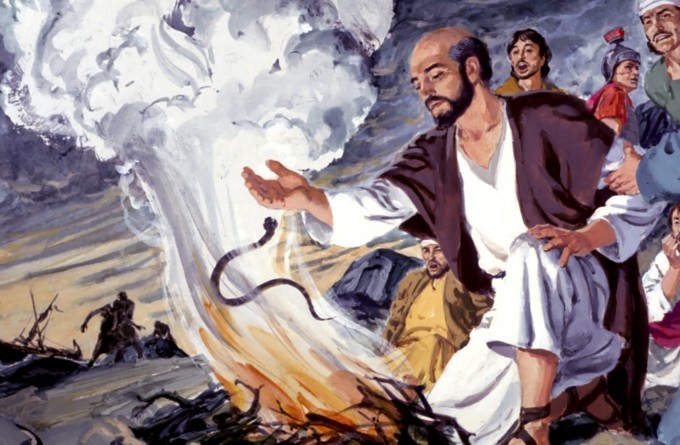
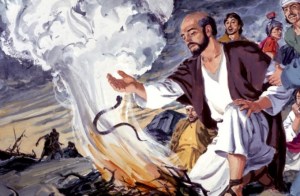
On Paul’s journey to Rome, his ship was wrecked on Melita, or Malta. There he was bit by a poisonous snake, but he didn’t die (Acts 27:39–28:6)

Luke picked up the account after the shipwreck, where they learned that the island they had safely reached is called Malta.  He said that the natives were kind and welcoming, and even helped them with a fire.  But a snake came out because of the heat, and fastened himself to Paul’s hand.  The sight of the deadly creature hanging from his limb just after he had been rescued from a life-threatening shipwreck made them suppose that he must be a murderer, getting his just reward (Greek and Roman tales had long spoken of just such events – “The Argonautica”, for example).  But God was certainly not going to let anything happen to him.  When he neither died nor showed any ill effects from the bite, they then thought Paul himself to be a god.

Publius in verse 7, is described as a “chief man” – the Greek term for which is “protos,” of which term several inscriptions have been found.  Several references to Publius and this chapter, along with photographs can be found in this article at BiblePlaces.com.  Publius’ father was ill with fever and dysentery (the description of which ills fit those of an infection caused by goat’s milk called “Malta fever”).  Paul healed him, as well as others of the island with diseases that were brought to him afterward (verses 8-9).

The shipwreck occurred on Malta, where the ship’s company spent three months. Finally, another ship gave them passage for the 100 miles to Syracuse, capital of Sicily, then sailed on to Rhegium, finally dropping anchor at Puteoli. Paul was taken to the forum on the Appian Way and to The Three Taverns before arriving in Rome.

After three months, they again set sail in a ship from Alexandria that had been wintering there.  Luke describes the ship as having a figurehead of the “twin gods” (Castor and Pollux, the mythological twin sons of Zeus and Leda, were seen as the protectors of seamen).  They put in at Syracuse for three days, then ended up in Puteoli, where they stayed with brethren they had found for seven days, then to Rome.  The brethren there heard, and came from as far away as “The Three Taverns” and the “Forum of Appius” (hence, the name, the Appian Way) (verses 12-16).

Paul spent considerable time preaching and trying to convince the Jews there of the good news of Jesus through the words of Moses and the prophets.  Some believed, but others did not – the latter leaving disagreeably (verses 23-25).  Paul quoted Isaiah 6:9-10 to them in verses 26-27; and then told them that now this news of the salvation of God will be brought to the Gentiles, for they will listen.

Verses 30-31 close out the book of Acts with the word that Paul remained there two full years, at his own expense, “teaching about the Lord Jesus Christ with all boldness and without hindrance.”  No further word is given of Paul’s appearance before Caesar, or any confirmation of secular writings that suggest he fulfilled his desire to go and preach in Spain, nor of a second imprisonment before his martyrdom.  As much as we would like to know of the rest of Paul’s story, the inspired word of God does not tell us because the book of Acts is not Paul’s biography, but the word “breathed out by God and profitable for teaching, for reproof, for correction, and for training in righteousness…” (2 Timothy 3:16).

So, one might wonder, if it was so important for Paul to appear before Caesar, why is there nearly a chapter and a half about the journey and shipwreck, and not a word about what was so important about that appearance?  The answer is that first, God had some reason for Paul to go to stand before Caesar that fulfilled His purpose, but there have been countless events since creation important to Him that are not  important for us to know about for teaching, for reproof, for correction, or for training in righteousness.  But the journey and shipwreck teach a couple of important lessons.  One is that when God wants something done, it gets done, period!  Nothing will stop it from completion.  The other is that God, as we have seen since Genesis, always keeps His promises.  Paul was imprisoned, betrayed, the target of assassination, 2,000 miles away from his destination, shipwrecked, stranded on an island, and had a deadly snake bite him severely enough to have hung from his hand.  Yet God wanted him to be in Rome, and had promised that he would get there safely.  We can take comfort, knowing that His will is going to be done, and that He has promised salvation for His faithful.

Read or listen to audio of ESV version of this selection from this link.

/Bob’s boy
___________________
some images © V. Gilbert & Arlisle F. Beers

Please note: I did not design the reading plan that I am following in my blog.  All of my comments in this blog, however, are solely my responsibility.  When reading ANY commentary, you should ALWAYS refer first to the scripture, which is God’s unchanging and unfailing word. Reading schedules, as well as a link to the site where you can get the reading plan that I’m currently following for yourself can be found on the “Bible Reading Schedules” page of my website at http://graceofourlord.com.  For questions and help, please see the “FAQ” and “Summaries” pages there.

Acts 27 – Paul Sails for Rome / Shipwreck

Once again, Luke begins the chapter speaking in the first person plural, indicating that he was with Paul all the way to Rome as they set sail for Italy.  The centurion, Julius, that Paul and the other prisoners were delivered to is said to have been “of the Augustan Cohort.”  A cohort generally consisted of six hundred men under the command of six centurions.  However, auxiliary forces of the cohort could push the numbers up to a thousand men.  The cohorts were given names – this one likely given the name for the imperially dedicated regiment founded by the emperor, Augustus, who reigned from 27 BC to 14 AD.

Map of Paul’s second missionary journey (shown to illustrate location of Mysia)

Don’t get confused by verse 2’s statement “embarking in a ship of Adramyttium.”  The ship was from Adramyttium (the Latin name for Edremit), an ancient port city of Mysia in the Roman province of Asia Minor (see first map), near present-day Edremit – Turkey.  But it was carrying them from their starting point in Caesarea – the next stop being Sidon (see second map).  Aristarchus, mentioned as accompanying them in the same verse, is one of the disciples that was dragged into the theater during the riot in Ephesus (Acts 19:29).

Verse 9’s “the Fast” refers to the Day of Atonement, which would have been in October.  From this time to about April, Meditteranean sailing is (and was) most dangerous; and Paul was already warning them that the voyage would result in “injury and much loss” (verse 10).  But the centurion sided with the captain and the rest of the crew, who judged the harbor at Fair Havens to be unsuitable for the winter.  So they decided to try to make it to “Phoenix, a harbor of Crete,” (probably present day Phineka Bay) to spend the winter.  This was, after all, a 2,000 mile voyage to Rome.

Paul began his 2,000 mile trip to Rome at Caesarea. To avoid the open seas, the ship followed the coastline. At Myra, Paul was put on a vessel bound for Italy. It arrived with difficulty at Cnidus, then went to Crete, landing at the port of Fair Havens. The next stop was Phoenix, but the ship was blown south around the island of Cauda, then drifted for two weeks until it was shipwrecked on the island of Malta.

When a northeaster – a fearsome storm – arrived, it tossed them about so badly that they began jettisoning cargo and tossing the ship’s “tackle” overboard (the tackle may have been the beam supporting the ship’s mainsail).  Most had lost hope when Paul told them that “an angel of the God to whom I belong and whom I worship” had appeared and told him not to be afraid – that he must stand before Caesar, so they would all be spared.  But, he told them, they would have to run the ship aground on “some island”  (verse 26).

The mention of the men taking a “sounding” refers to measuring the depth of the water by use of a “sounding line.”  When they found that they were nearing land, the sailors (afraid of the ship hitting rocks) were lowering boats to abandon ship under the pretense of laying anchors.  But Paul warned the centurion, saying that they would not make it if the sailors left the ship.  So the soldiers cut the boats loose from the ship to prevent escape.

Having conserved all they could, the fourteenth day without having eaten approached, and Paul urged them all to eat, in order to gather their strength.  He did so himself, giving thanks to God; and they were encouraged, and all ate some.  There were 276 aboard (verse 27) – about the right amount for the vessel to have been a large grain ship , meaning it was probably not worthy of such a voyage.

Verses 39-44 detail the horrific shipwreck on the reefs, and the escape to land that all of them made safely, hanging on to the wreckage.  Verses 42-43 tell us that the soldiers had planned to kill the prisoners, so that none could escape.  But the centurion, wishing to save Paul, prevented them.  God had, as always, made good on his promise to save them.

Read or listen to audio of ESV version of this selection from this link.

/Bob’s boy
___________________
some images © V. Gilbert & Arlisle F. Beers

Please note: I did not design the reading plan that I am following in my blog.  All of my comments in this blog, however, are solely my responsibility.  When reading ANY commentary, you should ALWAYS refer first to the scripture, which is God’s unchanging and unfailing word. Reading schedules, as well as a link to the site where you can get the reading plan that I’m currently following for yourself can be found on the “Bible Reading Schedules” page of my website at http://graceofourlord.com.  For questions and help, please see the “FAQ” and “Summaries” pages there.

Acts 26 – Paul’s Defense Before Agrippa

English: A coin bronze minted by Herod of Chal...

English: A coin bronze minted by Herod of Chalcis depicting Herod with his brother Agrippa of Judaea crowning Roman Emperor Claudius I. On display at the british museum. CM 1985.10-2.1 (Photo credit: Wikipedia)

As the chapter opens, Agrippa has given Paul permission to speak in his defense.  In verses 2-3, Paul speaks of feeling fortunate to be appearing before Agrippa, since he was familiar with “the customs and controversies of the Jews.”  In fact, Agrippa’s reputation was that of a pious Jew, though much of the rest of his reputation was not so good.  Still, he was (like his uncle Herod) in control of the temple treasury, and the Romans consulted him on religious matters.

Paul then tells Agrippa of his persecution of Christians before his conversion, then gives us the third account in this book of his vision – his encounter with the Lord on the road to Damascus (the other two being in Acts 9 and Acts 22), and ending with the charge that Jesus gave him (verses 15-18).  From this chapter’s account, we have more details about what Jesus said to him on that first occasion.  “To kick against the goads” in verse 14 is an old proverbial saying that refers to use of a pointed instrument to prod oxen as they plowed.  A stubborn ox that continued to kick would only injure itself if it continued to do so – making its resistance futile.

The outburst of Festus during Paul’s reference to the fulfilling of all that Moses and the prophets said would take place would seem to affirm his alignment with the Jewish accusers.  But Paul seems pretty confident that Agrippa is not so inclined.  Note verse 27 – “King Agrippa, do you believe the prophets? I know that you believe.”  Agrippa is no fool, and Paul is surely not foolish enough to speak hastily when he says in verse 26: “For the king knows about these things, and to him I speak boldly. For I am persuaded that none of these things has escaped his notice, for this has not been done in a corner.”  Indeed, regarding that last phrase, Coffman summed it up beautifully:

That earthquake which accompanied the Son of God in his visitation of our planet is still sending shock waves around the earth. The fact of his birth split human history into B.C. and A.D.; his crucifixion bruised the head of Satan himself; his resurrection brought life and immortality to light through the gospel; his teachings monitor the deeds and thoughts of all men; and his word shall judge the living and the dead at the Last Day. Done in a corner? Yes, in a little corner of the universe known as the Planet Earth; but that earth can never forget him, or get rid of him. As some of the Sadducees and Pharisees were able to see while he was among them: “The world is gone after him (John 12:19).

King Agrippa judged Paul, but Paul had already appealed to Caesar, so Agrippa could not set him free

Verse 28 is difficult in translation, but regardless of the translated version, it says that Agrippa was not quite ready to accept the fact of Jesus as Lord and Christ; and is the inspiration for the hymn, “Almost Persuaded.”  Paul’s response is that he would have Agrippa and all who hear him to be as Paul himself is (minus the chains, of course) – that is, to believe in the Lord.

Agrippa’s statement to Festus after he, Bernice and the others had met outside Paul’s presence (verses 30-32) is a sort of vindication, but not the end of Paul’s ordeal.  Agrippa could have set Paul free if he had not appealed to Caesar, but he had no choice by law but to send him to so appear before the emperor.

Read or listen to audio of ESV version of this selection from this link.

/Bob’s boy
___________________
some images © V. Gilbert & Arlisle F. Beers

Please note: I did not design the reading plan that I am following in my blog.  All of my comments in this blog, however, are solely my responsibility.  When reading ANY commentary, you should ALWAYS refer first to the scripture, which is God’s unchanging and unfailing word. Reading schedules, as well as a link to the site where you can get the reading plan that I’m currently following for yourself can be found on the “Bible Reading Schedules” page of my website at http://graceofourlord.com.  For questions and help, please see the “FAQ” and “Summaries” pages there.

Acts 25 – Paul Appeals to Caesar

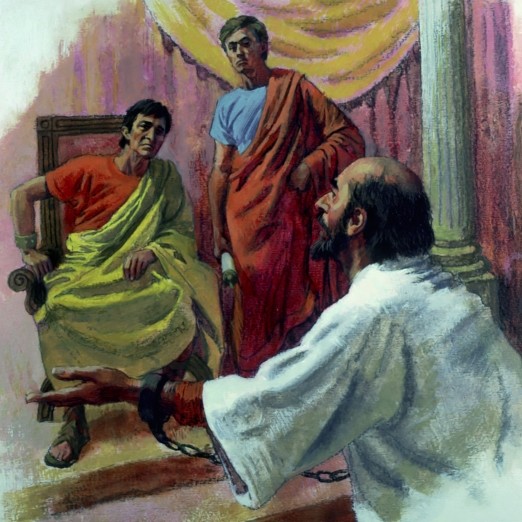
After Festus arrived in Caesarea to become governor instead of Felix, he judged Paul

Antonius Felix was replaced by Porcius Festus as the Roman procurator of Judea from about 59 to 62 AD.  During his reign, hostility to Roman rule was heating to a fevered pitch, preceding the “Great Revolt” (the Jewish-Roman war of AD 66) that ended with the destruction of Jerusalem in AD 70.  Wasting no time after Festus assumed his role, verse 2 says that “the chief priests and the principal men of the Jews laid out their case against Paul,” trying to persuade him to send Paul to Jerusalem so they could ambush him.  These “chief priests and principal men” were most likely of the Sanhedrin, and had conspired with more than 40 others to kill Paul in Acts 23:12-15.  In verse 9, Festus was ready to send Paul to Jerusalem as a favor to the Jews, when Paul invoked his right as a Roman citizen to appeal to Caesar.

After some days, Festus met with King Agrippa II and his sister, Bernice, who was always by his side (one of his other siblings was Drusilla, who was the wife of Festus’ predecessor, Felix).  This Agrippa was educated in the court of the emperor Claudius, and was the son of Herod Agrippa I, who in Acts 12:1-3 had the Apostle James killed and Peter arrested, and who the Lord stuck down dead in Acts 12:21-23.  He was also the great-grandson of Herod the Great – who had ordered the killing of all the male children of the region around Bethlehem when Jesus was born.   As Festus laid out the case against Paul, he concluded by surmising that the matter was a dispute about their religion, and the death of “a certain Jesus, who was dead, but whom Paul asserted to be alive” (verse 19).

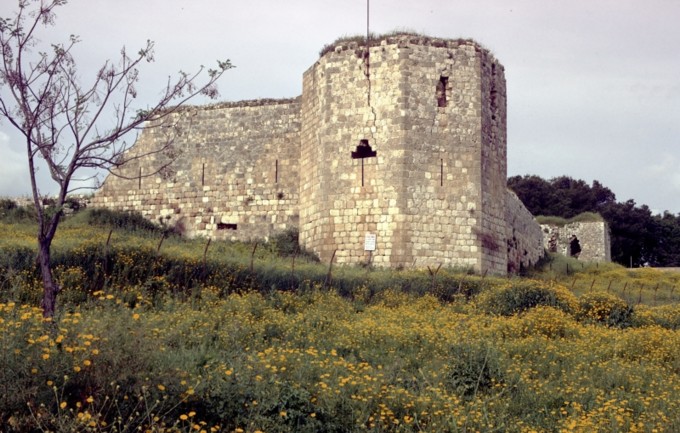
The first Herod, called The Great, wanted to honor his patron, Augustus Caesar, with a fine harbor. Joppa was not fitting since it was dominated by strong Jewish, anti-Roman, feelings. So Herod spent twelve years building a magnificent harbor and naming it Caesarea. Here Paul was imprisoned for two years and brought to trial before governors Felix and Festus, King Agrippa, and Bernice. Ruins here are from both Roman times and later Crusader times, about 1100-1300 A.D. Ruins of the Crusader city.

The next day, Festus introduced Paul, saying in a nutshell that (interestingly enough) he had found no charge deserving of death for Paul, and therefore he thought it wise to have him appear to Agrippa, so that maybe he (Festus) would have “something to write” before sending him to Caesar.

Read or listen to audio of ESV version of this selection from this link.

/Bob’s boy
___________________
some images © V. Gilbert & Arlisle F. Beers

Please note: I did not design the reading plan that I am following in my blog.  All of my comments in this blog, however, are solely my responsibility.  When reading ANY commentary, you should ALWAYS refer first to the scripture, which is God’s unchanging and unfailing word. Reading schedules, as well as a link to the site where you can get the reading plan that I’m currently following for yourself can be found on the “Bible Reading Schedules” page of my website at http://graceofourlord.com.  For questions and help, please see the “FAQ” and “Summaries” pages there.


Closing Acts \ Week 46 summary posted

Paul finally visited Rome while a captive awaiting his trial before Caesar. The letter to the Ephesians is one of the Prison Letters. It was probably written during his first imprisonment in Rome, which lasted from A.D. 60 to 62.

This week, we wrap up our reading of the Acts of the Apostles beginning with Paul still in prison.   He appears before King Agrippa II and his sister, Bernice, who was always by his side.  One of Agrippa’s other siblings was Drusilla, who was the wife of Festus’ predecessor, Felix).  This Agrippa was educated in the court of the emperor Claudius, and was the son of Herod Agrippa I, who in Acts 12:1-3 had the Apostle James killed and Peter arrested, and who the Lord stuck down dead in Acts 12:21-23.  These events are followed this week by shipwrecks, snakes, and of course, Paul preaching the good news about Jesus Christ. Then we will read the first chapter of Paul’s epistle to the Ephesians, which Paul wrote while in prison in Rome.

Summing Up

Each weekend, I am now posting a small PDF of one week of chapter summaries (on the website’s “Summaries” page), current to the beginning of the previous week.  I have posted the summary for Week 46 (November Week 2) of the schedule I am following.  This short PDF document contains condensed comments about 2 Corinthians 8, 9, and Romans 1, 2, and 3, with hyperlinks to the ESV version of each chapter for listening or reading, and joins the summaries for other weeks already posted there.

/Bob’s boy
___________________
image © V. Gilbert & Arlisle F. Beers

Please note: I did not design the reading plan that I am following in my blog.  All of my comments in this blog, however, are solely my responsibility.  When reading ANY commentary, you should ALWAYS refer first to the scripture, which is God’s unchanging and unfailing word. Reading schedules, as well as a link to the site where you can get the reading plan that I’m currently following for yourself can be found on the “Bible Reading Schedules” page of my website at http://graceofourlord.com.  For questions and help, please see the “FAQ” and “Summaries” pages there.

Acts 24 – Paul Before Felix at Caesarea

While Paul was held as a prisoner in Caesarea, Tertullus came to accuse him before governor Felix (Acts 24).

Having been escorted to Caesarea on the order of Lysias, the Roman tribune, Paul finally appears before Felix after Ananias and the rest of his accusers arrive.  Not much is known about the “spokesman,” Tertullus.  Some suppose that he may have been a both a Gentile (which, if true, this blogger finds nearly hilariously ironic and hypocritical) and a lawyer.  When he addresses Felix, he begins by flattering him with praise about his reforms and the “peace” they enjoy.  This was utter nonsense!  Antonius Felix is remembered today for his cruelty, bribe-taking, and general corruption; and the crime rate soared under his reign in Judea.   When he went back to Rome after his tenure, he was accused of using a dispute between Jews and Syrians to murder and pillage numbers of the  people of Caesarea. He escaped prosecution thanks to his brother, Marcus Antonius Pallas, who had been the secretary of treasury to Emperor Claudius.

When Felix gave him his turn, Paul laid out his defense in verses 10-21, methodically disputing the accusations with the obvious truth – which his accusers were unable to counter.  In verse 14, he “confesses” that he is a part of “the Way” (which Tertullus called “the sect of the Nazarenes,”), through which he worships “the God of our fathers, believing everything laid down by the Law and written in the Prophets, having a hope in God, which these men themselves accept, that there will be a resurrection of both the just and the unjust.”   Thus, Paul not only makes the case that he is a “good Jew,” but that Christianity is God’s divine will.

Felix seemed to be aware of Paul’s innocence, but was more interested in the possibility of getting some money from him over a period of time (verse 26), as well as garnering support from the Jews.  After two years had passed, he left Paul in prison as a favor to them when he was replaced by Porcius Festus.

Read or listen to audio of ESV version of this selection from this link.

/Bob’s boy
___________________
some images © V. Gilbert & Arlisle F. Beers

Please note: I did not design the reading plan that I am following in my blog.  All of my comments in this blog, however, are solely my responsibility.  When reading ANY commentary, you should ALWAYS refer first to the scripture, which is God’s unchanging and unfailing word. Reading schedules, as well as a link to the site where you can get the reading plan that I’m currently following for yourself can be found on the “Bible Reading Schedules” page of my website at http://graceofourlord.com.  For questions and help, please see the “FAQ” and “Summaries” pages there.

Acts 23 – A Plot to Kill Paul

Paul appeared before the Jewish council

Paul had just begun to speak to the Sanhedrin council, when the high priest unlawfully ordered him to be struck (it was unlawful to strike a man who had not yet been condemned).  Paul correctly predicts Ananias’ demise in verse 3, as he will be killed by his own people at the start of the Jewish war.  There are a lot of theories (total speculation, of course) about verses 4-5 and Paul’s disrespect for Ananias, but whatever the case, we should take Paul at his word that he did not know who he was addressing.  It is noteworthy, however, how quick they were to point out that fact, yet ignore the willful violation made against Paul.  At that point, he would have no question (if there was doubt before) about whether he would receive a fair hearing from them.

Paul then uses the fact that the Sanhedrin council was made up of both Pharisees and Sadducees to his advantage.  The Sadducees did not believe in resurrection, but the Pharisees did – and the division between them because of it was great.  Paul’s statement in verse 6 makes that division so sharp that it became violent.  The Roman tribune then feared that Paul would be torn to pieces, and had the soldiers remove him and take him to the barracks.  Paul’s statement that set it in motion was “brothers, I am a Pharisee, a son of Pharisees. It is with respect to the hope and the resurrection of the dead that I am on trial;” and every word of it was true.  Paul had been raised a Pharisee (Philippians 3:5-9), and it was indeed because of the resurrection of Jesus Christ, and the hope, that he was on trial.  The following night, the Lord stood by him for encouragement and told him that he must go to Rome to testify the facts about Him (verse 11).

Antipatris was the Old Testament Philistine city of Aphek (1 Samuel 4: 1; 29: 1). The New Testament city was built by Herod the Great in 9 BC. Antipatris was named for Antipater, Herod the Great’s father. Ras el-‘Ain is the site of the ruins of the ancient city. The spring at Antipatris is the source of the River Auja. Paul was taken here (Acts 23: 31) on the way to his imprisonment in Caesarea.

The Jews then sensed that Paul’s fate was slipping away, so more than forty of them conspired to kill him, taking an oath not to eat or drink until they had done so.  Such an oath was a serious matter – not made flippantly (and reminds us of Jezebel in 1 Kings 19:2).  Verse 14  leaves no doubt of the extent of corruption there, as we learn that the chief priests and elders were involved in this despicable plot.  But Paul’s sister learned of the plot and sent her son to warn him.  Paul then sends his nephew to tell the tribune (whose name we learn in verse 26 is  Claudius Lysias).  Lysias then composed a letter to Felix the governor (verse 26-30), putting himself, of course, in a favorable light.  At his orders, Paul gets an escort of two hundred soldiers to deliver him and the letter to Antipatris by the dark of night.  Upon reading the letter and questioning Paul as to his birthplace, he ordered Paul held in Herod’s praetorium (one of Herod’s palaces that the governor used for his quarters), as he awaits his accusers for a hearing.

Read or listen to audio of ESV version of this selection from this link.

/Bob’s boy
___________________
some images © V. Gilbert & Arlisle F. Beers

Please note: I did not design the reading plan that I am following in my blog.  All of my comments in this blog, however, are solely my responsibility.  When reading ANY commentary, you should ALWAYS refer first to the scripture, which is God’s unchanging and unfailing word. Reading schedules, as well as a link to the site where you can get the reading plan that I’m currently following for yourself can be found on the “Bible Reading Schedules” page of my website at http://graceofourlord.com.  For questions and help, please see the “FAQ” and “Summaries” pages there.