Romans 2 – God’s Judgment and the Law

Colosseum, Rome, Italy.
Many gladiators and wild beasts were killed here to entertain the Roman people. Tradition says that this was the site where many Christians were martyred, especially under the Emperor Nero.

In this chapter, Paul addresses the Jews of the church at Rome, as their self-righteousness threatens the unity of the church – just as it did in Galatia and elsewhere.  But here again, the applications to all people are clear.  He again states that the Gentiles are without excuse, for just as the evidence for God abounds, he also says “the law is written on their hearts.”  So even though they did not have prophets who wrote the law as the Jews knew it, the Gentiles knew enough “to do what the law requires” (verses 14-15).

But the Jews, who had the law and were circumcised, were warned that they who pass judgment on others are not without sin themselves.  So they should not boast and be judgmental because if they know the law and additionally are circumcised, but still live in sin they are just as guilty – for God shows no partiality.  They are not favored of God for their knowledge of the law or for their circumcision.  Though it is still admirable that they keep the law of circumcision, it is no longer required anyway, and it is of no value to them in their sin.

Paul is not speaking of baptism here, nor is he comparing it to circumcision.  But as Christians today we would do well to remember this passage when it comes to others.  Being “raised in the church,” knowing and even reading their Bible, and even having been baptized are all of no value if we live in sin anyway.  In that case, we will be just as lost as those who never obeyed the gospel.  As it was true then of being a Jew and being circumcised, it is living a life that is consistent with faith in (and commitment to) the Lord that has value.

Read or listen to audio of ESV version of this selection from this link.

/Bob’s boy
___________________
some images © V. Gilbert & Arlisle F. Beers

Please note: I did not design the reading plan that I am following in my blog.  All of my comments in this blog, however, are solely my responsibility.  When reading ANY commentary, you should ALWAYS refer first to the scripture, which is God’s unchanging and unfailing word. Reading schedules, as well as a link to the site where you can get the reading plan that I’m currently following for yourself can be found on the “Bible Reading Schedules” page of my website at http://graceofourlord.com.  For questions and help, please see the “FAQ” and “Summaries” pages there.

Romans 1 – God’s Wrath on Unrighteousness

Paul opens this letter affirming his apostleship, as was his custom with letters to churches that were not so familiar with him. He reinforces that in verses 4-6 by stating that, through Jesus, he and the other apostles “received grace and apostleship to bring about the obedience of faith for the sake of his name among all the nations, including you who are called to belong to Jesus Christ…”    The long introduction also affirms that Jesus is the Son of God, and that he was descended from David, fulfilling Old Testament prophecy (verse 4); and he declares the mission to the Gentiles (verse 13).  He also expresses, at some length, his eagerness to go to Rome for fellowship and sharing the gospel with them.
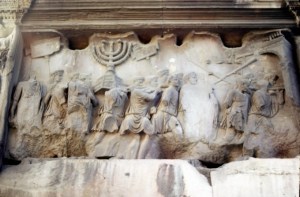
The Arch of Titus from outside the Forum, Rome, Italy. Located at the highest point of the Via Sacra which leads to the Roman Forum, this triumphal arch, with only one passageway, commemorates Titus’ conquest of Judea which ended the Jewish Wars (66-70). Engaged fluted columns frame the passageway.

Not much is known for certain about the church at Rome.  But by virtue of it being in Rome, its fame would have been considerable and, like the other churches, it was composed of both Jews and Gentiles.  The remainder of this chapter focuses on the need for righteousness on the part of the Gentiles, and Paul does not mince words in pointing out the history of unrighteousness on their part.  But as the letter continues, it will become apparent that McGarvey’s assessment is largely correct.  He writes:

“The Judaizing tendencies which had recently appeared in Corinth and Galatia were sure eventually to appear in other churches, perhaps ultimately in all, and the attitude assumed by a church already so influential and destined to increase in power was sure to carry great weight in deciding the controversy. Therefore, to set the church of Rome right as to the design and nature of the gospel was a work of supreme importance…”

Heading off such a crevasse in this church was of great concern, to be sure.  McGarvey further expounds most aptly:

“The purpose of the letter is to set forth, as Baur rightly expresses it, ‘both the relation of Judaism and heathenism to each other, and the relation of both to Christianity;’  primarily, for the instruction of the Christians in Rome, and, secondarily, for the benefit of all the churches by the establishment of peace between their Jewish and Gentile elements, and, ultimately, for the enlightening of the kingdom of God in all ages.”

Though verses 18-24 are here specifically directed at those Gentiles, they contain some of the most profound (and certainly definitive) statements applicable to all people everywhere concerning God’s existence, and thus they provide the very basis of sound apologetics.  The “wrath of God” in verse 18 represents his holiness, judgment, and yet loving response to the unrighteousness of mankind.  When Paul says that all mankind knows God, he is not speaking of the concept of a god or of deity in general.  Man knows the one true and living God because the evidence abounds in everything He created, yet he suppresses the truth in unrighteousness.  His attributes, including His eternal power and divine nature have been clearly perceived since the creation of the world, so that everyone is without excuse.

And God said, “Let the waters under the heavens be gathered together into one place, and let the dry land appear.” And it was so. Gen 1:9

Man has always tended to be full of himself because of the material knowledge he acquires, only made possible by God; and “claiming to be wise, they became fools…”  Man’s desire for sin and all that is an abomination to his Creator moves him to exchange the truth about God for a lie (verse 25) and worship the creature rather than the Creator even to this day.  People who deny Him do so by conscious choice in a futile attempt to justify their own unrighteousness.  The “shameful acts” Paul lists as driving this begins with unnatural relations of men and women with others of the same gender, and in verse 29 runs from gossips to murderers and “all manner of evil” in between – as God makes no distinction between what man considers “small” or large sins.

Any claim by someone who says they would believe if the evidence was there is hogwash.   Blindness to the more than substantial evidence is entirely willful.

Read or listen to audio of ESV version of this selection from this link.

/Bob’s boy
___________________
some images © V. Gilbert & Arlisle F. Beers

Please note: I did not design the reading plan that I am following in my blog.  All of my comments in this blog, however, are solely my responsibility.  When reading ANY commentary, you should ALWAYS refer first to the scripture, which is God’s unchanging and unfailing word. Reading schedules, as well as a link to the site where you can get the reading plan that I’m currently following for yourself can be found on the “Bible Reading Schedules” page of my website at http://graceofourlord.com.  For questions and help, please see the “FAQ” and “Summaries” pages there.

2 Corinthians 9 – The Cheerful Giver

Paul continues in this chapter about the collection for the saints at Jerusalem, acknowledging that the Corinthians had already expressed their desire to do it and made the pledge.  He wants to make sure they have it ready when the brethren arrive to take charge of it, so that it does not look like an after-thought.  If they have to scramble around and scurry after it, there is more chance that some will miss their opportunity to give – and this would reflect badly on the others.  Note Paul’s use of the word “we” in verse 4.  He is speaking not just of himself, but identifying himself with them at Corinth – as well as the other Gentiles who had shown their generosity.

Achaia mentioned in 2 Cor 9:2- (from Barnes’ notes): “This word, in its largest sense, comprehended the whole of Greece. Achaia proper, however, was a province of which Corinth was the capital. It embraced that part of Greece lying between Thessaly and the southern part of the Peloponnesus.”

The generous gifts to the poor at the Jerusalem church by these Christians (who had been pagans before) will increase the faith of those at Jerusalem and help them to see the sincerity and genuineness of the conversion of those at Corinth.  Verses 6-11 are sometimes used to promote the preaching of some that giving to others will bring the giver prosperity and health.  God surely blesses the cheerful giver (verse 7), but building material wealth for the generous giver is not God’s intention; and if such is the motive, it is vain.  God will surely “increase the harvest of your righteousness” as one gives cheerfully (verse 10), and will enrich one spiritually as well.  Any increase in wealth one enjoys should be the motivation for more generosity, and more thanksgiving to God (verses 11-12).

Read or listen to audio of ESV version of this selection from this link.

/Bob’s boy
___________________
some images © V. Gilbert & Arlisle F. Beers

Please note: I did not design the reading plan that I am following in my blog.  All of my comments in this blog, however, are solely my responsibility.  When reading ANY commentary, you should ALWAYS refer first to the scripture, which is God’s unchanging and unfailing word. Reading schedules, as well as a link to the site where you can get the reading plan that I’m currently following for yourself can be found on the “Bible Reading Schedules” page of my website at http://graceofourlord.com.  For questions and help, please see the “FAQ” and “Summaries” pages there.

2 Corinthians 8 – Encouragement to Give Generously

In chapter 7 of this letter, Paul expressed his joy at the news Titus brought him that the reception by the brethren at Corinth of his first letter.  Many of them had been moved to repentance (2 Corinthians 7:8-9).  Paul is sincerely proud of them, and now he reminds them of the collection for the poor in Jerusalem that was being gathered.  He had first spoken to them about it several months ago (verse 10), and they had been happy to commit to doing it.  Paul knows that this effort will be good for them as well.

Macedonia, Greece, east of Appolonia; Paul visited on his Second Missionary Journey after his Macedonian vision.

Paul also points out the generosity of the brethren of Macedonia in this effort, of which McGarvey writes: “The only Macedonian churches known to us were those at Philippi, Thessalonica and Beroea. The district of Macedonia had suffered in the three civil wars, and had been reduced to such poverty that Tiberius Cæsar, hearkening to their petitions, had lightened their taxes. But in addition to this general poverty, the churches had been made poor by persecution (2 Thess 1:4).”   As the Corinthian brethren were, by and large, substantially better off, Paul encourages their generosity as well, quoting Exodus 16:18 in verse 15.  In verses 16-22, he stresses the point that trusted brethren will be carrying these gifts, so that there could be no hint of impropriety.  One of those – the  “brother who is famous among all the churches for his preaching” of verse 18 – is thought by some to be Luke, but we do not know.

Read or listen to audio of ESV version of this selection from this link.

/Bob’s boy
___________________
some images © V. Gilbert & Arlisle F. Beers

Please note: I did not design the reading plan that I am following in my blog.  All of my comments in this blog, however, are solely my responsibility.  When reading ANY commentary, you should ALWAYS refer first to the scripture, which is God’s unchanging and unfailing word. Reading schedules, as well as a link to the site where you can get the reading plan that I’m currently following for yourself can be found on the “Bible Reading Schedules” page of my website at http://graceofourlord.com.  For questions and help, please see the “FAQ” and “Summaries” pages there.

Week 44 summary posted

The Arch of Constantine, Rome.
A triumphal arch, erected about 315 AD to commemorate the triumph of Constantine I after his victory over Maxentius in the battle at the Milvian Bridge in 312 AD. The arch is located in the valley of the Colosseum, between the Palatine Hill and the Colosseum, along the road taken by the triumphal processions.The arch is the largest of only three such arches to survive in Rome today. The two others are the Arch of Titus and the Arch of Septimius Severus, both in the nearby Forum Romanum.

We will be wrapping up our study of the Corinthian letters this week, and begin with the first three chapters of the book of Romans before returning to the book of Acts next week.

Summing Up

Each weekend, I am now posting a small PDF of one week of chapter summaries (on the website’s “Summaries” page), current to the beginning of the previous week.  I have posted the summary for Week 44 (October Week 5) of the schedule I am following.  This short PDF document contains condensed comments about Acts 19, 20, 1 Cor 1, 1 Cor 5, and 1 Cor 10, with hyperlinks to the ESV version of each chapter for listening or reading, and joins the summaries for other weeks already posted there.

/Bob’s boy
___________________
image © V. Gilbert & Arlisle F. Beers

Please note: I did not design the reading plan that I am following in my blog.  All of my comments in this blog, however, are solely my responsibility.  When reading ANY commentary, you should ALWAYS refer first to the scripture, which is God’s unchanging and unfailing word. Reading schedules, as well as a link to the site where you can get the reading plan that I’m currently following for yourself can be found on the “Bible Reading Schedules” page of my website at http://graceofourlord.com.  For questions and help, please see the “FAQ” and “Summaries” pages there.

2 Corinthians 6 – The Temple of the Living God

Corinth turkish watering place

Paul quotes Isaiah 49:8 in verse 2, noting that now is the favorable time for their salvation.  Receiving God’s grace in vain refers to having been saved and now running the risk of slipping away.  He points out that they experience great persecution unjustly (verses 8-10), but they endure hardships and adversities by the gifts of the spirit within them.  Verses 14-18 are often taken to mean that Christians should not have any associations with unbelievers, but such is not the case since he tells us in 1 Corinthians 5:10 that we would have to “go out of the world” in order to do that; and we must be “in the world” in order to spread the gospel.  Jesus prayed about being “in the world” but not “of the world” in John 17:15-16.  But their association with idol worshipers is problematic; and it may drag many back into its clutches (verses 14-18)s.

The applications for us are 1) that our faith in Jesus as Lord is our anchor when we suffer adversity and 2) that if we have a sinful inclination that we have overcome, we should not put ourselves in a position to be taken back into that sin. Just as it would be a mistake for someone who had been an alcoholic to return to frequenting bars for company, those who had previously worshiped idols should not return to spending time at those temples.

Read or listen to audio of ESV version of this selection from this link.

/Bob’s boy
___________________
some images © V. Gilbert & Arlisle F. Beers

Please note: I did not design the reading plan that I am following in my blog.  All of my comments in this blog, however, are solely my responsibility.  When reading ANY commentary, you should ALWAYS refer first to the scripture, which is God’s unchanging and unfailing word. Reading schedules, as well as a link to the site where you can get the reading plan that I’m currently following for yourself can be found on the “Bible Reading Schedules” page of my website at http://graceofourlord.com.  For questions and help, please see the “FAQ” and “Summaries” pages there.

2 Corinthians 3 – Ministers of the New Covenant

It would seem that some of those false teachers at Corinth that had caused some much trouble there had come forward with letters of recommendation from other brethren and/or churches that lent credence to their positions, while claiming that Paul was falsely promoting himself as a spiritual authority that had no basis in reality.  He responds in verses 2-4 by saying that the brethren at Corinth are his letter of recommendation “written not with ink but with the Spirit of the living God, not on tablets of stone but on tablets of human hearts.”    The transformation of their hearts and their lives (not to mention the spiritual gifts given them by the Spirit) served as their own testament to the fact that Paul was “an apostle of Christ Jesus by the will of God (2 Corinthians 1:1).”

And behold, the curtain of the temple was torn in two, from top to bottom. And the earth shook, and the rocks were split.

Paul’s points in verses 4-11 are that it was not anything in himself or his brethren that made a difference, but the sufficiency given by God as ministers of the new covenant.  The old covenant (the law of Moses , which was deficient only because of man’s sins) was the ministry of condemnation (because man could not uphold the law).  But the end of the old covenant is marked by the removal of the veil (which also could allude to the veil of the temple), which is removed through Christ, revealing the glory of the Lord (verses 14-18).

Read or listen to audio of ESV version of this selection from this link.

/Bob’s boy
___________________
some images © V. Gilbert & Arlisle F. Beers

Please note: I did not design the reading plan that I am following in my blog.  All of my comments in this blog, however, are solely my responsibility.  When reading ANY commentary, you should ALWAYS refer first to the scripture, which is God’s unchanging and unfailing word. Reading schedules, as well as a link to the site where you can get the reading plan that I’m currently following for yourself can be found on the “Bible Reading Schedules” page of my website at http://graceofourlord.com.  For questions and help, please see the “FAQ” and “Summaries” pages there.


1 Corinthians 15 – The Resurrection of the Dead

In chapter 15, Paul now moves to the subject of the Resurrection of the dead; and he has much to say to them on the subject, making this the longest chapter of all his epistles.  There were some at Corinth saying that there is no resurrection of the dead. Despite the nature of some of the problems Paul has had to address with them, this was probably the most troubling, since it is among the most basic facts of the gospel.  We do not know the source of these false teachings.  It is plausible that it was Sadducee influence among the brethren, but it just as likely came from the philosophic influence from those of Greek origin.  It seems somewhat hard to imagine this lapse of faith accompanying a continued practice of their Christianity – and so soon after they had been converted, as well as blessed with spiritual gifts!

After His resurrection, Jesus appeared many times to His disciples.

In any case, Paul points out that denial of resurrection would necessarily include that of Jesus; and if Jesus was not raised, their entire faith is futile (verses 16-17).  Paul most aptly states the obvious in verse 19 – “If in Christ we have hope in this life only, we are of all people most to be pitied.”  He then recounts the eyewitness accounts by the apostles of Jesus death and his appearances to them after he was raised.  Then he makes the point that they (the apostles) were all threatened and constantly in danger of losing their lives for continuing to boldly bear that witness to others.  It was absurd to suggest that they would continually risk their lives for an outright lie!

Verse 29 seems to be a very difficult passage, and is interpreted by some as indicating Paul’s approval of people being baptized (by proxy) for the dead.  Whether or not this verse is actually talking about such baptisms is disputed by many.  Parsing the Greek for the words translated “for the dead” in this verse has led many to different theories, but we can reach the proper conclusion easily by taking these and other scriptures into account for what Paul and the other apostles taught about baptism.  Advocating the baptism of living people in place of those who have died would run contrary to the importance of the active profession of faith and of repentance that the Scriptures require (Acts 2:38, John 3:18), as well as the conscious act of putting on Christ that Paul speaks of in relation to baptism in Galatians 3:27.

So then in verse 35, Paul turns to the question of what sort of body the risen will have if we are truly to be raised from the dead.  He uses the seed as an illustration of this, as they are well familiar with the fact that the seeds that are buried and decompose become reborn into something more magnificent – that God gives it a body just as he has chosen.  Paul reveals that the resurrection body will be incorruptible, glorious, powerful and spiritual, and that even those who are living will be transformed at the same time when Christ comes again (verse 51 – “We shall not all sleep, but we shall all be changed…”). 

The Lord, who has created all things, is certainly able to accomplish this promise to have the mortal and perishable body put on immortality (verses 53-54).  Just as we bear the image of the first Adam while we are here, we will bear the heavenly image of the last Adam (Jesus), who became a life-giving spirit (verses 45-49).  Paul refers to Hosea 13:14 in verse 55 then, as verse 26 promised, says in verse 57 “thanks be to God, who gives us the victory through our Lord Jesus Christ.”  What comfort!

Read or listen to audio of ESV version of this selection from this link.

/Bob’s boy
___________________
some images © V. Gilbert & Arlisle F. Beers

Please note: I did not design the reading plan that I am following in my blog.  All of my comments in this blog, however, are solely my responsibility.  When reading ANY commentary, you should ALWAYS refer first to the scripture, which is God’s unchanging and unfailing word. Reading schedules, as well as a link to the site where you can get the reading plan that I’m currently following for yourself can be found on the “Bible Reading Schedules” page of my website at http://graceofourlord.com.  For questions and help, please see the “FAQ” and “Summaries” pages there.

1 Corinthians 13 – The Way of Love

The words of this chapter about love are famous, and are often used, appropriately enough, in wedding ceremonies (including that of this blogger).  While they certainly do apply to love in the context of a husband and wife, Paul is speaking more about the love that Christians should have for each other, and for the Lord.   In chapter 12, Paul wrote to the Corinthians in part concerning the envy among them that arose from jealousy of some for the spiritual gifts that others had been given.  These feeling were contributing to the divisions that had developed among them.

46 is the earliest (nearly) complete manuscrip...

46 is the earliest (nearly) complete manuscript of the Epistles written by Paul in the new testament. (Photo credit: Wikipedia)

He is making the point to them that brotherly love will endure, but spiritual gifts will pass away (verse 8).  Some of the churches throughout the land had letters written to them or circulated from churches in other location.  But nobody in the Apostolic age had the completed New Testament.  So these spiritual gifts not only served the purpose of building faith, but of giving them part of the knowledge of God’s truth they needed.

When Paul says in verse 9 “For we know in part and we prophesy in part, but when the perfect comes, the partial will pass away,”  he refers to the fact that these gifts will no longer be needed when the recorded word of the Lord is complete.  The partial knowledge of the word, that these gifts provide, will no longer be required (note the words “all the truth” in John 16:13).  This makes their envy meaningless; and that is why Paul is cultivating their love for one another.  When he says in verse 11 “When I was a child, I spoke like a child, I thought like a child, I reasoned like a child. When I became a man, I gave up childish ways,” he means that the maturity of knowledge due to its availability will be the driving force that will allow these gifts to cease.

Paul puts faith and hope together with love in verse 13, for they go together with it – and love is eternal.

Read or listen to audio of ESV version of this selection from this link.

/Bob’s boy
___________________
some images © V. Gilbert & Arlisle F. Beers

Please note: I did not design the reading plan that I am following in my blog.  All of my comments in this blog, however, are solely my responsibility.  When reading ANY commentary, you should ALWAYS refer first to the scripture, which is God’s unchanging and unfailing word. Reading schedules, as well as a link to the site where you can get the reading plan that I’m currently following for yourself can be found on the “Bible Reading Schedules” page of my website at http://graceofourlord.com.  For questions and help, please see the “FAQ” and “Summaries” pages there.

1 Corinthians 11 – The Lord’s Supper

The first 16 verses of this chapter are notoriously difficult; and many honest and well-intentioned people have interpreted parts of them differently.  Unfortunately, they have also been misused and, most ironically (especially in light of verses 16 and 17), that has caused contention and division at times.    One thing that is not in question in these 16 verses is the fact that God intended men to be the leader of their families (verse 3, Genesis 3:16-17, Ephesians 5:22).  But what about the head covering?  What about hair length?

Lenski, in his commentary, translated the use of the covered head reference in verse 4 as “having something down from his head,” with no indication from the Corinthian letter of what that “something” was.  An effective argument can be made for the entirety of the references to covering as referring to hair.  But there are women even today who cannot, in good conscience, attend worship services without a hat on their head.  In that case, it is good that they go ahead and wear one for that reason.   It is pointed out also by many that in this pagan society at Corinth, the priestesses of Aphrodite and prostitutes were distinguished many times by cropped hair, and even shaved heads.  A very good point can be made that the main thing to take away from these 16 verses is that Christians must not set about the business of offending the sensibilities of the society in which live, nor give the appearance of being “of the world.”

It can be argued that the earlier verses about traditions are given far more importance than Paul intended.  Paul speaks of a very important tradition in verses 17-33 – one that was instituted by the Lord Himself – the Lord’s Supper.  Incredibly, they had turned the observance of the Lord’s Supper into a meal, with some even becoming drunk.  Just as bad, the wealthy would bring enough food to be gluttons, and leave the poor hungry.  This was not fellowship, and it was not “in remembrance” of the Lord; and by doing this, one was eating and drinking “judgment on himself.”  Paul admonishes them not only to observe the Lord’s Supper properly, but with reverence, with each one “examining” himself while doing so.

It is difficult for many of us to realize at times the complete turn-around that many of these Corinthians had made, or the struggles that they continued to have in doing so.   The society they lived in, and had participated in fully, was pagan; and idol-worship, drunkenness and revelry, as well as promiscuity, were a way of life.  It was certainly not any easier for them to be holy than it is for us today.

Read or listen to audio of ESV version of this selection from this link.

/Bob’s boy
___________________
some images © V. Gilbert & Arlisle F. Beers

Please note: I did not design the reading plan that I am following in my blog.  All of my comments in this blog, however, are solely my responsibility.  When reading ANY commentary, you should ALWAYS refer first to the scripture, which is God’s unchanging and unfailing word. Reading schedules, as well as a link to the site where you can get the reading plan that I’m currently following for yourself can be found on the “Bible Reading Schedules” page of my website at http://graceofourlord.com.  For questions and help, please see the “FAQ” and “Summaries” pages there.