January 2013 Reading Schedule Posted!

A big thank you to all who have read this blog during 2012!  While this blog is certainly not ever going to be the most popular WordPress “hangout,” we did just receive some statistics that are encouraging.  For example, the post on Peter’s rescue in Acts 12 received 652 views in one day. Not what we expected in the first year!  Thank you!

Here is the link to the 2013 reading schedule for January (January 2013 Reading Schedule).  In 2013, this blog will focus on the “Wisdom Literature” with a unique approach to Proverbs, Psalms, Song of Solomon, Ecclesiastes, Job, and as a special was to end 2013 the last week in December, the Book of James (often referred to as the “Proverbs of the New Testament”).  The first two weeks (beginning tomorrow 01/01/2013) we will read the first 9 chapters of Proverbs.  Theses chapters introduce the book, and what we actually know as “proverbs” do not really begin until chapter 10.

Psalm 1, Verse 1 and 2 in Biblia Hebraica Stut...

Psalm 1, Verse 1 and 2 in Biblia Hebraica Stuttgartensia (Photo credit: Wikipedia)

After those two weeks, we will settle into a schedule that adds variety to the five days per week of reading these books.  Each Monday in the first half of the year, we will read 8 verses of the longest chapter in the entire Bible – the 119th Psalm (with other, shorter Psalms included on many of those days).  This is a great Psalm that praises God and His word; and it is very rich in inspiration.  We will take a second look at these verses (and other Psalms) in the second half of the year from a fresh perspective. On Tuesdays, we will be reading from Proverbs with a similar approach.

On Wednesdays, we will be reading what are commonly called “lament” Psalms.  These are tremendously valuable in helping us with learning to call upon the Lord when life becomes very difficult, and even as tragedy and pain come our way.  Thursdays, we will read from the Book of Job, and on Fridays, we will be reading from other Psalms.

We will take a break at the end of June through July, and read through Ecclesiastes and Song of Solomon in their entirety, gaining much value learning about life, service to God, and the relationship of husbands and wives to each other.  Then we will resume the previously outlined schedule.

We are looking forward to what promises to be a very rewarding experience in God’s word in 2013!

/Bob’s boy
___________________
some images © V. Gilbert & Arlisle F. Beers

Please note: I did not design the reading plan that I am following in my blog.  All of my comments in this blog, however, are solely my responsibility.  When reading ANY commentary, you should ALWAYS refer first to the scripture, which is God’s unchanging and unfailing word. Reading schedules, as well as a link to the site where you can get the reading plan that I’m currently following for yourself can be found on the “Bible Reading Schedules” page of my website at http://graceofourlord.com.  For questions and help, please see the “FAQ” and “Summaries” pages there.
Looking to new Schedule \ Weeks 51 and 52 summaries posted

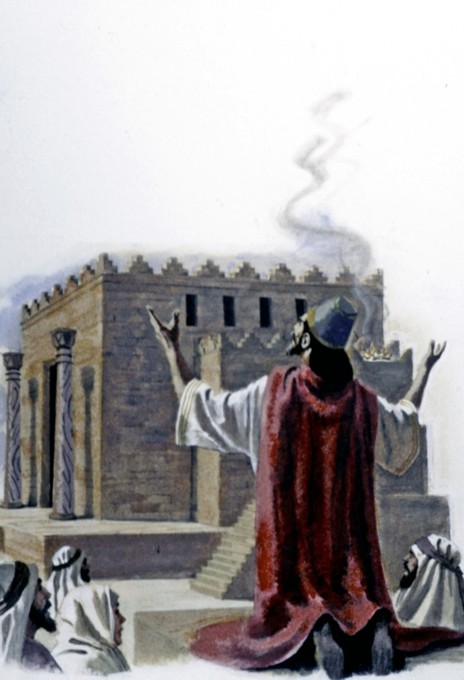
In Solomon's early years as king, when he built the Temple, he was a very godly man, offering a prayer of devotion to dedicate his finished Temple (1 Kings 8:22-61; 2 Chronicles 6:12--7:3).

In Solomon’s early years as king, when he built the Temple, he was a very godly man, offering a prayer of devotion to dedicate his finished Temple (1 Kings 8:22-61; 2 Chronicles 6:12–7:3).

In 2012, we have gone from the creation in Genesis to the end of Revelation studying the highlights of the Bible as the one story that it is (one chapter a day). What a year it has been!  This week, we will take a break from our reading in God’s word on Monday, and begin the new schedule of studying the “Wisdom Literature” in 2013 on New Year’s Day.  It is going to be a great year, and another very unique and, we trust, rewarding reading experience. We expect to see the completed schedule before Monday, and will post it then.  But we have reason to believe that we will start out in the Book of Proverbs.

We credit Solomon with the writing of Proverbs (we won’t debate the possibility of additional authors here), Ecclesiastes and Song of Solomon in particular, but much “non-inspired” literature is attributed to this king as well.  And we know that to be fact from what we are told in passages such as 1 Kings 4:29-34.  This passage starts with the great wisdom that God gave him (“And God gave Solomon wisdom and understanding beyond measure, and breadth of mind like the sand on the seashore) as a result of his request, which pleased the Lord (1 Kings 3:10-12).  Solomon reigned as king from about 970 – 931 B.C., and was the last king before the kingdom divided.

Summing Up

Each weekend, I post a small PDF of one week of chapter summaries (on the website’s “Summaries” page), current to the beginning of the previous week.  I have posted the summaries for Week 51 (December Week 3) and for Week 52 (December Week 4) of the schedule I have followed this year – the final two weeks for 2012!  The first of these short PDF documents contains condensed comments about Hebrews 6, 7, 8, 9, and 10, and the second about Hebrews 11, and Revelation 4, 5, 21, and 22 with hyperlinks to the ESV version of each chapter for listening or reading, and join the summaries for other weeks already posted there.

/Bob’s boy
___________________
image © V. Gilbert & Arlisle F. Beers

Please note: I did not design the reading plan that I am following in my blog.  All of my comments in this blog, however, are solely my responsibility.  When reading ANY commentary, you should ALWAYS refer first to the scripture, which is God’s unchanging and unfailing word. Reading schedules, as well as a link to the site where you can get the reading plan that I’m currently following for yourself can be found on the “Bible Reading Schedules” page of my website at http://graceofourlord.com.  For questions and help, please see the “FAQ” and “Summaries” pages there.
Revelation 22 – Jesus Is Coming

The imagery used here to describe heaven, the dwelling place of God and our Lord Jesus (and one day us as well) in these first few verses harkens back to Ezekiel 47:1-12.  No longer will there be anything accursed, verse 3 says; and the tree of life will be there (see Genesis 2:9).  This seems to be a symbol for the restored condition of things as they were between man and God before the fall (Genesis 3).

cross-005Verse 6 is a reminder that the other events spoken of in this book are to occur soon, but Jesus reminds that He is coming back (verse 7).  John affirms in verse 8 that it was he that received all of these visions; and he fell down to worship the angel who showed him, but was rebuked for doing so, as the angel reminded him that only the Lord was to be worshiped.

Jesus again promises that He is coming to bring his recompense for each of us for what we have done (Isaiah 62:11).  Verse 13 (“I am the Alpha and the Omega, the first and the last, the beginning and the end”) signifies the eternal supremacy of God and His Son.  Verse 17 repeats the promise that eternal life is available freely to all who will come – Jesus paid the price for it already.

John finishes the New Testament with the yearning call to Jesus as Lord to come.  Then finally, and appropriately: “The grace of the Lord Jesus be with all. Amen.”

Amen, indeed!

Read or listen to audio of ESV version of this selection from this link.

/Bob’s boy
___________________
some images © V. Gilbert & Arlisle F. Beers

Please note: I did not design the reading plan that I am following in my blog.  All of my comments in this blog, however, are solely my responsibility.  When reading ANY commentary, you should ALWAYS refer first to the scripture, which is God’s unchanging and unfailing word. Reading schedules, as well as a link to the site where you can get the reading plan that I’m currently following for yourself can be found on the “Bible Reading Schedules” page of my website at http://graceofourlord.com.  For questions and help, please see the “FAQ” and “Summaries” pages there.

Revelation 21 – The New Jerusalem

With all of the imagery amid these chapters, just what is meant by a new heaven and a new earth is highly debated.  Many see it as a literal renewal of earth after the old has passed away.  But much about what is spoken of in this chapter simply does not fit into such a notion.  2 Peter 3:10-13 affirms that the earth and the heavenly bodies will be destroyed – burned up  – after the judgment.  Just how this imagery of a new heaven and a new earth does fit into the coming of the faithful to heaven is uncertain.  What is certain is that there will be a literal new home for the faithful that is so wonderful than our minds probably could not grasp it without the imagery contained here that is full of references to precious metals and jewels and such.

Alexander building a wall against Gog and Magog

Alexander building a wall against Gog and Magog (Photo credit: Wikipedia)

No sun or moon will be needed because “the glory of God gives it light, and its lamp is the Lamb.”  No temple is there because God will be in the midst of his faithful, and they shall be His people.  This is an echo of the prophetic language in Isaiah 60:19-20.  The description of John being carried away in the Spirit to the high mountain to view the new Jerusalem is reminiscent of the time after “Gog and Magog’s” destruction Ezekiel 38-39, when Ezekiel was transported to “a very high mountain” (Ezekiel 40:2-3) to see the future temple of God.  The measurements done this time are enormous (a stadia was about 185 meters) and all are multiples of twelve; and the number is repeated in other descriptions here as both the twelve apostles and the twelve tribes of Israel are mentioned.  Both of these groups were important, after all, in both the old covenant and the new covenant.

The last word of comfort in this chapter for these first century Christians – and for us – is that once in heaven, no longer will they have to live among those who do evil in the world or, most especially, do evil to them, as verse 27 says “…nothing unclean will ever enter it, nor anyone who does what is detestable or false, but only those who are written in the Lamb’s book of life.”

Read or listen to audio of ESV version of this selection from this link.

/Bob’s boy
___________________
some images © V. Gilbert & Arlisle F. Beers

Please note: I did not design the reading plan that I am following in my blog.  All of my comments in this blog, however, are solely my responsibility.  When reading ANY commentary, you should ALWAYS refer first to the scripture, which is God’s unchanging and unfailing word. Reading schedules, as well as a link to the site where you can get the reading plan that I’m currently following for yourself can be found on the “Bible Reading Schedules” page of my website at http://graceofourlord.com.  For questions and help, please see the “FAQ” and “Summaries” pages there.

Revelation 5 – The Scroll and the Lamb

The lion is the symbol of the Tribe of Judah. ...

The lion is the symbol of the Tribe of Judah. It is often represented in Jewish art, such as this sculpture outside a synagogue (Photo credit: Wikipedia)

The image here of God holding the scroll that no one in heaven or on earth was worthy to open is certainly a symbol of the fulfillment of God’s plan for the redemption of man and our salvation.  Jesus is the only one that could fill that post.  The image of the Lamb who is the Lion of Judah ( a reference to Genesis 49:9) from the root of David all point back to Isaiah (Isaiah 11:1, 10, Isaiah 53:4-7).  Taking the scroll from the hand of God is clearly symbolic of Jesus, the Lamb, having been crucified, thereby fulfilling God’s plan and taking His place there with God, having proved himself worthy to be praised and worshiped as God was in the previous chapter (verses 9-11).

Read or listen to audio of ESV version of this selection from this link.

/Bob’s boy
___________________
some images © V. Gilbert & Arlisle F. Beers

Please note: I did not design the reading plan that I am following in my blog.  All of my comments in this blog, however, are solely my responsibility.  When reading ANY commentary, you should ALWAYS refer first to the scripture, which is God’s unchanging and unfailing word. Reading schedules, as well as a link to the site where you can get the reading plan that I’m currently following for yourself can be found on the “Bible Reading Schedules” page of my website at http://graceofourlord.com.  For questions and help, please see the “FAQ” and “Summaries” pages there.
Revelation 4 – The Throne in Heaven

John’s vision here begins with a door open into heaven.  The first voice he hears in verse one is generally accepted to be that of Jesus.  John had heard that voice on earth.  As John is then aware of being fully in the manifested presence of the Holy Spirit, the visions that occur after that remind us of a similar reference in Ezekiel 3:12-15.   Much interpretation of the detail of the imagery that follows has been made to the point of extremity.  One writer noted: One who adapts Biblical images as freely as he (John) has in this chapter should not be expected to preserve an undeviating consistency in his pictures. They are for kindling the imagination, not for transference to the drawing board.

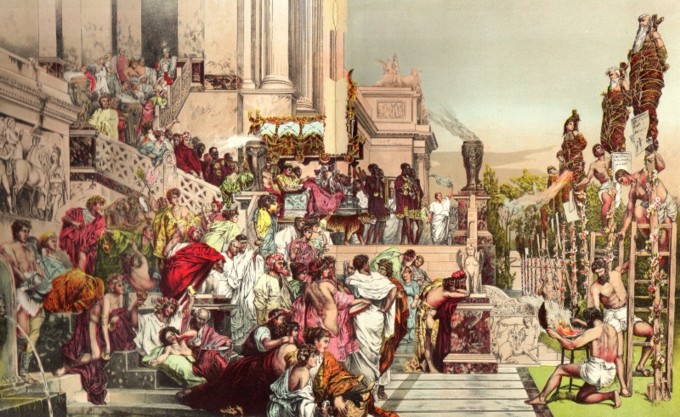
Nero's human torches of Christians

Nero’s human torches of Christians

No matter what interpretation you give each of these eleven verses, keep in mind the original audience.  These were persecuted Christians, many of whom may have known people – even had loved ones – that had been killed because of their faith in the Lord.  But they were holding on to that faith while looking toward heaven.  Here, as instructed by the Lord in Revelation 1:10-11, John gives them a grand glimpse of that splendor in the sort of literary imagery that was common to their day.  In the middle of the Lord’s battle with Satan, John gets that look at the throne of our Creator in heaven, and the worship that He worthily receives there.

Read or listen to audio of ESV version of this selection from this link.

/Bob’s boy
___________________
some images © V. Gilbert & Arlisle F. Beers

Please note: I did not design the reading plan that I am following in my blog.  All of my comments in this blog, however, are solely my responsibility.  When reading ANY commentary, you should ALWAYS refer first to the scripture, which is God’s unchanging and unfailing word. Reading schedules, as well as a link to the site where you can get the reading plan that I’m currently following for yourself can be found on the “Bible Reading Schedules” page of my website at http://graceofourlord.com.  For questions and help, please see the “FAQ” and “Summaries” pages there.

Hebrews 11 – By Faith

Shadrach, Meshach, and Abednego refused to bow to the Babylonian king's golden statue, so the king ordered them thrown into a fiery furnace. But God protected them (Daniel 3)

Shadrach, Meshach, and Abednego refused to bow to the Babylonian king’s golden statue, so the king ordered them thrown into a fiery furnace. But God protected them (Daniel 3)

Famous for the great description of faith in verse 1 (“faith is the assurance of things hoped for, the conviction of things not seen”), Hebrews 11 is (arguably most unfortunately) often called the “Hall of Faith” or the “Faith Hall of Fame.” Most of the accounts of people in this chapter are familiar to most people.  Some of the references are not so clear, and some maybe not so familiar.  Verse 33’s reference to those who “quenched the power of fire” is likely of Shadrach, Meshach, and Abednego from Daniel 2:49-3:30.  Verse 35’s women who “received back their dead by resurrection” is likely (among others) of Elijah raising the son of the widow of Zarephath (1 Kings 17:17-24) and Elisha raising the son of a Shunammite woman (2 Kings 4:18-37).  Verse 37’s gruesome deaths may refer to the extra-biblical accounts of the deaths of Jeremiah and Isaiah.

But this chapter is not an account of extraordinary men and women with supreme faith.  It is rather the story of ordinary men and women like you and me, who because of their faith in God, were blessed with the power and grace of His mighty hand.  It is the story of their endurance and perseverance through all manner of evil against them and bitter times, and how that endurance saw them through it by their faith.  It is the assurance that the recipients of this letter can persevere by their faith through the endurance the writer encouraged them to have in chapter 10.  It is the assurance that we can do it as well.  We have a better promise, through a better covenant, and if we are faithful, we will receive our reward – which will be the same perfect reward those mentioned in this chapter will ultimately receive (verses 39-40).

Read or listen to audio of ESV version of this selection from this link.

/Bob’s boy
___________________
some images © V. Gilbert & Arlisle F. Beers

Please note: I did not design the reading plan that I am following in my blog.  All of my comments in this blog, however, are solely my responsibility.  When reading ANY commentary, you should ALWAYS refer first to the scripture, which is God’s unchanging and unfailing word. Reading schedules, as well as a link to the site where you can get the reading plan that I’m currently following for yourself can be found on the “Bible Reading Schedules” page of my website at http://graceofourlord.com.  For questions and help, please see the “FAQ” and “Summaries” pages there.

Reading Revelation \ Week 50 summary posted

This week, we will start with one more chapter from the Epistle to the Hebrews, then we will finish the year with four chapters from the Book of Revelation.  We cannot do justice to the latter in just four days of reading,  but we can get an overview of how the book brings an ending to the story of the Bible we began in Genesis this year.  This book is intimidating to many people, and it certainly can be challenging.  It is also one of the most misunderstood and misinterpreted books of the Bible.  But it is not as difficult to read or to understand if one keeps in mind the context in which it was written.

The Angel Appears to John. The book of Revelat...

The Angel Appears to John. The book of Revelation. 13th century manuscript. British Library, London. (Photo credit: Wikipedia)

John wrote this epistle (yes Revelation is a letter) to Christians in the first century about first century times; and it was intended to strengthen their faith and hope during times that were extremely difficult – and promised to become even more so.  There was much Apocalyptic literature around in those times, and people were used to such imagery and symbolism.  But those same two things have led many scholars to come away with misguided ideas – such as the supposition that Jesus failed at a first attempt to establish an earthly kingdom, and is going to do it successfully (for a thousand years?) in the future.  The very idea of the Lord failing at anything is ludicrous, and shows a total misunderstanding of what the kingdom is in the first place.  Also, where many commentators and scholars go awry is in trying to give prophetic (and often even literal) meaning to every single detail.   Others want part of a passage full of imagery to be literal, and part to be figurative, so they can “pigeon-hole” it into the prophetic word they wish it to be.

For those interested in a more in-depth reading of Revelation, we would like to recommend a very well-written and informative book that aids in understanding Apocalyptic literature contained in such books of the Bible as Isaiah, Daniel, Ezekiel, Joel, and yes, Revelation in particular.  The name of the book is “Understanding Apocalyptic Literature (A Guide to the Book of Revelation)” by Mark Roberts.  It is an easy read – less than 100 pages; and this writer benefited enormously from reading it before tackling Revelation during last year’s full Bible reading schedule.  It is well worth the very low price (5.99 at the time of this writing), and can be purchased at this link.

It is helpful first to understand what Apocalyptic literature is.  The word Apocalypse is associated today with an “end of time” situation, the end of the world in particular.  But that is a view of the term that has been perverted over time.  Translated literally from Greek, it is “a disclosure of knowledge, hidden from humanity in an era dominated by falsehood and misconception.”

Page 289r: The Opening of the Fifth and Sixth ...

Page 289r: The Opening of the Fifth and Sixth Seals, Revelation 6:9-16 (Photo credit: Wikipedia)

There is tremendous value to the Book of Revelation for us today, as with all of God’s word.  But we must remember that as Revelation 1:1, and other passages of the book state, it was to show “the things that must soon take place.”  It does not predict things like the tragedy of 9-11, or even good things like the establishment of the United Nations, as some have claimed.  “Revelation does not address life in our times because that was of no interest or help to its original audiences… It promises God’s action soon” (Roberts, 2011).

So what understanding should one have after reading the Book of Revelation?  If you come away with the assurance that, although there is great evil in the world and it wants to thwart and utterly defeat the followers of Jesus Christ, that there is more to be hopeful for than just this earthly life, and that in the end, Jesus will be triumphant, then you have understood the message of the book as it was intended.

Works Cited

Roberts, Mark.  “Understanding Apocalyptic Literature” A Guide to the Book of Revelation.  Temple Terrace, Florida: Florida College Press, 2011.

Summing Up

Each weekend, I am now posting a small PDF of one week of chapter summaries (on the website’s “Summaries” page), current to the beginning of the previous week.  I have posted the summary for Week 50 (December Week 2) of the schedule I am following.  This short PDF document contains condensed comments about 1 Peter 1, 1 Peter 2, and Hebrews 3, 4, and 5, with hyperlinks to the ESV version of each chapter for listening or reading, and joins the summaries for other weeks already posted there.

/Bob’s boy
___________________
image © V. Gilbert & Arlisle F. Beers

Please note: I did not design the reading plan that I am following in my blog.  All of my comments in this blog, however, are solely my responsibility.  When reading ANY commentary, you should ALWAYS refer first to the scripture, which is God’s unchanging and unfailing word. Reading schedules, as well as a link to the site where you can get the reading plan that I’m currently following for yourself can be found on the “Bible Reading Schedules” page of my website at http://graceofourlord.com.  For questions and help, please see the “FAQ” and “Summaries” pages there.

Hebrews 10 – The Full Assurance of Faith

In the previous chapters of this letter, the writer has been driving home the superiority of the new covenant, and of Jesus as our high priest.  He continues in verse one, stating that the law was just “a shadow of the good things to come instead of the true form of these realities.”    The sacrifices of old, year after year, were just a temporary forgiveness of sins because “it is impossible for the blood of bulls and goats to take away sins.”  But Jesus Christ came to do God’s will (verses 5-7 quote Psalm 40:6-8), and offered Himself up as a single sacrifice for all time (verses 10-12).

Crucifixion

Crucifixion (Photo credit: Wikipedia)

Verses 19-23 bring it all home.  Whereas before we as servants of God could not enter the holy place, Jesus has torn the curtain – the veil – open for all time (an allusion to the literal event of Matthew 27:51-52 when Jesus was crucified).  And because we have “a great priest over the house of God,” we can draw near with confidence, clean from evil conscience, and with a true heart – full of the assurance of faith that our sins are forgiven.  We can now hold fast to our hope without wavering because “he who promised is faithful.”

Verses 24-25 are quoted often to remind us that we need to be faithful in attendance of worship, as it says:

“…let us consider how to stir up one another to love and good works, not neglecting to meet together, as is the habit of some, but encouraging one another…”

Those who claim they can serve the Lord themselves without being part of a worship service ignore this passage at their own peril.  How can we “stir up one another” or “encourage one another” if we do not meet together, as the writer, inspired by the Holy Spirit, says?  Verse 26, and following, warn of the danger of trying to “go it alone.” It is far too easy to slip away from the path, and back into sin.  As verse 31 says, “It is a fearful thing to fall into the hands of the living God.”

We need each other because that encouragement, those things that “stir up one another” help give us endurance.  And we “have need of endurance, so that when you have done the will of God you may receive what is promised.”

Read or listen to audio of ESV version of this selection from this link.

/Bob’s boy
___________________
some images © V. Gilbert & Arlisle F. Beers

Please note: I did not design the reading plan that I am following in my blog.  All of my comments in this blog, however, are solely my responsibility.  When reading ANY commentary, you should ALWAYS refer first to the scripture, which is God’s unchanging and unfailing word. Reading schedules, as well as a link to the site where you can get the reading plan that I’m currently following for yourself can be found on the “Bible Reading Schedules” page of my website at http://graceofourlord.com.  For questions and help, please see the “FAQ” and “Summaries” pages there.

Hebrews 9 – Redemption Through the Blood of Christ

When Aaron prepared the Levites for consecration, he adjusted the seven lamps of the menorah, candlestick, or lampstand forward.(Numbers 8:1-4).

When Aaron prepared the Levites for consecration, he adjusted the seven lamps of the menorah, candlestick, or lampstand forward.(Numbers 8:1-4).

When considering this chapter’s beginning, as it speaks of the tabernacle prepared by Moses instead of the Herodian temple, it is because the theme of the writer is that of the covenant being “inaugurated” (verse 18), or “sealed.” Moses did so with the blood of animals, as verses 19-21 remind us.   As verse 22 says, “Indeed, under the law almost everything is purified with blood, and without the shedding of blood there is no forgiveness of sins.”  Jesus Christ sealed the new covenant with His own blood.

The tabernacle and the items inside (the lampstand, table, the Bread of the Presence, etc) described in the first few verses, are detailed for the most part in Exodus 25, 30 and 37. As the text says, only the high priest could enter the section that was the “Most Holy Place,” and even he could only do so once a year – to offer blood for himself and for the unintentional sins of others (verse 7) – which had to be repeated each year.  All these things, it says, were mere copies of the heavenly things (verse 23).  Jesus entered the true “Most Holy Place” which is heaven, by offering His own blood – “once for all” and “thus securing an eternal redemption” for us all.  Verse 28 concludes with the glorious promise for us: “so Christ, having been offered once to bear the sins of many, will appear a second time, not to deal with sin but to save those who are eagerly waiting for him.”

The Arch of Titus from outside the Forum, Rome, Italy.  Located at the highest point of the Via Sacra which leads to the Roman Forum, this triumphal arch, with only one passageway, commemorates Titus' conquest of Judea which ended the Jewish Wars (66-70). Engaged fluted columns frame the passageway.

The Arch of Titus from outside the Forum, Rome, Italy. Located at the highest point of the Via Sacra which leads to the Roman Forum, this triumphal arch, with only one passageway, commemorates Titus’ conquest of Judea which ended the Jewish Wars (66-70). Engaged fluted columns frame the passageway.

As an aside, Coffman offers some interesting facts regarding the Holy things of the temple:

History, through the overruling providence of God, has preserved a likeness of the golden candlestick that was in the Herodian temple destroyed by Vespasian and Titus in 70 A.D. The candlestick, along with other treasures, was looted and carried in the triumphal procession in Rome; and, when the Arch of Titus was constructed to memorialize the victory, both the table of showbread and the candlestick were detailed in the carvings decorating the arch and may still be seen there in the excavated ruins of ancient Rome. Plaster casts of those carvings are exhibited in the Metropolitan Museum, New York; and from these is evident the immense weight of those golden treasures, several men being necessary to bear each of them.

Read or listen to audio of ESV version of this selection from this link.

/Bob’s boy
___________________
some images © V. Gilbert & Arlisle F. Beers

Please note: I did not design the reading plan that I am following in my blog.  All of my comments in this blog, however, are solely my responsibility.  When reading ANY commentary, you should ALWAYS refer first to the scripture, which is God’s unchanging and unfailing word. Reading schedules, as well as a link to the site where you can get the reading plan that I’m currently following for yourself can be found on the “Bible Reading Schedules” page of my website at http://graceofourlord.com.  For questions and help, please see the “FAQ” and “Summaries” pages there.