The Poor Widow – Luke 21

Verse one says that Jesus saw the rich putting their gifts into the offering box. This was one of thirteen collection chests that were shaped like trumpets. A very good description of this arrangement can be found in this article at Ferrell’s Travel Blog. Jesus also saw a poor widow put in two small copper coins. The coins are known by most people as the widow’s “mites.”

Lepton

Lepton

There was no coin at that time called a mite, but when the King James Bible was created there was one. But the Greek word for the coins in the scripture was a Lepton (pl. Lepta), which means “small” or “the thin one.” The Lepton was reportedly minted by Alexander Janneaus, who was king of Judea from 103-76 B.C. The coins were only about one centimeter in diameter, and were worth only about 1/128 of a denarius. A denarius was a day’s wages for the common worker.

According to Pharisaical law of the day, it was not acceptable to put in less than two gifts. So this poor widow literally contributed, on that occasion, the smallest gifts possible. But Jesus said that she had contributed more than any of the rich that He had seen making their contributions. They had given just a minute portion of the wealth that they had, whereas the widow had literally given all that she had to live on.

The widow’s actions demonstrated not only her selfless heart, but also her great faith that the Lord would take care of her.

(This year’s reading plan for Luke, Acts, and 1 and 2 Chronicles averages just 15 verses per day – 5 days per week!)
Schedule for this week
Read or listen to audio of today’s selection from Luke here
Read or listen to audio of today’s selection from 1 Chronicles here

/Bob’s boy
___________________
some images © V. Gilbert & Arlisle F. Beers

Please note: I did not design the reading plan that I am following in my blog.  All of my comments in this blog, however, are solely my responsibility.  When reading ANY commentary, you should ALWAYS refer first to the scripture, which is God’s unchanging and unfailing word. Reading schedules, as well as a link to the site where you can get the reading plan that I’m currently following for yourself can be found on the “Bible Reading Schedules” page of my website at http://graceofourlord.com.  

Enhanced by Zemanta

Knowledge and Self-Control – 2 Peter

In his second letter, Peter uses his standard form of opening, identifying himself in this case as Simeon Peter, an apostle of Jesus Christ. In the opening chapter, he also declares his witnessing of the transfiguration (2 Peter 1:16-18), which was recorded in Matthew 17:1-8.  It is evident that Peter knows that his death is eminent, as we can see from 2 Peter 1:12-15. Many scholars believe that he wrote this second letter during the Roman persecution which occurred before Nero’s death in 68 A.D. This would make for a date of the writing of this letter from 64-67 A.D.

16th-century map of Anatolia from Münster's Co...

16th-century map of Anatolia from Münster’s Cosmographia showing “Capadocia” (Photo credit: Wikipedia)

It is a shorter letter, and a passionate one, as Peter probably knows that it will be his last communication to these churches. He is addressing the same churches that he wrote to in the first epistle (Pontus, Galatia, Cappadocia, Asia, and Bithynia), as we can see from 2 Peter 3:1. The second chapter may be the source of Peter’s urgency in writing this letter before his martyrdom. In that chapter, he warns of false prophets and teachers that have already been a problem in other churches. And there is a reference to some sort of sensual activity that is being held up as an acceptable lifestyle for Christianity.

Most of the rest of the letter deals with the requirement for the Christian to endure in their godly lives, and to reassure them that “the day of the Lord” will come. He reminds them also in the first chapter of his eyewitness account of the things they have been taught; and that he and his fellow apostles can be trusted to have delivered to them the truth – not the myths of man.

He reminds them also of the precious gift of godliness that has allowed them an escape “from the corruption that is in the world because of sinful desire.” In verses 5-9 of the first chapter, Peter gives a most beautiful summary of the timeless advice for Christian living:

“For this very reason, make every effort to supplement your faith with virtue, and virtue with knowledge, and knowledge with self-control, and self-control with steadfastness, and steadfastness with godliness, and godliness with brotherly affection, and brotherly affection with love.
For if these qualities are yours and are increasing, they keep you from being ineffective or unfruitful in the knowledge of our Lord Jesus Christ. For whoever lacks these qualities is so nearsighted that he is blind, having forgotten that he was cleansed from his former sins.”


(This year’s reading plan for Luke, Acts, and 1 and 2 Chronicles averages just 15 verses per day – 5 days per week!)
Schedule for this week


/Bob’s boy


___________________


some images © V. Gilbert & Arlisle F. Beers


Please note: I did not design the reading plan that I am following in my blog.  All of my comments in this blog, however, are solely my responsibility.  When reading ANY commentary, you should ALWAYS refer first to the scripture, which is God’s unchanging and unfailing word. Reading schedules, as well as a link to the site where you can get the reading plan that I’m currently following for yourself can be found on the “Bible Reading Schedules” page of my website at http://graceofourlord.com.


Enhanced by Zemanta

The Lord Said To My Lord – Luke 20

Verse 41 begins with “but He said to them…” This shows that Jesus is still addressing the Sadducees after He convincingly answered their question about resurrection. he asks them “How can they say that the Christ is David’s son?” As He points out, David himself said in Psalm 110:1:

The Lord said to my Lord,
Sit at my right hand,
until I make your enemies your footstool

English: David's Love for God's House, as in 1...

English: David’s Love for God’s House, as in 1 Chronicles 22:6-16, illustration from a Bible card published by the Providence Lithograph Company (Photo credit: Wikipedia)

Jesus brought this question up to the Sadducees to give them the opportunity to see the truth about the Christ from the scriptures themselves. As he points out, “David thus calls him Lord, so how is he his son?” The answer, we of course know, is that the Christ is God, and thus is Lord over David. But in the flesh, he was a son (descendant) of David. But their eyes were not open to the truth.

Seeing that fact, Jesus said to the disciples (within the hearing of all) that they should beware of the scribes. He then warns of their hypocrisy and their unjust treatment of others – including “devouring” widows’ houses. Luke does not tell us what exactly it was they did to these widows, but we can be sure they had dealt miserably with some, else Jesus would not be making a fuss about it here.

One way or another, throughout this chapter, Jesus had made stronger enemies out of all three major groups of religious leaders. And all He had done was tell the truth and try to teach them what was right.

(This year’s reading plan for Luke, Acts, and 1 and 2 Chronicles averages just 15 verses per day – 5 days per week!)
Schedule for this week
Read or listen to audio of today’s selection from Luke here
Read or listen to audio of today’s selection from 2 Chronicles here

/Bob’s boy
___________________
some images © V. Gilbert & Arlisle F. Beers

Please note: I did not design the reading plan that I am following in my blog.  All of my comments in this blog, however, are solely my responsibility.  When reading ANY commentary, you should ALWAYS refer first to the scripture, which is God’s unchanging and unfailing word. Reading schedules, as well as a link to the site where you can get the reading plan that I’m currently following for yourself can be found on the “Bible Reading Schedules” page of my website at http://graceofourlord.com.  

Enhanced by Zemanta

The God of the Living – Luke 20

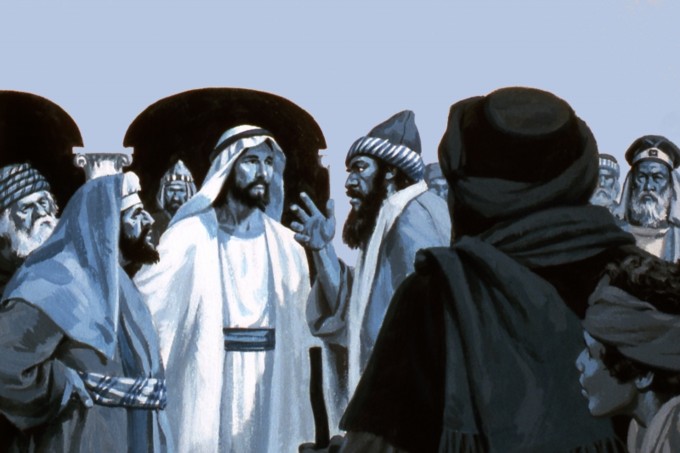
Jewish leaders of Jesus' time were mostly Pharisees, Sadducees, or Scribes. They were against Jesus, hating him so much that they wanted to kill him, for they were afraid they would lose their authority and their jobs.

Jewish leaders of Jesus’ time were mostly Pharisees, Sadducees, or Scribes. They were against Jesus, hating him so much that they wanted to kill him, for they were afraid they would lose their authority and their jobs.

In verse 27, the Sadducees get in on the act of trying to best the Lord with their questions. The Sadducees did not believe in a resurrection.  So they pose a question designed to prove that point where God’s own word is concerned. Had they known they were speaking to “the word” (John 1:1-2;14), they would have realized how futile the attempt was.

The “trick question” concerned a woman whose husband had died. According to the Law of Moses (Deuteronomy 25:5):

“If brothers dwell together, and one of them dies and has no son, the wife of the dead man shall not be married outside the family to a stranger. Her husband’s brother shall go in to her and take her as his wife and perform the duty of a husband’s brother to her.”

So the Sadducees extend that scenario out into the realm of absurdity. In their story, the man who died had six brothers. Each one took the woman as his wife and died without giving her a child. So after the resurrection, whose wife would she be – seeing that all seven brothers had been her husband? They were sure they had Him on this point, because none of the brothers would have a greater claim on the woman than any of the others. Surely that proves by God’s own law that there is no resurrection.

Three angels visiting Abraham

Three angels visiting Abraham (Photo credit: Wikipedia)

Jesus ignores the absurdity, and addresses the crux of the matter. He explains that “the sons of this age” (and daughters) marry and are “given in marriage,” but those who “attain to that age”- and to the resurrection – do neither. He says that they can no longer die, and are equal to angels in that respect. Notice He does not say that they are angels. Nowhere does the Bible teach that we become angels after we die. They are separate and distinct beings. But we become Sons of God and sons of the resurrection.

He goes on to assure them that there is a resurrection according to the word of God. He points out that even Moses said in the passage about the burning bush (Exodus 3-4:17) that the Lord is the God of Abraham and the God of Isaac and the God of Jacob. God is not the God of the dead, but of the living. The Sadducees could only then say that Jesus had answered very well.

They had taken their best shot, and came up empty.

(This year’s reading plan for Luke, Acts, and 1 and 2 Chronicles averages just 15 verses per day – 5 days per week!)
Schedule for this week
Read or listen to audio of today’s selection from Luke here
Read or listen to audio of today’s selection from 2 Chronicles here

/Bob’s boy
___________________
some images © V. Gilbert & Arlisle F. Beers

Please note: I did not design the reading plan that I am following in my blog.  All of my comments in this blog, however, are solely my responsibility.  When reading ANY commentary, you should ALWAYS refer first to the scripture, which is God’s unchanging and unfailing word. Reading schedules, as well as a link to the site where you can get the reading plan that I’m currently following for yourself can be found on the “Bible Reading Schedules” page of my website at http://graceofourlord.com.  
Enhanced by Zemanta

Setting a Trap For the Son of God – Luke 20

Verse 19 makes it clear that Jesus had told the parable of the Wicked Tenants in the presence of the chief priests and scribes, and they knew very well that He had them in mind when He told it. They wanted to seize Him right then, but they were afraid of His followers. So they sent spies – people pretending to be sincerely wishing to learn from Him, in hopes of trapping Him by His own words – with something they could use against Him.

Julius Caesar, Summer garden, Saint-Petersburg

Julius Caesar, Summer garden, Saint-Petersburg (Photo credit: Wikipedia)

They are so transparent in verse 21, saying “Teacher, we know that you speak and teach rightly, and show no partiality, but truly teach the way of God.” Knowing that Jesus certainly knew who these men were and what their intention was, it would have been hard for anyone else in His place to keep from rolling their eyes at such gratuitous flattery. But there is no indication that Jesus did anything but answer them with wisdom. They wanted Him to say, of course, that they should not have to pay taxes to Caesar, but instead give it to the Lord. This would have given them the fuel they needed. Instead, he had them look at Caesar’s likeness on the denarius – a coin of the day. Give Caesar what is his, he told them; and give to God what is His. Neither of those acts precludes the other – they should do both.

Though none of their other attempts is written about here, verse 26 makes it clear that they did keep trying, but were unsuccessful at setting the trap.

(This year’s reading plan for Luke, Acts, and 1 and 2 Chronicles averages just 15 verses per day – 5 days per week!)
Schedule for this week
Read or listen to audio of today’s selection from Luke here
Read or listen to audio of today’s selection from 2 Chronicles here

/Bob’s boy
___________________
some images © V. Gilbert & Arlisle F. Beers

Please note: I did not design the reading plan that I am following in my blog.  All of my comments in this blog, however, are solely my responsibility.  When reading ANY commentary, you should ALWAYS refer first to the scripture, which is God’s unchanging and unfailing word. Reading schedules, as well as a link to the site where you can get the reading plan that I’m currently following for yourself can be found on the “Bible Reading Schedules” page of my website at http://graceofourlord.com.  

Enhanced by Zemanta

The Cornerstone – Luke 20

Concerning the parable of the Wicked Tenants in verses 9-18, we commented extensively in this previous post. To summarize, the owner of the vineyard equates to God. The tenants are God’s people. The servants that He sends are His prophets. After the servants have been treated violently, the owner sends His son, with whom they should be respectful. This of course is Jesus. The tenants killed the Son. Jesus asks them what they think the owner will do. He says that he will destroy the tenants and give the vineyard to others.

A vineyard with bird-netting.

A vineyard with bird-netting. (Photo credit: Wikipedia)

Note that those hearing this parable did not have any trouble understanding what it meant because verse 16 says When they heard this, they said, ‘Surely not!'” But Jesus answers quoting from Psalm 118:22: The stone that the builders rejected has become the cornerstone.” This also was not lost on His listeners. The builders were the religious leaders of the day, and Jesus was the cornerstone. Then He added “Everyone who falls on that stone will be broken to pieces, and when it falls on anyone, it will crush him.”

Here, Jesus has turned up the rhetoric, knowing that His time is coming soon; and the scribes and Pharisees were already plotting against Him.  But His goal is not simply to anger them. The Lord is giving them fair warning and every chance in the world to see what should already have been obvious – this is the Messiah, the Son of God, in their midst.

(This year’s reading plan for Luke, Acts, and 1 and 2 Chronicles averages just 15 verses per day – 5 days per week!)
Schedule for this week
Read or listen to audio of today’s selection from Luke here
Read or listen to audio of today’s selection from 2 Chronicles here

/Bob’s boy
___________________
some images © V. Gilbert & Arlisle F. Beers

Please note: I did not design the reading plan that I am following in my blog.  All of my comments in this blog, however, are solely my responsibility.  When reading ANY commentary, you should ALWAYS refer first to the scripture, which is God’s unchanging and unfailing word. Reading schedules, as well as a link to the site where you can get the reading plan that I’m currently following for yourself can be found on the “Bible Reading Schedules” page of my website at http://graceofourlord.com.  

Enhanced by Zemanta

Jesus Preaching the Gospel – Luke 20

Luke chapter 20 opens with “One day, as Jesus was teaching the people in the temple and preaching the gospel…” When most people think of “the gospel,” they think of Matthew, Mark, Luke, and John. We think of Jesus as the Christ – of his crucifixion, burial, and resurrection. The term, as applied to Jesus’ preaching, is used elsewhere, such as in Matthew 9:35 and Mark 8:35.  So what gospel was Jesus preaching? It was the gospel of the kingdom. The Greek word for gospel from which this was derived is “euangellion,” which is best translated as “good news” or “glad tidings.” It was the good news of the kingdom of God that He had taught His disciples and sent them out to teach as well (Mt 4:23, Mk 1:14-15, Lk 9:1-2, and Lk 10:1-11). The “rest of the gospel” – the path of salvation was very much a work in progress. As Jesus said, the kingdom was at hand.

John the Baptist acclaims Jesus Christ. Part o...

John the Baptist acclaims Jesus Christ. Part of a 16th century polychrome sequence in Amiens cathedral. (Photo credit: Wikipedia)

Jesus preached as one with authority (Matthew 7:29), and he had performed many “signs and wonders” – miracles. As chapter 19 closed, He had driven out those who sold within the temple right under the noses of the chief priests and scribes, further enraging them to the point that they wished to destroy Him (Luke 19:47). So they came up to Him with the elders, and said “Tell us by what authority you do these things, or who it is that gave you this authority.” It was more than just the equivalent of our phrase today “just who do you think you are?” They wanted Him to “convict” Himself by His own words – giving them ammunition for the destruction they sought for Him.

But it was not yet His time, so Jesus told them that He would answer only if they told Him by what authority John the baptist did his baptism – from heaven or from man. This put them in the horns of a dilemma. The people considered  – knew – John to be a prophet, and these men feared violence if they said it was only by man. But none of them had believed in John, and Jesus, they knew, would expose them as liars if they said they believed it was from heaven. So they simply said that they did not know. So Jesus told them that He would not answer their question either.

They had come to set a trap for Him with the most revered of witnesses, thinking to outsmart Him. But the tables had been turned on them once again; and you can be certain that their anger burned even hotter.

(This year’s reading plan for Luke, Acts, and 1 and 2 Chronicles averages just 15 verses per day – 5 days per week!)
Schedule for this week
Read or listen to audio of today’s selection from Luke here
Read or listen to audio of today’s selection from 2 Chronicles here

/Bob’s boy
___________________
some images © V. Gilbert & Arlisle F. Beers

Please note: I did not design the reading plan that I am following in my blog.  All of my comments in this blog, however, are solely my responsibility.  When reading ANY commentary, you should ALWAYS refer first to the scripture, which is God’s unchanging and unfailing word. Reading schedules, as well as a link to the site where you can get the reading plan that I’m currently following for yourself can be found on the “Bible Reading Schedules” page of my website at http://graceofourlord.com.  

Enhanced by Zemanta

Elect Exiles – 1 Peter

Cappadocia was the largest province of Asia Minor, located in what is today eastern Turkey. It became more easily accessible to points south, including Jerusalem, after the Romans constructed roads through the Cilician Gates in the Taurus range. Despite the Roman empire's disdain for Christians, these roads actually helped the Gospel to spread.

Cappadocia was the largest province of Asia Minor, located in what is today eastern Turkey. It became more easily accessible to points south, including Jerusalem, after the Romans constructed roads through the Cilician Gates in the Taurus range. Despite the Roman empire’s disdain for Christians, these roads actually helped the Gospel to spread.

Peter’s first letter begins with him declaring his authorship, and it was accepted as such by the early church fathers. It is addressed to the “elect exiles of the Dispersion in Pontus, Galatia, Cappadocia, Asia, and Bithynia…” These are all in an area of Asia minor which is now northern Turkey. Because Peter speaks to them as “exiles of the Dispersion,” some have taken that to mean that Peter is addressing Jews that have scattered to these lands.

But it is clear from many passages in the letter that Peter is addressing all Christians – and probably Gentiles in particular – in this letter. One such example is 1 Peter 1:14, where Peter urges them not to “be conformed to the passions of your former ignorance,” which is indicative of Gentiles. Obviously, he refers to a more symbolic form of exile and dispersion, as he says they are exiles according to the foreknowledge of God the Father, in the sanctification of the Spirit, for obedience to Jesus Christ.” The best explanation is that these Christians, who will dwell in heaven, are in a strange land – this world is not our home. “The foreknowledge of God” refers to the fact that God always knew that the Gentiles would be part of the kingdom, as evidenced in many passages, all the way back to, and including, Genesis 12:3, where God tells Abraham that in you all the families of the earth shall be blessed.

English: Political map of Asia Minor in 500 BC

English: Political map of Asia Minor in 500 BC (Photo credit: Wikipedia)

Several references in the text indicate that Peter probably wrote this letter before the persecutions by Nero began, putting it about 62-63 A.D. It is also indicated that he wrote it from Rome. The mention of Babylon in 1 Peter 5:13 is believed by most scholars to be a figurative reference to Rome. The order of the churches addressed in that opening section of chapter one is thought by many to be the actual order in which the letter would have been delivered. 1 Peter 5:12 states that it was to be delivered by Sylvanus (another name for Silas). If coming by way of the Black Sea, a logical port for a starting point would be Pontus. Then a counter-clockwise circuit through the other cities would end up at Bithynia.

The letter is full of encouragement for those who are suffering, and reminders of the suffering and resurrection of the Lord, Jesus. There is much encouragement to remember the hope they have of their inheritance of an eternal home (1 Peter 1:3-9); and they admonished to live righteously, abstaining from fleshly passions (1 Peter 2:11; 1 Peter 3:7). But the most famous passage in this letter might be the one that has become synonymous with the area of apologetics (1 Peter 3:15), which says:

“But in your hearts honor Christ the Lord as holy, always being prepared to make a defense to anyone who asks you for a reason for the hope that is in you; yet do it with gentleness and respect…”

(This year’s reading plan for Luke, Acts, and 1 and 2 Chronicles averages just 15 verses per day – 5 days per week!)
Schedule for this week

/Bob’s boy
___________________
some images © V. Gilbert & Arlisle F. Beers

Please note: I did not design the reading plan that I am following in my blog.  All of my comments in this blog, however, are solely my responsibility.  When reading ANY commentary, you should ALWAYS refer first to the scripture, which is God’s unchanging and unfailing word. Reading schedules, as well as a link to the site where you can get the reading plan that I’m currently following for yourself can be found on the “Bible Reading Schedules” page of my website at http://graceofourlord.com.

Enhanced by Zemanta

Solomon Recruits Help – 2 Chronicles 2

English: Tyre, Lebanon - a view of the Christi...

English: Tyre, Lebanon – a view of the Christian quarter from the fishing harbour pier) Slovenščina: Tir, Libanon – pogled na krščansko četrt s pomola v ribiškem pristanišču (Photo credit: Wikipedia)

Solomon prepares for building not only the temple, but also his own palace. The chronicler mentions that fact here, but nothing else is mentioned of its construction, which we find documented in 1 Kings 7:1-12. The king of Tyre was said to have had great love for David (1 Kings 5:1), and had sent cedars, carpenters, and masons to help build his house (2 Samuel 5:11). So Solomon sent the king a letter, asking for similar help, promising great amounts of wheat, barley, wine, and oil in return.

Hiram responded with his own letter, praising Solomon for what he was about to do, and sent a man skilled to work in gold, silver, bronze, iron, stone, and wood, and in purple, blue, and crimson fabrics and fine linen, and to do all sorts of engraving and execute any design.” He would also provide the timber cutters for the cedars he would send by sea to Joppa.

Solomon then took a census of all of the resident aliens of Israel, and there were 153,600. Most of these would be descendants of the Canaanites that were never driven out of the land. He conscripted them to work on the project. Verse 18 details the division of their labor – Seventy thousand of them he assigned to bear burdens, 80,000 to quarry in the hill country, and 3,600 as overseers to make the people work.

(This year’s reading plan for Luke, Acts, and 1 and 2 Chronicles averages just 15 verses per day – 5 days per week!)
Schedule for this week
Read or listen to audio of today’s selection from Luke here
Read or listen to audio of today’s selection from 2 Chronicles here

/Bob’s boy
___________________
some images © V. Gilbert & Arlisle F. Beers

Please note: I did not design the reading plan that I am following in my blog.  All of my comments in this blog, however, are solely my responsibility.  When reading ANY commentary, you should ALWAYS refer first to the scripture, which is God’s unchanging and unfailing word. Reading schedules, as well as a link to the site where you can get the reading plan that I’m currently following for yourself can be found on the “Bible Reading Schedules” page of my website at http://graceofourlord.com.  

Enhanced by Zemanta

Jesus Weeps For Jerusalem – Luke 19

Titus Destroying Jerusalem by Wilhelm von Kaulbach

Titus Destroying Jerusalem by Wilhelm von Kaulbach (Photo credit: Wikipedia)

In verse 41, on His approach, Jesus weeps for Jerusalem. Here, He shows not only His compassion for a people that would put Him to death, but also His deity. Being both man and God, Jesus had a love for them, just as God Himself had always had for His people. But their rejection of the Lord (this time of His Son) would finally exact a price higher than that of the Babylonian captivity. The city, He says, will be surrounded by its enemies and torn asunder, stone by stone. There can be no doubt that Jesus was here predicting the fall of Jerusalem at the hands of Titus and his troops in A.D. 70.

Jesus then cleanses the temple, driving out those who sold inside the perimeter. Afterward, He began teaching in the temple every day. While He did, the Pharisees and scribes “were seeking to destroy him.” But it was not time just yet, so they could not find a way to do so; and all of the people around the Lord served as a buffer between them and Jesus.

(This year’s reading plan for Luke, Acts, and 1 and 2 Chronicles averages just 15 verses per day – 5 days per week!)
Schedule for this week
Read or listen to audio of today’s selection from Luke here
Read or listen to audio of today’s selection from 2 Chronicles here

/Bob’s boy
___________________
some images © V. Gilbert & Arlisle F. Beers

Please note: I did not design the reading plan that I am following in my blog.  All of my comments in this blog, however, are solely my responsibility.  When reading ANY commentary, you should ALWAYS refer first to the scripture, which is God’s unchanging and unfailing word. Reading schedules, as well as a link to the site where you can get the reading plan that I’m currently following for yourself can be found on the “Bible Reading Schedules” page of my website at http://graceofourlord.com.  

Enhanced by Zemanta