The Law, the Spirit, and the Flesh – Romans 7-8

In Romans 7, Paul makes an analogy of sin and the law by using marriage. He points out that as long as a man is alive, his wife is bound to him by law. But once he is dead, she is free to marry again. The analogy is more for the understanding of the Jews at Rome that he was addressing, but it had relevance for the Gentiles as well.Paul tells them that they likewise had died to the Law of Moses and now they were bound to another, through Jesus Christ. We are free from the death of sin.

The Romans of the Decadence

The Romans of the Decadence (Photo credit: Wikipedia)

In chapter 8, he tells them that they are now in the Spirit, and not in the flesh. Those who set their mind on the Spirit live accordingly. But those who set their mind on the flesh are hostile to God. What he means by someone like this is that those are the people who are slaves to sin, and to whom fleshly, worldly pleasures are the most important things in their lives. Such people are hostile to God because serving Him would mean denying themselves. Paul says not only will those people not submit themselves to God, they simply cannot do so. Those who are in the flesh in this way cannot please God — not until they change their hearts.

/Bob’s boy

Bible Reading Schedule for this month
Click links below to read or listen to audio of one of this week’s chapters in Colossians and Luke

Romans 5, Romans 6, Romans 7, Romans 8, Romans 9

___________________

some images © V. Gilbert & Arlisle F. Beers

Please visit this site’s menu item “The Author’s Books” for info on the author’s books, website, and Facebook page.

All of my comments in this blog are solely my responsibility. When reading any commentary, you should always refer first to the scripture, which is God’s unchanging and unfailing word.


By Grace, We are Slaves? – Romans 5-6

In chapter 5, Paul compares the transgression of Adam and its consequences to the cure for it- – Jesus and his sacrifice — and the consequences of that action. In the case of the former, sin reigned in the “death” that came from that. But grace reigns in the wake of the sacrifice of Jesus.

English: Fragments of the Epistle to the Romans

English: Fragments of the Epistle to the Romans (Photo credit: Wikipedia)

But in chapter 6, Paul makes it clear that this “free gift” of grace does not give us a license to continue to live in sin. We serve the Lord, and in doing so, we become slaves to righteousness. Otherwise, we are slaves to sin. There is no third choice. We are slaves to one or the other.

/Bob’s boy

Bible Reading Schedule for this month
Click links below to read or listen to audio of one of this week’s chapters in Colossians and Luke

Romans 5, Romans 6, Romans 7, Romans 8, Romans 9

___________________

some images © V. Gilbert & Arlisle F. Beers

Please visit this site’s menu item “The Author’s Books” for info on the author’s books, website, and Facebook page.

All of my comments in this blog are solely my responsibility. When reading any commentary, you should always refer first to the scripture, which is God’s unchanging and unfailing word.


The Move From the Law to Faith -Romans 3-4

In Romans 3, Paul tells them that Jews are no better and no worse than the Gentiles. All, he says, have sinned. He says that the Gentiles are now true Jews by way of the Spirit, Paul then addresses the question that would naturally come from the Jews.  Was there no advantage or value of being a Jew, or of being circumcised?  Paul says that indeed there was.  The Jews had been the keepers of the “oracles of God” (verse 2) – the Scriptures; and in that capacity at least, they had remained faithful.

Painting by Rembrandt of Paul, one of the most...

Painting by Rembrandt of Paul, one of the most notable of early Christian missionaries, who called himself the “Apostle to the Gentiles.” Paul, a Hellenistic Jew, was very influential on the shift of Christianity to Gentile dominated movement. (Photo credit: Wikipedia)

God’s word, as He would make certain, had been preserved; and just as importantly, God had remained faithful to His promises to them, despite the unfaithfulness they had shown to Him. In chapter 4, he speaks about faith throughout the chapter. The point he makes is that the promise to Abraham and his offspring that he would be heir of the world did not come through the law but through the righteousness of faith. It is this transition from the law to faith that is causing contention and division among the Jews there and the Gentiles. They must move past this.


/Bob’s boy

Bible Reading Schedule for this month
Click links below to read or listen to audio of one of this week’s chapters in Colossians and Luke

Acts 28, Romans 1, Romans 2, Romans 3, Romans 4

___________________

some images © V. Gilbert & Arlisle F. Beers

Please visit this site’s menu item “The Author’s Books” for info on the author’s books, website, and Facebook page.

All of my comments in this blog are solely my responsibility. When reading any commentary, you should always refer first to the scripture, which is God’s unchanging and unfailing word.


Paul’s Opening words to the Romans – Romans 1-2

Paul opens this letter affirming his apostleship, as was his custom with letters to churches that were not so familiar with him. He reinforces that in verses 4-6 by stating that, through Jesus, he and the other apostles “received grace and apostleship to bring about the obedience of faith for the sake of his name among all the nations, including you who are called to belong to Jesus Christ…” The long introduction also affirms that Jesus is the Son of God, and that he was descended from David, fulfilling Old Testament prophecy (verse 4); and he declares the mission to the Gentiles (verse 13). He also expresses, at some length, his eagerness to go to Rome for fellowship and sharing the gospel with them.

English: page with text of Epistle to the Roma...

English: page with text of Epistle to the Romans 1:1-7 (Photo credit: Wikipedia)

Not much is known for certain about the church at Rome. But by virtue of it being in Rome, its fame would have been considerable and, like the other churches, it was composed of both Jews and Gentiles. The remainder of this chapter focuses on the need for righteousness on the part of the Gentiles, and Paul does not mince words in pointing out the history of unrighteousness on their part.

Though verses 18-24 are here specifically directed at those Gentiles, they contain some of the most profound (and certainly definitive) statements applicable to all people everywhere concerning God’s existence, and thus they provide the very basis of sound apologetics. The “wrath of God” in verse 18 represents his holiness, judgment, and yet loving response to the unrighteousness of mankind. When Paul says that all mankind knows God, he is not speaking of the concept of a god or of deity in general. Man knows the one true and living God because the evidence abounds in everything He created, yet he suppresses the truth in unrighteousness. His attributes, including His eternal power and divine nature have been clearly perceived since the creation of the world, so that everyone is without excuse.

Man has always tended to be full of himself because of the material knowledge he acquires, only made possible by God; and “claiming to be wise, they became fools…” Man’s desire for sin and all that is an abomination to his Creator moves him to exchange the truth about God for a lie (verse 25) and worship the creature rather than the Creator even to this day. People who deny Him do so by conscious choice in a futile attempt to justify their own unrighteousness. The “shameful acts” Paul lists as driving this begins with unnatural relations of men and women with others of the same gender, and in verse 29 runs from liars to murderers and “all manner of evil” in between – as God makes no distinction between what man considers “small” or large sins.

In chapter 2, Paul addresses the Jews of the church at Rome, as their self-righteousness threatens the unity of the church – just as it did in Galatia and elsewhere.  But here again, the applications to all people are clear.  He again states that the Gentiles are without excuse, for just as the evidence for God abounds, he also says “the law is written on their hearts.”  So even though they did not have prophets who wrote the law as the Jews knew it, the Gentiles knew enough “to do what the law requires” (verses 14-15).

But the Jews, who had the law and were circumcised, were warned that they who pass judgment on others are not without sin themselves.  So they should not boast and be judgmental because if they know the law and additionally are circumcised, but still live in sin they are just as guilty – for God shows no partiality.  They are not favored of God for their knowledge of the law or for their circumcision.  Though it is still admirable that they keep the law of circumcision, it is no longer required anyway, and it is of no value to them in their sin.

Christians today would do well to remember this when it comes to others.  Being “raised in the church,” knowing and even reading their Bible, and even having been baptized are all of no value if they live in sin anyway.  In that case, they will be just as lost as those who never obeyed the gospel.

/Bob’s boy

Bible Reading Schedule for this month
Click links below to read or listen to audio of one of this week’s chapters in Colossians and Luke

Acts 28, Romans 1, Romans 2, Romans 3, Romans 4

___________________

some images © V. Gilbert & Arlisle F. Beers

Please visit this site’s menu item “The Author’s Books” for info on the author’s books, website, and Facebook page.

All of my comments in this blog are solely my responsibility. When reading any commentary, you should always refer first to the scripture, which is God’s unchanging and unfailing word.


Paul in Rome – Acts 28

After the shipwreck, they learned that the island they had safely reached is called Malta. He said that the natives were kind and welcoming, and even helped them with a fire. But a snake came out because of the heat, and fastened himself to Paul’s hand. The sight of the deadly creature hanging from his limb just after he had been rescued from a life-threatening shipwreck made them suppose that he must be a murderer, getting his just reward (Greek and Roman tales had long spoken of just such events – “The Argonautica”, for example). But God was certainly not going to let anything happen to him. When he neither died nor showed any ill effects from the bite, they then thought Paul himself to be a god.

Showing Castor and Pollux fighting at the Batt...

Showing Castor and Pollux fighting at the Battle of Lake Regillus. Woodcut from Engraving by John Reinhard Weguelin (1849 to 1927). Drawing is signed “JRW1880” in bottom right corner (Photo credit: Wikipedia)

Publius in verse 7, is described as a “chief man” – the Greek term for which is “protos,” of which term several inscriptions have been found. Several references to Publius and this chapter, along with photographs can be found in this article at BiblePlaces.com. Publius’ father was ill with fever and dysentery (the description of which ills fit those of an infection caused by goat’s milk called “Malta fever”). Paul healed him, as well as others of the island with diseases that were brought to him afterward (verses 8-9).

After three months, they again set sail in a ship from Alexandria that had been wintering there. Luke describes the ship as having a figurehead of the “twin gods” (Castor and Pollux, the mythological twin sons of Zeus and Leda, were seen as the protectors of seamen). They put in at Syracuse for three days, then ended up in Puteoli, where they stayed with brethren they had found for seven days, then to Rome. The brethren there heard, and came from as far away as “The Three Taverns” and the “Forum of Appius” (hence, the name, the Appian Way) (verses 12-16).

Paul spent considerable time preaching and trying to convince the Jews there of the good news of Jesus through the words of Moses and the prophets. Some believed, but others did not – the latter leaving disagreeably (verses 23-25). Paul quoted Isaiah 6:9-10 to them in verses 26-27; and then told them that now this news of the salvation of God will be brought to the Gentiles, for they will listen.

Verses 30-31 close out the book of Acts with the word that Paul remained there two full years, at his own expense, “teaching about the Lord Jesus Christ with all boldness and without hindrance.” No further word is given of Paul’s appearance before Caesar, or any confirmation of secular writings that suggest he fulfilled his desire to go and preach in Spain, nor of a second imprisonment before his martyrdom. As much as we would like to know of the rest of Paul’s story, the inspired word of God does not tell us because the book of Acts is not Paul’s biography, but the word “breathed out by God and profitable for teaching, for reproof, for correction, and for training in righteousness…” (2 Timothy 3:16).


/Bob’s boy

Bible Reading Schedule for this month
Click links below to read or listen to audio of one of this week’s chapters in Colossians and Luke

Acts 28, Romans 1, Romans 2, Romans 3, Romans 4

___________________

some images © V. Gilbert & Arlisle F. Beers

Please visit this site’s menu item “The Author’s Books” for info on the author’s books, website, and Facebook page.

All of my comments in this blog are solely my responsibility. When reading any commentary, you should always refer first to the scripture, which is God’s unchanging and unfailing word.


Paul’s Shipwreck – Acts 27

Once again, Luke begins the chapter speaking in the first person plural, indicating that he was with Paul all the way to Rome as they set sail for Italy. The centurion, Julius, that Paul and the other prisoners were delivered to is said to have been “of the Augustan Cohort.” A cohort generally consisted of six hundred men under the command of six centurions. However, auxiliary forces of the cohort could push the numbers up to a thousand men. The cohorts were given names – this one likely given the name for the imperially dedicated regiment founded by the emperor, Augustus, who reigned from 27 BC to 14 AD.

Verse 9’s “the Fast” refers to the Day of Atonement, which would have been in October. From this time to about April, Meditteranean sailing is (and was) most dangerous; and Paul was already warning them that the voyage would result in “injury and much loss” (verse 10). But the centurion sided with the captain and the rest of the crew, who judged the harbor at Fair Havens to be unsuitable for the winter. So they decided to try to make it to “Phoenix, a harbor of Crete,” (probably present day Phineka Bay) to spend the winter. This was, after all, a 2,000 mile voyage to Rome.

Kaloi Limenes in Crete, where the ancient city...

Kaloi Limenes in Crete, where the ancient city of Lasea was located (Photo credit: Wikipedia)

When a northeaster – a fearsome storm – arrived, it tossed them about so badly that they began jettisoning cargo and tossing the ship’s “tackle” overboard (the tackle may have been the beam supporting the ship’s mainsail). Most had lost hope when Paul told them that “an angel of the God to whom I belong and whom I worship” had appeared and told him not to be afraid – that he must stand before Caesar, so they would all be spared. But, he told them, they would have to run the ship aground on “some island” (verse 26).

The mention of the men taking a “sounding” refers to measuring the depth of the water by use of a “sounding line.” When they found that they were nearing land, the sailors (afraid of the ship hitting rocks) were lowering boats to abandon ship under the pretense of laying anchors. But Paul warned the centurion, saying that they would not make it if the sailors left the ship. So the soldiers cut the boats loose from the ship to prevent escape.

Having conserved all they could, the fourteenth day without having eaten approached, and Paul urged them all to eat, in order to gather their strength. He did so himself, giving thanks to God; and they were encouraged, and all ate some. There were 276 aboard (verse 27) – about the right amount for the vessel to have been a large grain ship , meaning it was probably not worthy of such a voyage.

Verses 39-44 detail the horrific shipwreck on the reefs, and the escape to land that all of them made safely, hanging on to the wreckage. Verses 42-43 tell us that the soldiers had planned to kill the prisoners, so that none could escape. But the centurion, wishing to save Paul, prevented them. God had, as always, made good on his promise to save them.

/Bob’s boy

Bible Reading Schedule for this month
Click links below to read or listen to audio of one of this week’s chapters in Colossians and Luke

Acts 23, Acts 24, Acts 25, Acts 26, Acts 27

___________________

some images © V. Gilbert & Arlisle F. Beers

Please visit this site’s menu item “The Author’s Books” for info on the author’s books, website, and Facebook page.

All of my comments in this blog are solely my responsibility. When reading any commentary, you should always refer first to the scripture, which is God’s unchanging and unfailing word.


Paul Before Agrippa – Acts 25-26

Antonius Felix was replaced by Porcius Festus as the Roman procurator of Judea from about 59 to 62 AD. After some days, Festus met with King Agrippa II and his sister, Bernice, who was always by his side (one of his other siblings was Drusilla, who was the wife of Festus’ predecessor, Felix). This Agrippa was educated in the court of the emperor Claudius, and was the son of Herod Agrippa I, who in Acts 12:1-3 had the Apostle James killed and Peter arrested, and who the Lord stuck down dead in Acts 12:21-23. He was also the great-grandson of Herod the Great – who had ordered the killing of all the male children of the region around Bethlehem when Jesus was born. As Festus laid out the case against Paul, he concluded by surmising that the matter was a dispute about their religion, and the death of “a certain Jesus, who was dead, but whom Paul asserted to be alive” (verse 19).

Herod Agrippa II was the seventh and last king...

Herod Agrippa II was the seventh and last king of the family of Herod the Great, thus last of the Herodians. (Photo credit: Wikipedia)

The next day, Festus introduced Paul, saying in a nutshell that (interestingly enough) he had found no charge deserving of death for Paul, and therefore he thought it wise to have him appear to Agrippa, so that maybe he (Festus) would have “something to write” before sending him to Caesar.

In chapter 26, Agrippa gave Paul permission to speak in his defense. Agrippa’s reputation was that of a pious Jew, though much of the rest of his reputation was not so good. Still, he was (like his uncle Herod) in control of the temple treasury, and the Romans consulted him on religious matters. Paul then gives us the third account in this book of his vision – his encounter with the Lord on the road to Damascus (the other two being in Acts 9 and Acts 22), and ending with the charge that Jesus gave him (verses 15-18). From this chapter’s account, we have more details about what Jesus said to him on that first occasion.

The outburst of Festus during Paul’s reference to the fulfilling of all that Moses and the prophets said would take place would seem to affirm his alignment with the Jewish accusers. But Paul seems pretty confident that Agrippa is not so inclined. Note verse 27 – “King Agrippa, do you believe the prophets? I know that you believe.” Agrippa is no fool, and Paul is surely not foolish enough to speak hastily when he says in verse 26: “For the king knows about these things, and to him I speak boldly. For I am persuaded that none of these things has escaped his notice, for this has not been done in a corner.” Verse 28 is difficult in translation, but regardless of the translated version, it says that Agrippa was not quite ready to accept the fact of Jesus as Lord and Christ; and is the inspiration for the hymn, “Almost Persuaded.” Paul’s response is that he would have Agrippa and all who hear him to be as Paul himself is (minus the chains, of course) – that is, to believe in the Lord.

Agrippa’s statement to Festus after he, Bernice and the others had met outside Paul’s presence (verses 30-32) is a sort of vindication, but not the end of Paul’s ordeal. Agrippa could have set Paul free if he had not appealed to Caesar, but he had no choice by law but to send him to so appear before the emperor.

/Bob’s boy

Bible Reading Schedule for this month
Click links below to read or listen to audio of one of this week’s chapters in Colossians and Luke

Acts 23, Acts 24, Acts 25, Acts 26, Acts 27

___________________

some images © V. Gilbert & Arlisle F. Beers

Please visit this site’s menu item “The Author’s Books” for info on the author’s books, website, and Facebook page.

All of my comments in this blog are solely my responsibility. When reading any commentary, you should always refer first to the scripture, which is God’s unchanging and unfailing word.


Paul Transported to Caesarea – Acts 23-24

The high priest (in Acts 23) unlawfully ordered him to be struck. Paul predicted Ananias’ demise in verse 3, and he actually was killed by his own people at the start of the Jewish war. Paul”s accusers were to point out Paul’s disrespect for him, yet ignored the willful violation made against Paul. At that point, he would have no question about whether he would receive a fair hearing from them.

The excution of the Pharisees by Alexander Jan...

The excution of the Pharisees by Alexander Jannaeus, by Willem Swidde, 17th century. (Photo credit: Wikipedia)

Paul then played the Pharisees and Sadducees against each other — with the truth. The Sadducees did not believe in resurrection, but the Pharisees did. Paul’s statement in verse 6 makes that division so sharp that it became violent. The Roman tribune then feared that Paul would be torn to pieces, and had the soldiers remove him and take him to the barracks. Paul’s statement that set it in motion was “brothers, I am a Pharisee, a son of Pharisees. It is with respect to the hope and the resurrection of the dead that I am on trial.” Paul had been raised a Pharisee (Philippians 3:5-9), and it was indeed because of the resurrection of Jesus Christ, and the hope, that he was on trial. The following night, the Lord stood by him for encouragement and told him that he must go to Rome to testify the facts about Him (verse 11).

The Jews then feared that Paul’s fate was slipping away. More than forty of them conspired to kill him, taking an oath not to eat or drink until they had done so. In verse 14, we learn that the chief priests and elders were involved in this despicable plot. But Paul’s sister learned of the plot and sent her son to warn him. Paul then sent his nephew to tell the tribune (whose name was Claudius Lysias). Lysias then composed a letter to Felix the governor (verse 26-30), putting himself in a favorable light. At his orders, Paul gets an escort of two hundred soldiers to deliver him and the letter to Antipatris by the dark of night. Upon reading the letter and questioning Paul as to his birthplace, he ordered Paul held in Herod’s praetorium (one of Herod’s palaces that the governor used for his quarters).

In chapter 24, Paul had been escorted to Caesarea. He finally appeared before Felix after Ananias and the rest of his accusers arrived.  When Felix gave Paul his turn to speak, he laid out his defense, disputing the accusations with the obvious truth – which his accusers were unable to counter.  In verse 14, he “confessed” that he is a part of “the Way” (which Tertullus called “the sect of the Nazarenes,”), through which he worships “the God of our fathers, believing everything laid down by the Law and written in the Prophets, having a hope in God, which these men themselves accept, that there will be a resurrection of both the just and the unjust.”   Thus, Paul not only makes the case that he is a “good Jew,” but that Christianity is God’s divine will.

Felix seemed to be aware of Paul’s innocence. But he was more interested in the possibility of getting some money from him over a period of time (verse 26), as well as garnering support from the Jews.  After two years had passed, he left Paul in prison as a favor to them when he was replaced by Porcius Festus.

/Bob’s boy

Bible Reading Schedule for this month
Click links below to read or listen to audio of one of this week’s chapters in Colossians and Luke

Acts 23, Acts 24, Acts 25, Acts 26, Acts 27

___________________

some images © V. Gilbert & Arlisle F. Beers

Please visit this site’s menu item “The Author’s Books” for info on the author’s books, website, and Facebook page.

All of my comments in this blog are solely my responsibility. When reading any commentary, you should always refer first to the scripture, which is God’s unchanging and unfailing word.


Paul Before the Tribune – Acts 22

Paul was arrested and beaten, and at the close of chapter 22 convinced the Roman tribune to allow him to speak to the mob. When he spoke in Hebrew, it settled them down and they listened. He then gave them a history of himself as a Jew, “educated at the feet of Gamaliel” (a Pharisee and renowned teacher, who was also a member of the Sanhedrin council – see Acts 5:34). He also recounted his own persecution of Christians and the “Way ” (see previous post here for more information on “the Way”); and then told of his encounter with the Lord in Acts 9:3-8, in which he was blinded. The re-telling of that event here in verses 6-11 is not contradictory at all, despite what some say. Those who were with Paul on that road could hear what was said, but were not made to understand.

The toga was the characteristic garment of the...

The toga was the characteristic garment of the Roman citizen (Photo credit: Wikipedia)

Paul then turns to Ananias restoring his sight and his subsequent baptism in verses 12-16. But when he told them of his encounter with the Lord, and how He had told Paul that He was sending him to the Gentiles (verses 17-21), the crowd became wild with anger again. The tribune ordered him to be flogged in order to find out why they were shouting out against him. But as he was stretched out, Paul told the tribune that he was a Roman citizen by birth (verses 25-28); and the Roman tribune became fearful (Roman law forbade flogging a Roman citizen without a hearing or a formal condemnation). So in verse 30, the chapter ends with the tribune having Paul brought before the Sanhedrin, since scourging was not an option.

/Bob’s boy

Bible Reading Schedule for this month
Click links below to read or listen to audio of one of this week’s chapters in Colossians and Luke

Acts 18, Acts 19, Acts 20, Acts 21, Acts 22

___________________

some images © V. Gilbert & Arlisle F. Beers

Please visit this site’s menu item “The Author’s Books” for info on the author’s books, website, and Facebook page.

All of my comments in this blog are solely my responsibility. When reading any commentary, you should always refer first to the scripture, which is God’s unchanging and unfailing word.


Paul’s Goodbye to Ephesus and Journey to Jerusalem – Acts 20-21

After the riot in Ephesus had passed, Paul said his farewells and went to Macedonia, then to Greece where he spent three months until a plot against him by the Jews was discovered. So he headed back to Macedonia accompanied by others, including Timothy, Aristarchus and Gaius (two victims of the riot from Acts 19:29), all of whom were sent on to Troas. It is there that Paul broke bread with them on the first day of the week and, preaching to midnight, a young man named Eutychus fell asleep and fell from a third-story window. But Paul took him in his arms, and in verse 12 “they took the youth away alive, and were not a little comforted.” Indeed, excitement over this resurrection would no doubt have contributed to their staying up until daybreak (verse 11). Then, Luke says that he and the others set sail for Assos, while Paul went by land and met them there. From there, they sailed to To Chios, Samos and Miletus, as Luke says that Paul had decided not to stop at Ephesus because he wanted to get to Jerusalem by Pentecost.
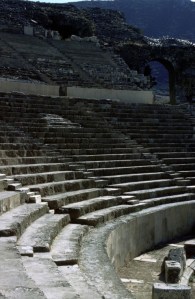
Ephesus, in modern Turkey, is the best-preserved classical city on the Mediterranean, and one of the best places in the world to get the feeling for what life was like for early Christians in Roman times. Roman theater.

Ephesus, in modern Turkey, is the best-preserved classical city on the Mediterranean, and one of the best places in the world to get the feeling for what life was like for early Christians in Roman times. Roman theater.

But while at Miletus, Paul called the elders at Ephesus to come to him, a journey of perhaps 30 miles or so. Verses 18-37 end with a tearful goodbye, as he tells them that he knows he will never see their faces again. He tells them that he is going to Jerusalem and that he does not know what will happen to him “except that the Holy Spirit testifies to me in every city that imprisonment and afflictions await me.” He recounts his faithfulness to preaching and teaching the word in the three years that he had spent with them, declaring that he was “innocent of the blood of all.”

These very emotional parting words have an important point besides the obvious. In his letter to the Thessalonians, Paul had stressed the importance of the local church members having respect for those who had been appointed as elders of their congregation (1 Thessalonians 5:12-13). Here in Acts 20, he is making it clear to these elders – and to all elders of the church everywhere – that they have the responsibility to shepherd the flock among them. Fierce wolves, he says, will come in “not sparing the flock,” and that “from among your own selves will arise men speaking twisted things, to draw away the disciples after them.” The elders of the local church everywhere have an awesome responsibility, and must always be on guard for the souls of those in their midst. It was true then, as it is now.

So in Chapter 21, Paul began the journey to Jerusalem. They sailed past Cos, Rhodes, Patera, Cyprus and landed at Tyre, where they remained for seven days, then on to Ptolemais and finally Caesarea before setting off on foot to Jerusalem. While in Caesarea, they stayed at the house of Philip, who Luke says was “one of the seven.” Most likely he means that he was one of the seven chosen to serve in Acts 6:1-6, and was the same Philip who converted the Ethiopian eunuch. And after that event, he did end up in Caesarea (Acts 8:40).

After arriving in Jerusalem, Paul went to see James and told him and the elders about his travels and the many Gentile conversions, for which they glorified God. They then asked Paul to demonstrate that he was not preaching that Jews had to become like Gentiles and give up all of their customs in order to be a Christian, as many were falsely reporting. So Paul participated with four men under a vow in a purification ritual. This event is the subject of much confusion and controversy. But it does not have to be. Paul never preached that Jews had to give up their entire way of life or never participate in any ritual or feast (remember Romans 14 and 15), nor that they should not circumcise their young. Remember that he circumcised Timothy to avoid offending the Jews they were going to visit in Acts 16:3.

But still Paul was arrested, having been dragged from the temple first and beaten by a mob that had gone wild with accusations and fervor. Until Paul spoke Greek to him, the tribune that arrested him was under the impression that he was an Egyptian revolutionary (verse 38). The event he mentions in that verse was written about by the historian, Josephus. At Paul’s urging, the tribune allows him to speak to the mob; and he does so in Hebrew, as the chapter closes.

/Bob’s boy

Bible Reading Schedule for this month
Click links below to read or listen to audio of one of this week’s chapters in Colossians and Luke

Acts 18, Acts 19, Acts 20, Acts 21, Acts 22

___________________

some images © V. Gilbert & Arlisle F. Beers

Please visit this site’s menu item “The Author’s Books” for info on the author’s books, website, and Facebook page.

All of my comments in this blog are solely my responsibility. When reading any commentary, you should always refer first to the scripture, which is God’s unchanging and unfailing word.